Are you finding it challenging to put GRC into practice within your IT enterprise? Many leaders realize that effective governance, risk, and compliance isn’t just about having the right policies, it’s about how you implement, automate, and integrate them into daily operations. Implementing GRC well means moving beyond spreadsheets and manual processes to a system that brings together risk management, compliance tracking, and policy enforcement in one place.
In today’s digital-first environment, IT enterprises operate in a risk landscape that’s more complex than ever. From rising cyber threats and global regulations to ESG disclosures and operational dependencies, organizations must embed GRC into the digital core of their business to stay resilient and compliant.
Before diving into the value of ServiceNow GRC, it’s important to understand why traditional GRC approaches often fall short.
Why Traditional GRC Fails IT Enterprises?
Despite good intentions, many enterprises struggle with fragmented GRC programs. Common challenges include:
- Disconnected tools and processes leading to inconsistent risk views
- Siloed compliance data stored in emails, spreadsheets, and disparate systems
- Manual effort required for audits, policy attestation, and evidence collection
- Delayed response to new regulations or risk events
- Lack of real-time dashboards and enterprise-wide visibility
ServiceNow GRC addresses these issues by offering a unified, intelligent platform that automates risk and compliance workflows, integrates with existing systems, and delivers real-time insights across the enterprise.
For example, in a ServiceNow internal case study1, the organization saved $2.6 million annually by automating and streamlining its GRC processes. Additionally, automation reduced the time spent on quarterly control certifications by 66%, and audit case processing time was cut by 4 hours per case.
In this blog post, we will discuss how IT enterprises are adopting ServiceNow GRC, what steps are involved in doing GRC right, and what results you can expect from a well-executed implementation, including the measurable financial benefits realized by industry leaders.
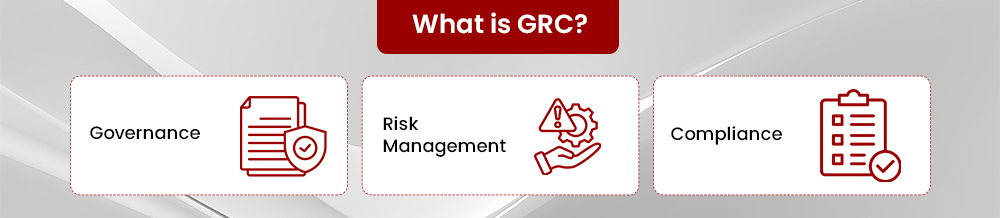
What is GRC (Governance, Risk, and Compliance)?
GRC is a structured approach that enterprises use to align their IT and business activities with overall business goals, manage risks, and meet regulatory and industry requirements.
1. Governance
Governance provides the structure to ensure that policies and decisions support business priorities. It embeds accountability and consistency across operations. It defines clear roles, aligns policies with objectives, and ensures governance is part of everyday workflows. This improves transparency and drives continuous improvement.
2. Risk Management
Risk management helps organizations identify, assess, and address potential threats before they impact operations. It involves maintaining a centralized risk register, running assessments, and automating reporting. These actions support faster, insight-driven decisions.
Get more insights on Guide to Understanding Risk Management in ServiceNow GRC
3. Compliance
Compliance ensures the organization meets legal, regulatory, and internal policy requirements through automation and oversight. It maps internal controls to global frameworks like GDPR, HIPAA, and DPDP. Automation improves audit readiness and reduces compliance risks.
What are Benefits of ServiceNow GRC for IT Enterprises?
ServiceNow GRC delivers measurable advantages across compliance assurance, enterprise risk visibility, operational resilience, and cost optimization.
Built natively on the Now Platform, ServiceNow GRC unifies fragmented risk and compliance processes into a single integrated system of record, enhancing decision-making at every level of the enterprise.
There are the following benefits of using ServiceNow GRC for IT businesses:
1. Centralized Risk and Compliance Data
ServiceNow consolidates all risk, control, and compliance data across business functions into a unified, real-time risk register. This eliminates the inefficiencies of siloed spreadsheets, disparate toolsets, and ad hoc reporting.
- Unified data model connecting policies, risks, controls, and issues.
- Live dashboards for residual, inherent, and target risk scoring.
- Integration with ERP, ITSM, SecOps, and HR systems to ingest KRIs automatically.
2. Streamlined Policy and Control Management
GRC frameworks such as SOX, GDPR, ISO 27001, or India's DPDP Act can be configured and continuously monitored through automated workflows. Control owners receive real-time alerts, while compliance managers maintain full traceability of policy enforcement.
- Dynamic policy lifecycle management with version control.
- Control attestation workflows with automated evidence collection.
- Real-time policy-to-regulation mapping across global jurisdictions.
3. Automated Compliance Monitoring
ServiceNow enables automated testing of controls, continuous monitoring of key compliance metrics, and proactive remediation workflows. This reduces the effort and errors associated with manual compliance.
- Scheduled control tests with prebuilt workflows.
- Rule-based non-compliance detection and remediation tasking.
- Audit-ready reports generated on demand.
4. Enhanced Audit Readiness and Cost Savings
Audit teams gain a centralized view of engagement scopes, audit tasks, evidence status, and control effectiveness. This reduces the overall audit cycle time and improves quality assurance.
- 30–60% reduction in audit preparation time through automation.
- Immutable audit trail with built-in evidence repositories.
- On-demand reports aligned to frameworks like PCI-DSS, SOC2, and DORA.
5. Scalable Vendor Risk Management
ServiceNow TPRM (Third Party Risk Management) automates onboarding, risk classification, due diligence, and ongoing monitoring across thousands of suppliers.
- Risk-based assessments are auto-assigned based on business impact.
- External integrations with tools like BitSight or RiskRecon for cyber posture data.
- SLA tracking and performance scoring for strategic vendor visibility.
6. Integrated Operational Resilience
It supports business impact analysis (BIA), continuity planning, and crisis simulation which allows enterprises to build a resilient response framework.
- CMDB-based dependency mapping of services, assets, and processes.
- Disruption scenario modeling for cyber, physical, and supply chain risks.
- Centralized incident management linked to continuity of playbooks.
7. Predictive Risk Intelligence with Gen AI
ServiceNow Gen AI capabilities enable anomaly detection, risk trend forecasting, and intelligent task assignment, improving the responsiveness and accuracy of risk mitigation.
- Predictive scoring to identify emerging high-risk areas.
- Suggested mitigations based on past resolution patterns.
- Automated classification and routing of issues to risk owners.
8. Real-Time Dashboards and Executive Insights
C-suite leaders gain access to dashboards that consolidate enterprise risk, compliance posture, audit status, and policy exceptions; it allows them to make data-backed decisions.
- Role-specific views for CRO, CIO, CISO, CFO, and board committees.
- Integration with BI platforms like Tableau, Power BI, and ServiceNow Performance Analytics.
- Exportable reports with SLA tracking and risk heatmaps.
9. Compliance and Regulatory Agility
With constantly evolving data privacy, financial, ESG, and industry-specific regulations, ServiceNow’s modular GRC framework provides agility to stay compliant globally.
- Prebuilt content packs for DPDP, GDPR, SOX, HIPAA, ISO, NIST, and more.
- Continuous updates to regulatory mappings.
- Central repository for compliance documentation and audit evidence.
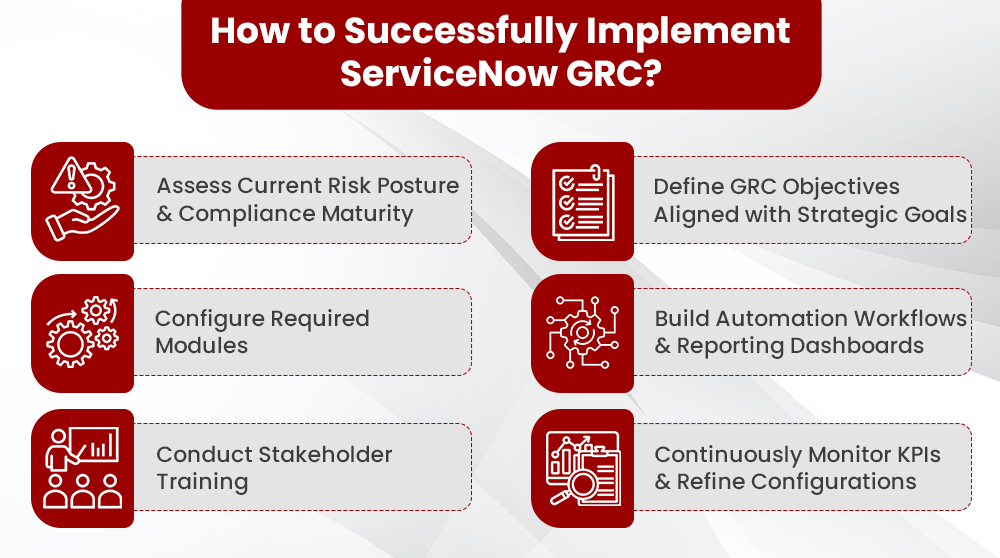
How to Successfully Implement ServiceNow GRC?
To get real value from your ServiceNow GRC investment, implementation requires technical configuration, strategic alignment, stakeholder engagement, and iterative improvement. A well-executed GRC implementation aligns people, processes, and technology in the following key stages:
1. Assess Current Risk Posture and Compliance Maturity
Begin with a baseline assessment to understand existing controls, known gaps, and risk appetite. This helps prioritize focus areas and identify where automation can add the most value.
2. Define GRC Objectives Aligned with Strategic Goals
Set measurable objectives that reflect broader business outcomes, such as reducing audit fatigue, strengthening third-party risk oversight, or enabling faster regulatory response.
3. Configure Required Modules
Select and configure modules (policy, risk, audit, vendor, and resilience) based on your GRC use cases. Tailor risk scoring models, workflows, and issue management to align with your risk framework and governance structure.
4. Build Automation Workflows and Reporting Dashboards
Automate manual tasks like policy attestation, risk assessments, and control testing. Use dashboards to track compliance status, overdue tasks, and key risk indicators in real time.
5. Conduct Stakeholder Training
Engage first-line users, risk owners, and compliance teams early. Provide role-based training and promote adoption through clear communication of GRC benefits.
6. Continuously Monitor KPIs and Refine Configurations
Use insights from usage metrics, audit findings, and incident trends to fine-tune configurations.
Role-Based Responsibilities in the GRC Framework
A successful GRC implementation relies on clearly defined roles and responsibilities across the enterprise. The following outlines how each stakeholder interacts with and manages specific components within the GRC framework.
- Risk Managers: Maintain risk register, monitor KRIs, review scorecards.
- Compliance Officers: Update policy frameworks, track requirement mappings.
- Internal Auditors: Launch assessments, address findings, track remediation.
- IT/Security Teams: Submit incident data, handle vulnerabilities.
- Executives/C-Suite: Access executive dashboards aligned to KPIs.
- Vendors: Submit risk questionnaires and manage compliance status through portals.
Conclusion
ServiceNow GRC delivers more than just operational efficiency; it creates a strong foundation where governance is integrated, risk is managed, and compliance becomes continuous rather than reactive.
The data is clear: enterprises that invest in integrated GRC strategies realize significant returns like lower compliance costs, reduced audit fatigue, faster incident response, and improved profitability. But the true value lies in what GRC enables: confident decision-making, stakeholder trust, and faster go-to-market in the face of constant change.
At inMorphis, we help enterprises align risk and compliance initiatives with strategic goals, embed automation into every layer, and create visibility that empowers every stakeholder with the help of ServiceNow GRC.
