As enterprises grow, managing software assets across on-premises, cloud, and hybrid environments becomes more complicated. Without central visibility and control of these assets, enterprises often face challenges such as license overspending, compliance failures, and operational inefficiency. To solve these problems, many enterprises are looking for automated solutions that integrate with their IT environment and business processes.
ServiceNow SAM (Software Asset Management) helps address this challenge through its automated, policy-driven solution that monitors the life cycle of software assets. This plays a pivotal role in helping enterprises optimize costs, ensure compliance, and streamline software asset management at scale. Let’s explore ServiceNow SAM and its core features.
What is ServiceNow SAM?
ServiceNow SAM is an asset management module of ServiceNow designed to manage the lifecycle of software assets for enterprises. It helps to track software installations, normalize and reconcile data, manage entitlements, and identify potential cost-cutting opportunities through license optimization.
Technically, ServiceNow SAM operates across three core pillars:
1. Discovery and Standardization
- Uses ServiceNow Discovery, System Center Configuration Manager (SCCM) or other data sources to track down all installed software across your estate accurately.
- Applies content-based normalization to align raw install data with established software titles, versions, and publishers.
2. Reconciliation and License Management
- Reconciles normalized software with license entitlements (purchased via contracts or agreements).
- Tracks license consumption models (per device, user, core instance, etc.) and automate true-up calculations.
3. Optimization and Governance
- Identifies underused or unused software for reclamation.
- Enables software re-harvesting, downgrade rights management, and automated workflows for license reallocation or deactivation.
- Supports audit readiness and risk mitigation with built-in compliance dashboards and reports.
Why do IT Enterprises need ServiceNow SAM?
Managing different IT environment complexity often leads to operational inefficiencies, cost overruns, and compliance risks. ServiceNow SAM works as part of the broader Now Platform, leveraging data from Discovery, CMDB, and IT workflows to deliver unified software asset governance, ensuring visibility, governance, and optimization of all software assets.
The common challenges faced by enterprises are:
- Shadow IT
When a software is installed without IT's knowledge or approval; it leads to untracked applications and increased security and compliance risks.
- License Overspending
Due to limited visibility into what is actually being used, businesses frequently purchase more licenses than necessary, inflating software costs.
- Audit Exposure
Incomplete or inaccurate license tracking leaves enterprises vulnerable during vendor audits, which can result in substantial penalties or retroactive costs.
- Manual Tracking and Disconnected Tools
Many teams rely on spreadsheets or siloed systems to manage software assets. These methods are inefficient, error-prone, and cannot scale with the needs of a growing enterprise.
ServiceNow SAM solves these problems through a combination of automation, integration, and intelligence. It provides a centralized system of record, built on the Configuration Management Database (CMDB), that brings together software inventory, entitlement data, usage metrics, and compliance reporting.
Key capabilities of ServiceNow SAM that help to mitigate these challenges include:
- Centralizing software asset data in a unified, accurate repository.
- Automating entitlement tracking and reconciling license usage against contracts.
- Enabling real-time compliance reporting and preparing audits with detailed evidence.
- Optimizing software spend through intelligent usage monitoring, license reclamation, and reuse strategies.
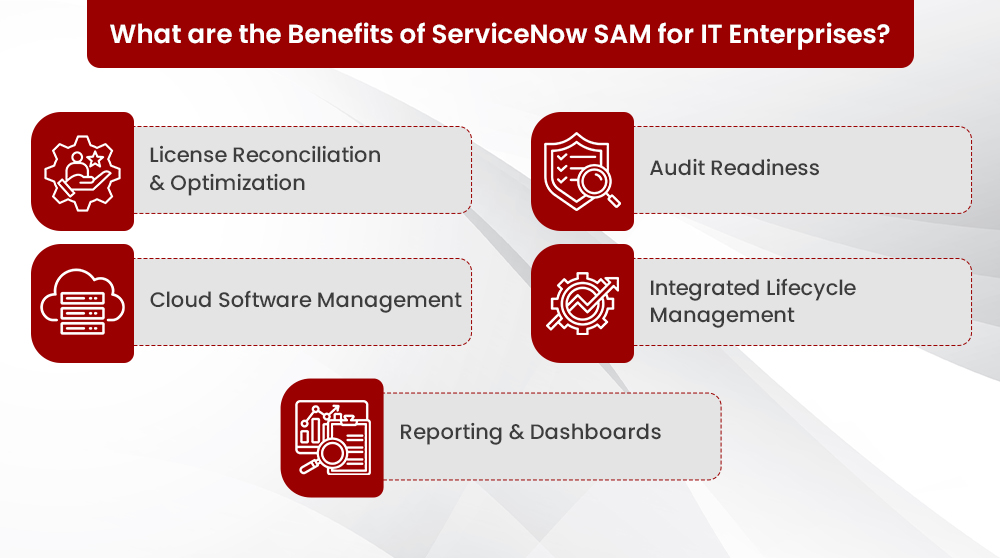
What are the Benefits of ServiceNow SAM for IT Enterprises?
ServiceNow SAM delivers both operational efficiency and valuable outcomes for an IT business. Some of the key benefits include:
- License Reconciliation and Optimization
Enterprises can track entitlements, monitor usage, and reconcile software installations against contract terms. This allows them to reclaim unused licenses and avoid unnecessary purchases.
- Audit Readiness
ServiceNow SAM provides real-time compliance tracking with vendor-specific rules for software publishers such as Microsoft, Oracle, IBM, and Adobe. It generates reports and audit documentation that reduce risk during software audits.
- Cloud Software Management
ServiceNow SAM extends support to many SaaS applications, helping track subscription usage, assignments, and renewal cycles — especially for major vendors like Microsoft and Adobe.
- Integrated Lifecycle Management
By connecting SAM to procurement, request management, and ITSM workflows, enterprises can enforce policy-based approvals, automate software fulfillment, and align software assets with employee roles and business needs.
- Reporting and Dashboards
ServiceNow SAM includes configurable dashboards and KPIs that provide insights into compliance, software usage trends, and cost-saving opportunities.
How to Implement ServiceNow SAM?
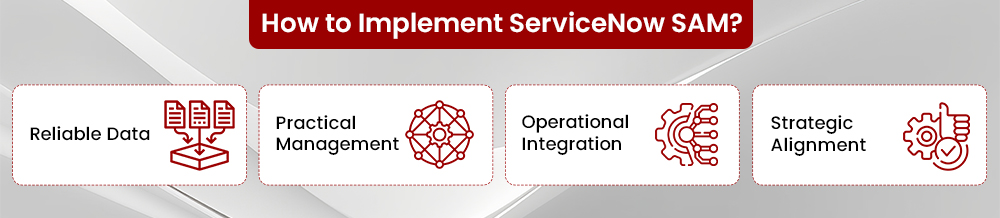
ServiceNow recommends a four-tier Capability Blueprint to implement SAM in a phased and scalable manner:
Tier 1 – Reliable Data
In this foundational phase, the enterprise configures discovery tools to collect software installation data. This data is then normalized using the ServiceNow SAM Content Service, which standardizes software titles, vendors, and versions. Accurate and reliable data is essential for all subsequent SAM activities.
Tier 2 – Practical Management
After establishing reliable data, the next step is to import entitlement records from contracts and purchase orders. Enterprises configure license metrics based on the specific rules of each software publisher. This enables basic license reconciliation and compliance tracking, allowing the business to identify gaps or surpluses in its software licenses.
Tier 3 – Operational Integration
At this stage, SAM is integrated into the enterprise's broader IT operations. Software requests can be routed through ServiceNow's request fulfillment workflows. License approvals, procurement, and deployment processes are automated. Integration with HR and CMDB systems ensures that software assets are managed throughout the employee lifecycle.
Tier 4 – Strategic Alignment
In the final stage, enterprises implement advanced features such as publisher packs for Microsoft, Oracle, or IBM, which offer deeper compliance checks. Cloud license management, renewal tracking, and license forecasting help align SAM efforts with IT financial planning and governance.
Understanding the ServiceNow SAM Content Service
The ServiceNow SAM Content Service1 enhances software normalization and license tracking by providing a curated, cloud-based library of software metadata. It helps convert raw discovery data into accurate, standardized software records, reducing manual effort, and improving compliance.
How does the ServiceNow SAM Content Service Works?
Enterprises that opt in to the service anonymously share unrecognized software installation data with ServiceNow. This data is processed and matched against ServiceNow’s proprietary content library. In return, the enterprise receives automatic updates that help identify and normalize software titles across their respective environments. This ensures that even obscure or custom software installations are accurately cataloged and tracked.
How ServiceNow SAM Protects Your Data?
The SAM Content Service is designed with strong privacy and security measures to protect customer data. ServiceNow follows industry best practices to ensure that the service not only delivers value but also respects enterprise confidentiality and regulatory compliance.
- Anonymized data sharing: Only non-identifiable metadata is collected, such as software installation strings or file hashes. No customer-specific or user-identifiable data is ever transmitted.
- End-to-end encryption: Data is encrypted during transfer and while stored, ensuring it cannot be intercepted or accessed without authorization.
- Purpose-limited use: The collected data is strictly used for enhancing ServiceNow’s global content library to improve software recognition and normalization.
- Strict data retention policies: Once the data is processed, it is securely deleted based on ServiceNow’s defined data governance and privacy protocols.
- Frequent content refresh: Updates are typically delivered weekly, which helps organizations stay current with new software entries and reduces the lag between software discovery and normalization.
- Compliance-aligned: The service aligns with major data protection standards and frameworks, such as GDPR and ISO 27001.
Conclusion
ServiceNow SAM provides a scalable, automated solution for managing software assets across the enterprise. It helps enterprises control software spend, ensure compliance, prepare audits, and integrate asset management into broader IT and business processes.
By following a structured implementation roadmap and utilizing supporting features such as the SAM Content Service, enterprises can transition from reactive asset tracking to proactive, strategic software governance. In a world where software costs are rising and audit risks are increasing, ServiceNow SAM offers the control, visibility, and intelligence needed to succeed.
Partner with inMorphis to improve your SAM maturity journey. Our experts help you deploy ServiceNow SAM effectively, integrate it with your IT ecosystem, and drive measurable outcomes in software compliance, cost optimization, and governance.
