In the hyper-connected, fast-changing digital business world of today, artificial intelligence (AI) is no longer some futuristic dream, it's a reality that businesses need to compete with today. Perhaps one of the most significant transformations in this AI revolution is the birth of AI agents—autonomous or semi-autonomous software that can interpret human intent, make decisions, and perform tasks in complex business workflows.
These AI agents are rule-based robots, integrated with natural language understanding (NLU), machine learning (ML), and process orchestration to manage complex, multi-step processes that used to require heavy human involvement. Through constant learning from data and responsiveness to new contexts, AI agents can drive multiple scenarios, from service requests to incident closure, with unprecedented agility.
What are the Key Workflow Pain Points Solved by AI Agents?
In historical business setups, workflows are typically plagued with:
- Tedious, repetitive manual tasks that hog precious human bandwidth.
- Isolated automation where multiple teams are working in silos without visibility into end-to-end processes.
- Delays in routing and triage of incoming requests or incidents.
- Scaling issues like adding more human resources (more expense) or risking decreased response time.
AI agents address these pain points by bringing intelligence to automation. Compared to rigid scripts or simple automation tools, AI agents can understand unstructured inputs, apply context knowledge, and determine the optimal course of action, sometimes without any human intervention.
For example, if a customer gives a general service request such as "My email isn't working", a legacy system may necessitate manual classification and subsequent questions. An AI agent can read the language, deduce that it is probably an Outlook login or server connectivity problem, and route it to the proper support queue, or even fix it through a self-service process, immediately.
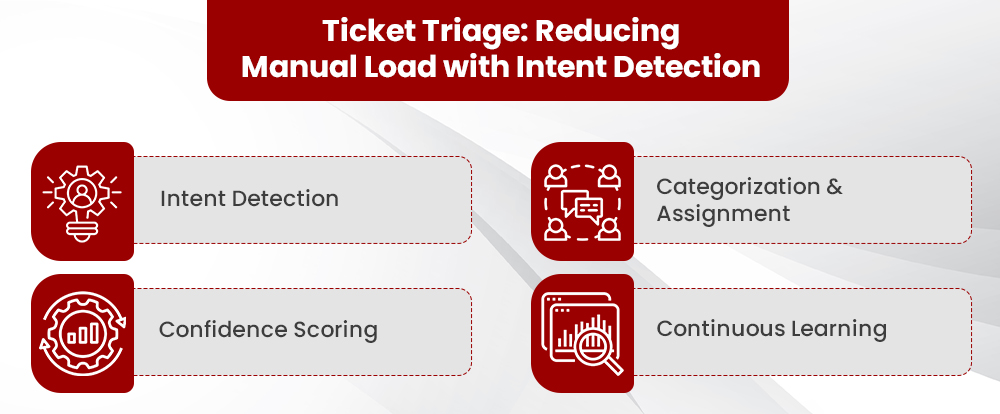
Ticket Triage: Reducing Manual Load with Intent Detection
One of the costliest activities service desks engage in is ticket triage—scanning every incoming request, deciding its type, and routing it to the correct team or expert.
ServiceNow's AI triage exploits natural language processing (NLP) and past incident data to drive this categorization automatically. This is how it goes about it:
- Intent Detection – The AI agent reads the ticket description and recognizes the main problem.
- Categorization and Assignment – Based on patterns learned, it forecasts the correct category, subcategory, and assignment group.
- Confidence Scoring – The system supplies a confidence in its forecast so that human validation is possible if necessary.
- Continuous Learning – Every triage decision enhances the model, enhancing accuracy with each passing moment.
Example: A ticket with the message "Laptop fan loudly screeching, device overheating" is automatically placed in Hardware Issues > Laptop > Cooling and directed to the Desktop Support Hardware Team without human intervention.
Not only does this save time but also:
- Eliminates resolution delays (no more intake bottlenecks).
- Reduces human error with ticket classification.
- Redeploys service desk agents to solve complex problems rather than tedious sorting.
When blended with Virtual Agent in ServiceNow, ticket triage is even more effective. The virtual agent can interact with the requester in real-time, seek clarification of details if necessary, and provide instant solutions to routine issues—sometimes fixing the issue prior to a ticket being opened.
Orchestrating Multi-Agent Workflows Across Functions
The real power of AI agents lies in their capacity to collaborate across functions.
ServiceNow's AI Agent Orchestrator serves as the core intelligence layer, orchestrating several specialized agents and allowing them to work together. Each agent handles a distinct domain, IT operations, HR processes, security actions, finance approvals, etc., while the orchestrator provides seamless handoffs and context awareness among them.
Example: Employee Onboarding Workflow
- HR AI Agent: Automates document gathering, background checks, and payroll configuration.
- IT AI Agent: Provisions laptop, corporate accounts setup, VPN configuration.
- Facilities AI Agent: Allocates desk space, building access card management.
- Security AI Agent: Configures role-based access within systems and applications.
If they were not orchestrated, every team would execute their tasks separately, often resulting in miscommunication or postponement. Orchestration makes all these AI agents act in harmony, ensuring activities occur in the correct order, data moves from system to system without issues, and the process is completed more quickly and with fewer errors.
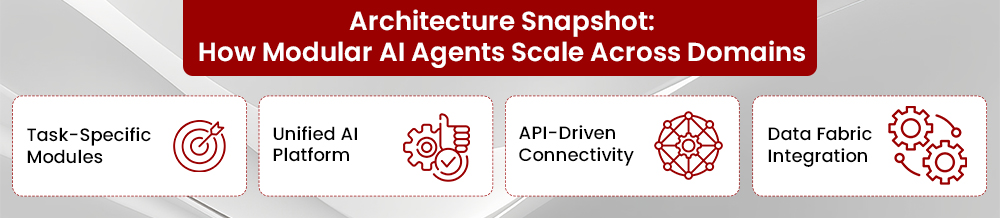
Architecture Snapshot: How Modular AI Agents Scale Across Domains
Scalability is paramount in enterprise automation, and ServiceNow accomplishes this with a modular AI agent architecture. This design principle separates intelligence from the interface so that AI abilities are reused across numerous workflows and domains.
Core architectural components are:
- Task-Specific Modules – Agents designed for specific tasks such as NLP, sentiment analysis, or workflow execution.
- Unified AI Platform – A common layer that oversees agent lifecycles, training, monitoring, and integration.
- API-Driven Connectivity – Provides agents with the ability to interact with both older on-prem systems and newer cloud-based applications.
- Data Fabric Integration – Retrieves data from diverse sources to deliver a complete context for decision-making.
For businesses, this architecture results in:
- Fast development of new AI agents without having to start from scratch.
- Effortless scalability to accommodate rising request volumes.
- Centralized governance for compliance and performance monitoring.
Dashboards monitor agent performance, accuracy rates, and ROI measures, so continuous improvement is possible. And since agents are modular, organizations can update or replace individual components without replacing the entire automation system.
Case Study 1: Implementing Agentic AI in ServiceNow Despite Data Maturity Concerns
Challenge
Many organizations hesitate to adopt AI because of immature and fragmented data systems1. Service desk operations often rely on outdated tracking methods, siloed platforms, and inconsistent knowledge bases. This makes it challenging to automate effectively, as AI agents need reliable, unified data to function. Concerns typically include:
- Fragmented systems and manual processes.
- Incomplete or inconsistent data sources.
- Limited ability to scale automation across IT, HR, and customer service.
- Lack of integration between platforms, especially in incident management.
Solution
Using ServiceNow’s Agentic AI, organizations were able to overcome these barriers by leveraging:
- Workflow Data Fabric to unify structured and unstructured data across the enterprise, reducing silos and enabling secure, zero-copy data access.
- Virtual Agents to handle employee self-service tasks such as ticket logging, HR form submissions, and onboarding processes, freeing up human agents for more complex issues.
- AI Agent Orchestrator to allow multiple AI agents to collaborate, manage context, and automate end-to-end workflows.
- Cross-platform orchestration between ServiceNow and other enterprise tools to automate incident management and knowledge preservation, even during high-priority events.
- This method allowed automation in early-stage data environments by leveraging ServiceNow to centralize and standardize information.
Outcome
By implementing Agentic AI with ServiceNow
- Routine tasks like ticket handling, HR requests, and transactional IT processes were automated, saving thousands of hours annually.
- Service desk productivity improved, with deflection rates increasing by over 10% and major incident resolution times reduced by 15–25 minutes.
- Employee and customer experiences were enhanced through consistent, reliable self-service options available 24/7.
- Incident management became more efficient through multi-agent collaboration, ensuring better knowledge preservation and faster resolution for critical issues.
- Organizations demonstrated that data maturity is not a blocker when using ServiceNow’s Workflow Data Fabric to unify disparate systems.
Case Study 2: GenAI-Powered Digital Transformation via ServiceNow
Challenge
- To rapidly expand internal operations and foster innovation, a ServiceNow partner engaged new strategies.
- Manual coding tasks slowed developers, delaying ServiceNow customizations.
- HR and IT support teams struggled with reactive support models and limited self-service options.
- The sales team lacked efficient tools for responding to RFPs, limiting agility and productivity.
Solution
Implementing a trio of ServiceNow AI Agent–driven solutions delivered in just four weeks:
1. Citizen Code Generation
- Integrated a Microsoft Teams chatbot with ServiceNow’s LLMs.
- ServiceNow code could be generated via chat, enhancing productivity and enabling business user participation.
2. AI-Powered Employee Support Bot
- Built an intelligent assistant that processes HR and IT queries by accessing a centralized knowledge base—including documents, spreadsheets, and PDFs.
- Delivered real-time, natural language answers to employee inquiries, improving self-service capabilities.
3. AI Response Assistant for Sales
- Integrated AI agents into the RFP workflow for automated evaluation and response generation.
- Included prompts to clarify intent and auto-search relevant sales documentation within Teams—making responses faster and more aligned.
Outcome
- 73% coding accuracy via the Teams-based developer assistant—massively improving speed and reducing errors.
- 100% adherence to IT and HR Service Level Agreements (SLAs) thanks to instant, self-service support.
- 2.5× increase in sales team productivity, driven by faster RFP response and improved document access.
Conclusion
The transformation to AI agent-native businesses is already in full swing, and ServiceNow's convergence of these intelligent agents signals a turning point in workflow automation.
With the convergence of ticket triage automation, multi-agent orchestration, and a modular AI architecture, organizations can transition from reactive, manual operations to proactive, intelligent processes. Additionally, operational expenses are reduced, and employee productivity and customer satisfaction are also increased.
The lines between teams, systems, and processes fade away and they are replaced with a seamless orchestration of AI agents collaborating to drive business results faster, smarter, and more consistently than ever before.
That’s where inMorphis, a ServiceNow Invested Partner, comes in. From strategy to execution, we help enterprises operationalize AI agents at scale. Contact us today.
