
Operational Technology (OT) once lived in a world of isolation, controlling machines and industrial environments without worrying about the internet’s threats. However, as we enter 2025, the convergence of OT and IT has become inevitable, bringing increased efficiency, enhanced visibility, and data-driven decision-making across factories, power plants, and critical infrastructure.
This convergence has also opened the gates for cyber threats that can disrupt physical systems, halt production, and endanger lives. If you’re an enterprise leader or technology decision-maker, understanding how to cyber-secure your operational technology is no longer optional; it’s critical.
This blog explores the growing cybersecurity challenges in operational technology, the latest insights on OT/IT convergence, and best practices to secure OT systems in 2025 and beyond.
The Rising Cybersecurity Challenges in Operational Technology
In the past, OT environments were “air-gapped,” with machines communicating only with each other, thereby minimizing cyber risks. But to compete, enterprises have integrated operational technology with IT networks for predictive maintenance, real-time monitoring, and advanced analytics.
This connectivity has drastically expanded the attack surface:
- Legacy systems with no security by design: Because they were built for isolated networks, most older PLCs and SCADA systems don’t support encryption or secure access.
- Increased ransomware attacks targeting OT: Attackers now exploit vulnerabilities to halt operations, demanding high ransoms to restore production lines.
- Supply chain risks: A single compromised vendor system can propagate malware into your OT environment.
- Lack of visibility: Security teams often lack real-time insights into industrial networks, making it challenging to detect lateral movements.
- Case in point: In 2024, a major energy provider experienced a ransomware attack that disrupted pipeline operations for 48 hours, resulting in losses exceeding $30 million. Investigations revealed that the attacker gained entry through an exposed remote access system connected to their OT environment1.
- Bottom line: The risks are not theoretical. They directly impact production, safety, and reputation.
Also, read What is the difference between OT & IT?
Operational Technology/IT Convergence – What the Latest Research Shows
Why OT/IT Convergence is Unstoppable?
According to IDC’s 2025 Industrial Trends Report2:
- 67% of manufacturers utilize live OT/IT data streams for continuous production optimization.
- 55% have integrated predictive maintenance using IoT sensors connected to central IT systems.
This convergence enables:
- Predictive analytics that reduce unplanned downtime.
- Centralized observability across industrial machinery, assembly lines, and IT infrastructure.
- AI-driven insights for operational efficiency.
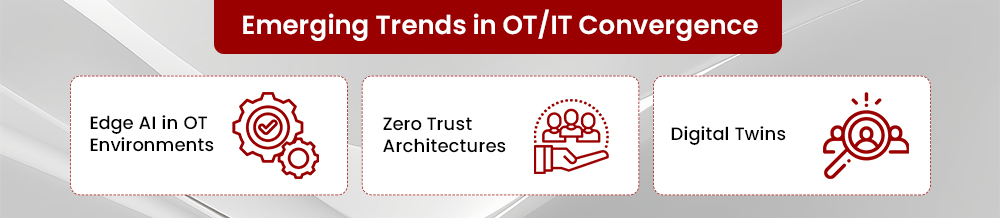
Emerging Trends in OT/IT Convergence
1. Edge AI in OT Environments
AI-powered edge devices process OT data locally, enabling quick decision-making and reducing latency while minimizing the risk of massive data transfers.
2. Zero Trust Architectures
Organizations are shifting from traditional perimeter security to Zero Trust within OT networks, ensuring every device and user is continuously authenticated and monitored.
3. Digital Twins
Creating real-time digital replicas of physical assets enables the simulation of failures, prediction of maintenance needs, and optimization of performance, necessitating deep integration between OT and IT.
Convergence Without Cybersecurity is a risk multiplier.
Recent industry studies suggest that many enterprises still lack a unified security framework for OT/IT environments. Without it, convergence creates:
- Inconsistent access controls across IT and OT.
- Outdated OT infrastructure without timely patching creates exploitable entry points within converged IT/OT environments.
- Blind spots due to separate monitoring tools.
- Successful OT/IT convergence must pair efficiency with a strong cybersecurity foundation.
Also, read 5 Strategies to Enhance OT Security
Best Practices for Cyber-Securing Operational Technology
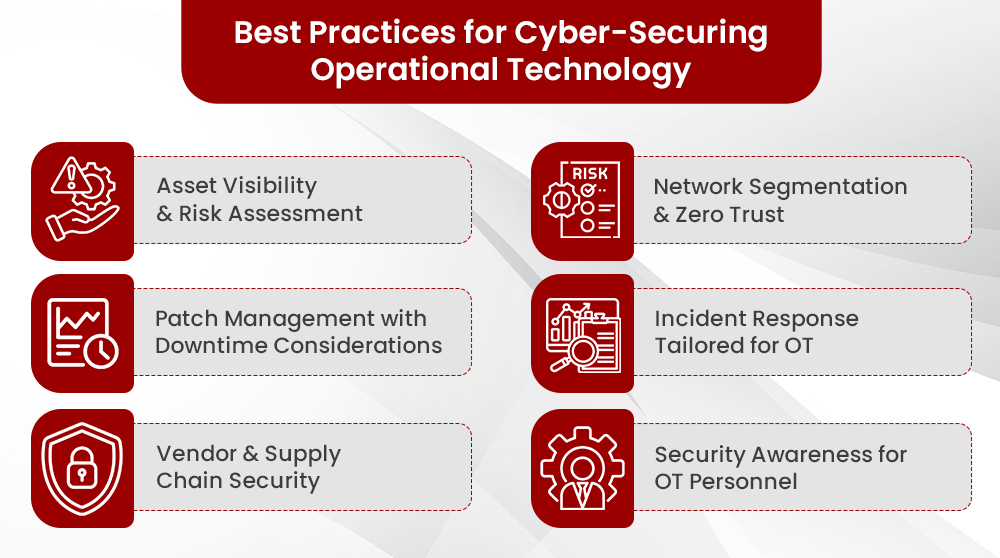
To protect your converged OT/IT environment, here are practical, field-tested best practices:
1. Asset Visibility and Risk Assessment
- Perform comprehensive OT asset discovery, capturing device types, firmware versions, and network topology.
- Use OT-specific threat detection tools to monitor traffic patterns and detect anomalies.
- Perform risk assessments regularly to identify critical assets and high-risk pathways.
2. Network Segmentation and Zero Trust
- Create precise segmentation between OT and IT networks using firewalls and demilitarized zones (DMZs).
- Apply Zero Trust principles within OT networks through lightweight identity enforcement, micro-segmentation, and behaviour-based access monitoring.
- Least privilege access.
- Multi-factor authentication for all users and devices.
- Continuous monitoring of network activities.
3. Patch Management with Downtime Considerations
- Establish patch testing environments before deploying updates to production systems.
- Coordinate with operations teams to schedule patches during planned downtimes.
- Where patching is not possible, apply virtual patching and compensating controls.
4. Incident Response Tailored for OT
- Develop incident response playbooks specific to OT scenarios, including ransomware or unauthorized device access.
- Run regular tabletop exercises with both IT and OT teams to improve readiness.
5. Vendor and Supply Chain Security
- Evaluate vendor security practices and require them to meet your OT security standards.
- Implement continuous monitoring of vendor remote access and use secure tunneling protocols.
6. Security Awareness for OT Personnel
- Implement continuous training programs to equip OT staff with the skills to detect and report social engineering attempts.
- Develop collaborative risk management frameworks that reflect both IT and OT security priorities.
Conclusion
The merging of OT and IT is powering data-driven optimization, reduced downtime, and enhanced cross-domain collaboration. However, without robust cybersecurity, it can become a liability rather than an asset.
In summary, to cyber-secure your operational technology while enabling convergence:
- Inventory and assess OT assets and risks.
- Segment networks and apply Zero Trust principles.
- Develop OT-specific incident response plans.
- Continuously monitor and adapt to evolving threats.
Enterprises that embrace secure OT/IT convergence will gain a competitive edge, reducing downtime, improving safety, and enabling innovation without compromising trust or compliance.
Ready to Make Your OT/IT Convergence Cyber-Secure?
At inMorphis, we help enterprises navigate the complexities of OT cybersecurity with precision and expertise, ensuring:
- Faster time-to-value through secure convergence strategies.
- Ongoing optimization and governance for OT environments.
- Industry-aligned compliance with evolving regulations.
If you’re planning your OT/IT convergence or looking to strengthen your operational technology’s security posture, let’s connect to make your transformation safe, scalable, and effective.
