By 2025, customer expectations will outpace most service desks. Traditional Service Level Agreements (SLAs) still matter for operational hygiene, but they’re increasingly out of sync with what customers actually experience.
You can hit every response and resolution target and still leave customers frustrated. That gap is why organizations are shifting toward Experience Level Agreements (XLAs)—measures that capture how customers feel about a service, not just whether it met a clock.
In this blog, we’ll unpack what’s broken with SLAs, what XLAs look like inside ServiceNow Customer Service Management (CSM), how GenAI accelerates the shift, five XLAs you can adopt right now, and a real-world case study that shows tangible impact.
What’s Wrong with Traditional SLAs?
SLAs measure operational outputs like response and resolution times, but not actual user outcomes which leads to the “watermelon effect,” where metrics appear green while user experience is poor. SLAs often mask friction such as unclear updates, repetitive information requests, confusing portals, or the emotional toll of a recurring issue. They also tend to be negotiated and enforced as contractual guardrails, which can push teams to optimize for the metric—not the customer.
The net effect: leaders think service is healthy because the numbers are “on target,” while customers feel the opposite. This disconnect erodes trust and creates avoidable churn or escalations. Experience needs to be measured directly, not inferred from timeliness alone.
What Are XLAs in ServiceNow Customer Service Management?
XLAs (Experience Level Agreements) define experience-based commitments, measuring clarity, effort, emotional tone, and outcome usefulness. In ServiceNow CSM, XLAs are enabled through a combination of experience surveys (CSAT/NPS)1, sentiment analytics on interactions, proactive experience monitoring, and dashboards that track trends over time. Rather than “resolve within 4 hours,” an XLA might state “maintain >4.5/5 post-resolution CSAT and positive interaction sentiment in 80%+ of cases.”
Common experience-centric measures you can operationalize in ServiceNow include:
- Post-resolution CSAT embedded into case workflows.
- NPS for relationship health over time.
- Sentiment score from case comments, agent notes, and chat transcripts.
- Digital friction indicators (e.g., self-service task success rate, time-to-deflection, portal abandonment).
ServiceNow’s CSM and broader customer experience content emphasize connecting service teams and orchestrating workflows that remove friction across silos—an essential foundation for XLAs.
The Shift from SLA to XLA: GenAI Advantage
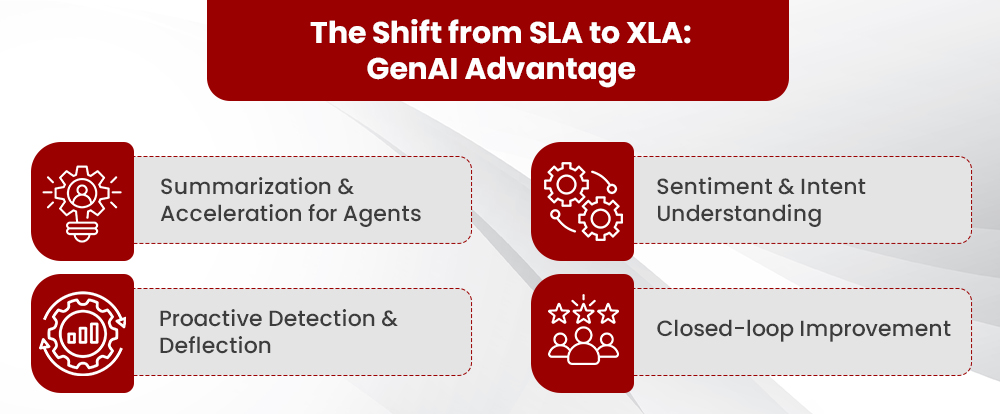
Moving to XLAs means augmenting operational metrics with qualitative cues and shortening the loop from detection to corrective action. That’s precisely where GenAI on the Now Platform helps:
- Summarization and Acceleration for Agents: GenAI condenses complex case histories and authoring tasks, so agents spend more time engaging empathetically and less time on administrative work.
- Sentiment and Intent Understanding: AI-driven analysis surfaces emotional context and intent across voice and written exchanges. This lets supervisors coach proactively and trigger experience recovery plays before satisfaction dips.
- Proactive Detection and Deflection: AI spots patterns (recurring login errors, repeat “how-to” questions) and nudges teams to fix root causes or auto-deflect with accurate knowledge, reducing effort for customers while boosting perceived value.
- Closed-loop Improvement: Experience dashboards, fed by AI insights, pinpoint where friction lives (knowledge gaps, UI issues, handoff delays), making it practical to run experience-centric continual improvement, not just SLA firefighting.
5 Strategic XLAs You Should Adopt
1. Post-Resolution CSAT (Target ≥ 4.5/5)
Embed a lightweight survey at case closure and trigger an experience recovery workflow when the score falls below a threshold. Shift coaching from handle-time focus to experience-driven feedback. In ServiceNow, this can be automated within CSM case flows and visualized on experience dashboards.
2. Sentiment Trend Score (Maintain Positive/Neutral ≥ 85%)
Use AI to analyze conversation tone across emails, virtual agent chats, and call notes. Watch trend lines by product, region, or channel; investigate sudden dips tied to releases or policy changes. This is your early-warning system for “watermelon risk.”
3. Digital Friction Index (DFI) for Self-Service (Improve Monthly)
Track self-service success rate, portal task completion, repeat visits before resolution, and abandonment. If customers start a case because the portal didn’t help, that’s friction you can remove by tuning knowledge, search, or flow logic. Pair DFI with A/B tests on portal UX.
4. Communication Clarity Score (≥ 90% “Clear/Very Clear”)
Ask one extra question: “How clear were the updates?” Measure clarity separately from timeliness. Clarity reduces anxiety and reopens, and it’s highly coachable with GenAI prompts/templates for updates and next steps.
5. Proactive Outreach Rate (≥ 20% of High-Risk Cohorts)
Make “proactive help” part of the contract: when AI flags a spike in similar issues (e.g., auth failures), outreach affected customers with validated guidance. Customers remember help they didn’t need to ask for—that’s experience value.
Recommended Best Practices for XLAs in ServiceNow (Practical Moves)
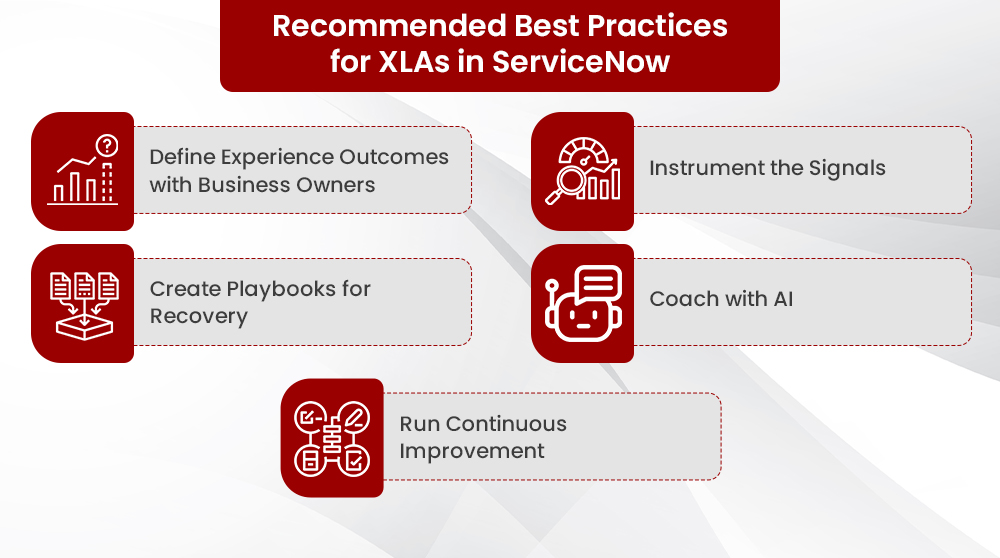
- Define Experience Outcomes with Business Owners: Start with moments that matter (onboarding, outage comms, billing disputes), then craft one or two experience promises per moment.
- Instrument the Signals: Enable feedback collection through surveys, sentiment analysis, and behavioral telemetry. Use CSM and Experience Management patterns to pipe data into unified dashboards.
- Create Playbooks for Recovery: When CSAT < threshold or sentiment dips, trigger a human callback, revised resolution guidance, or a goodwill gesture. Make recovery measurable.
- Coach with AI: Use GenAI summaries and suggested replies to improve clarity and empathy at scale. Review patterns with supervisors weekly.
- Run Continuous Improvement: Analyse XLA data monthly to identify and eliminate recurring barriers (forms, knowledge gaps, policy lags).
Conclusion
SLAs in CSM ensure operations run smoothly; XLAs ensure customers stay engaged and loyal. The move to XLAs does not replace SLAs; it augments them by adding user-centric experience metrics to operational performance. ServiceNow CSM uses GenAI to combine speed with summaries, guidance, detection and experience signals like sentiment and friction. To adopt XLA, you can start with a dual scorecard, pick five experience measures, and tie leadership incentives to outcomes that customers can feel. Organizations making this shift are already seeing faster resolution, more transparent communication, and most importantly, higher trust.
To translate SLAs into measurable experience outcomes, inMorphis can design your first XLA scorecard, integrate the right signals, and pilot a GenAI-powered recovery loop in under a quarter—ensuring that when your dashboards show green, your customers truly experience it too.
