As organizations move towards greater automation, “AI Agents” are emerging as powerful alternatives to traditional “Rule-based workflow”. Unlike strict, predefined logic that requires constant maintenance and scripting, AI Agents operate dynamically, learning from data, understanding context, and ranking decisions in real time. These agents can execute advanced workflows including:
- Predicting incident categorization.
- Auto-assigning tasks based on behaviour, not just rules.
- Conversational issue resolution via virtual agents.
- Proactive anomaly detection and remediation.
In this blog, we will explore how agentic AI is replacing rule-based workflows and the key benefits for businesses. Let’s first understand what AI Agents are.
What are AI Agents?
An AI agent is an intelligent program that can perceive its environment, make decisions, and take actions to achieve goals. Unlike traditional scripts or rules, AI agents utilize machine learning, natural language understanding, and historical data to inform their behaviour.
With intelligent behaviour, AI agents reduce administrative overhead, increase flexibility, and deliver a more personalised user experience.
Limitations of Rule-Based Workflows
Some of the limitations of the rule-based workflows that limit their business applications are:
1. Strict and Static:
- Rule-based workflows most likely follow “if-then” logic.
- Any modification to workflows requires manual intervention for system updates.
- System lacks contextual awareness to handle non-standardized workflows.
Example: If an incident doesn’t match defined conditions, it may be misrouted or left unassigned.
2. Difficult to Maintain at Scale:
- As more rules are added, the workflow becomes complex and more challenging to manage.
- Changing conditions mean rules can quickly become outdated.
Example: Managing assignment rules for hundreds of catalogue items.
3. Lack of Learning and Improvements:
- A rule-based system does not learn from outcomes, nor does it improve based on past results.
- They don’t adapt to changing trends in data or service patterns.
4. Dependency on Admin or Developer:
- Extensive technical resources required to build, test, and deploy.
- Maximize dependency on system admins or developers.
Example: Even a simple change in assignment logic may require development effort.
How AI Agents Work Differently?
The following key features of Agentic AI make them beneficial over rule-based workflows:
1. Data Driven:
Learns patterns from historical data and adopts behaviour over time, not based on predefined logic like rule-based systems.
Example: Instead of hard-coding assignment rules, an AI agent analyses thousands of past incidents to determine who should handle a new one.
2. Context-Aware Decisions:
AI agents consider the full context, such as user type, history, device information, ticket urgency, etc. They go beyond static rules to understand the relationships between variables.
Example: A VIP user logging a low-impact issue might still get priority handling because the AI understands their profile.
3. Continuous Learning and Improvements:
AI agents learn from each interaction. Over time, AI agents improve accuracy and decision-making by reducing the need for manual updates.
Example: Over time, an AI agent may notice that password reset tickets are almost always resolved with a specific article and start suggesting it automatically.
4. Conversational and Interactive:
Integrating with Virtual agents, AI agents engage with users via natural language. AI agents understand requests and provide real-time solutions or guidance.
Example: A user types, “My Outlook is crashing,” into the chat. An AI agent interprets it, identifies a known issue, and walks the user through a fix.
Key Business Benefits of AI Agents
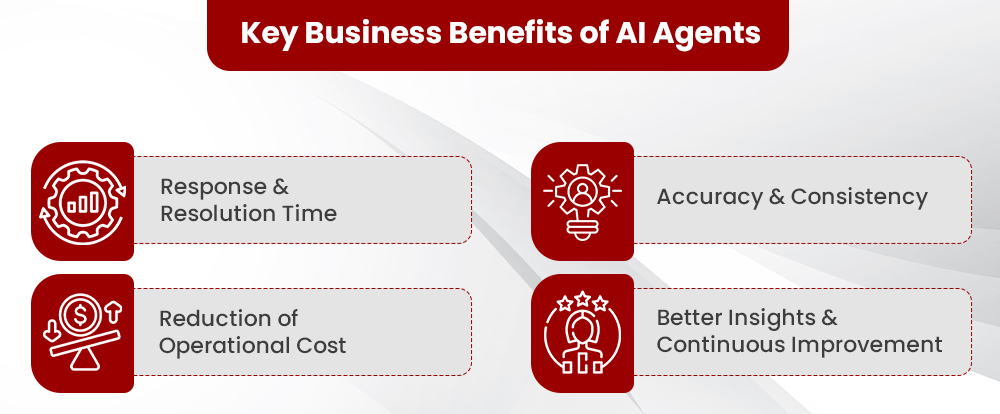
1. Response and Resolution Time:
- By automating triage, assignment, and resolution, AI agents reduce wait time for the end user.
- Handle repetitive tasks instantly, no queues, no delays.
Example: Incidents are routed to the right team instantly, rather than waiting in an unassigned queue.
2. Accuracy and Consistency:
- AI agents eliminate manual dependencies, improving accuracy and logical completeness.
- Ensures uniform handling of similar issues across teams.
Example: Tickets are categorized and prioritized consistently based on real-time data.
3. Reduction of Operational Cost:
- Eliminates repetitive manual processes through intelligent automation.
- Fewer escalations and less need for L1 support reduce labour costs.
Example: An AI agent handling 40–50% of incoming IT requests reduces workload on service desk agents.
4. Better Insights and Continuous Improvement:
- AI Agents collect data on usage patterns, failure points, and success rates.
- Enable continuous optimization of workflows and services.
Example: Proactively identify bottlenecks or tickets that are frequently misrouted.
AI Agents do more than automate workflows; they unlock smarter, faster, and more adaptive ways of working. AI Agents help organizations reduce costs and improve the quality of service by combining intelligence and automation.
Use Cases of AI Agents
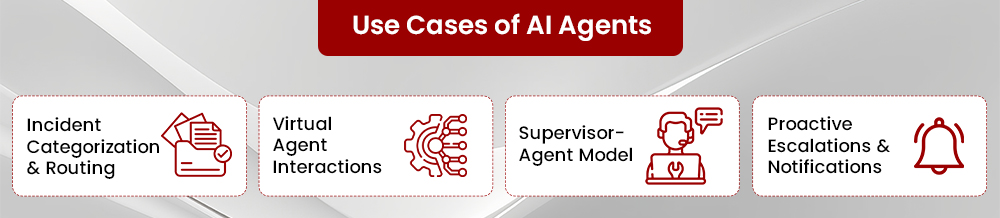
1. Incident Categorization and Routing:
- AI agents automatically categorize incoming incidents and route them to the most suitable resolver group.
- They cut end-user wait times with smart automation.
2. Virtual Agent Interactions:
- Supports users via chat, understands natural language, and orchestrates AI-driven workflows like password resets or status updates.
- Improves end-user experience with 24/7 intelligent assistance.
3. Supervisor-Agent Model:
- Structure workflows with a "supervisor" agent overseeing specialized sub-agents—for example, one for data retrieval, another for approving tasks.
- Delivers robust, modular, and error-resilient agentic processes.
4. Proactive Escalations and Notifications:
- AI agents recognize critical issues and notify the correct stakeholders automatically through escalation workflows.
Conclusion
AI agents in ServiceNow represent a significant leap from static automation to dynamic, intelligent, and context-aware workflows. By leveraging tools, orchestration models, and data fabric, these agents enhance responsiveness, reduce manual effort, and scale automation across complex environments. They are modular, proactive, and capable of integrating with both internal and external systems, enabling more efficient and effective service delivery.
Connect with inMorphis, a ServiceNow-invested partner, to climb up the ladder of GenAI to Agentic AI and get more value from your existing ServiceNow investments.
