
A significant 77% of organizations actively seek ways to unlock greater value from their existing workflow solutions, often facing difficulty in measuring, quantifying, and realizing tangible business value (Everest Group, 2025). However, in 2026, nearly 78% of enterprises are prioritizing efforts to maximize value from digital workflow platforms, yet many still struggle to connect platform usage with measurable business outcomes.
A Value Realization Framework (VRF) helps to bridge this gap by providing a structured approach to assess and optimize an enterprises’ digital transformation journey.
The core of VRF is Key Performance Indicators (KPIs), which serve as quantifiable measures of progress and continuous improvement. In 2026 and beyond, VRFs are increasingly powered by AI-driven insights, real-time analytics, and predictive KPIs—making value realization more proactive rather than reactive.
In this blog, we will explore how KPIs support this framework by driving tangible business outcomes.
What is the Value Realization Framework?
Value Realization Framework (VRF) is a structured approach designed to ensure businesses consistently meet and surpass customer value expectations over their journey.
It provides a roadmap for defining, monitoring, and optimizing value delivery across various business functions. VRF ensures technology initiatives align with strategic goals while measuring their value creation, efficiency gains, and business impacts.
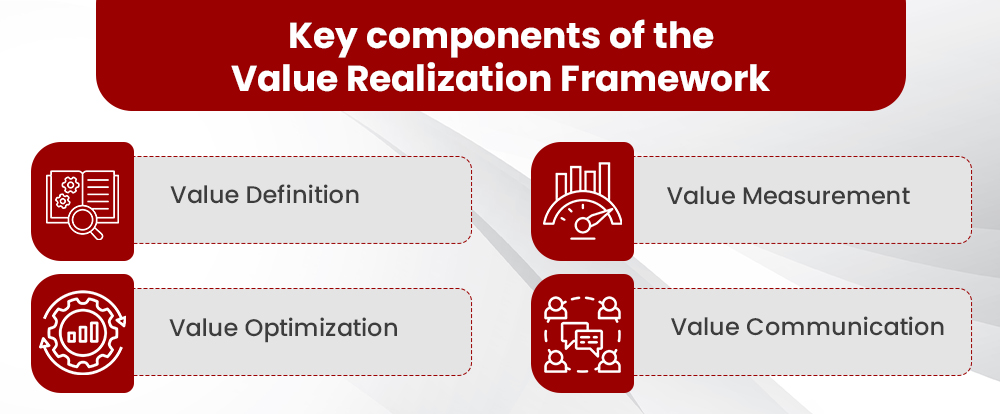
Key components of the Value Realization Framework include:
- Value Definition: Establishing clear business goals and expected outcomes is of great significance.
- Value Measurement: Using KPIs and benchmarks to track performance.
- Value Optimization: Consistently improving processes using KPI-driven insights.
- Value Communication: Report accomplishments and align stakeholders.
Modern VRFs are evolving to incorporate AI, automation, and platform intelligence (such as ServiceNow GenAI), enabling organizations to predict value leakage and optimize outcomes in real time.
Understanding KPIs and Their Importance
KPIs are measurable values used by enterprises to track progress toward their strategic goals. KPIs for a value realization framework provides insights into system performance, operational efficiency, and business impact.
Importance of KPIs for Digital Transformation:
- Measuring Success: Establish clear success metrics for ServiceNow implementations.
- Enhance Decision-Making: Deliver data-driven insights for continual improvement.
- Optimize Performance: Identify bottlenecks and areas for improvement.
- Accountability: Ensure your teams align their efforts with the enterprise's objectives.
- Increase ROI: Demonstrate tangible and predictable value from ServiceNow and AI-powered workflow platform investments, ensuring continuous alignment with business outcomes.
In 2026, KPIs are no longer just tracking tools1, they act as decision intelligence layers, feeding AI models that recommend actions, automate workflows, and forecast performance trends.
KPIs: The Backbone of the Value Realization Framework
According to a study,60% of enterprises don’t measure realized value through KPIs, resulting in non-optimized ROIs. Recent studies indicate that nearly 65% of enterprises still lack mature KPI frameworks to measure realized value, leading to underutilized platform capabilities and missed ROI opportunities.
Recent studies indicate that nearly 65% of enterprises still lack mature KPI frameworks to measure realized value, leading to underutilized platform capabilities and missed ROI opportunities.
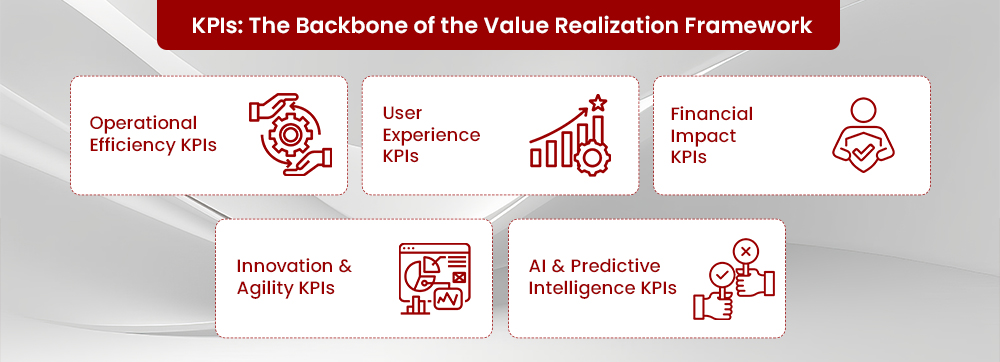
KPIs are essential to ServiceNow's Value Realization Framework (VRF). They help enterprises measure the success of their adoption and optimization efforts, ensuring investments in the platform translate into tangible business benefits. This becomes even more critical as organizations move toward AI-led and autonomous operations. The key KPIs that help with the value realization framework are:
1. Operational Efficiency KPIs
- Incident Resolution Time (IRT): Measures the average time taken to resolve an IT incident, where lower resolution times, especially when supported by an AIOps platform for proactive detection and resolution.
- Change Success Rate: Track the percentage of successfully implemented changes without service disruptions or rollbacks, thus reflecting an effective change process. A high success rate indicates a sound change process.
- Service Request Fulfillment Rate: This monitors how quickly and effectively service requests, such as access requests and hardware/software provisioning, are completed. A high fulfillment rate indicates streamlined IT support.
2. User Experience KPIs
- Employee Satisfaction Scores (ESPs): ESPs measure how satisfied employees are with IT services and support provided, typically measured through surveys or feedback forms.
- Self-Service Adoption Rate: Measures the percentage of users benefiting from the self-service portals instead of contacting IT support for assistance.
- Mean Time to Acknowledge (MTTA): This measures how quickly IT teams respond to incidents and requests. Lower MTTA times indicate faster responses, leading to improved user experiences.
3. Financial Impact KPIs
- Cost Savings with Automation: Calculates the financial benefits of automating IT and business workflows, thus reducing manual efforts and errors.
- Reducing IT Spend: Tracks cost reductions in IT operations, such as lower maintenance expenses, optimal resource allocation strategies, and less reliance on legacy systems.
- Attributed Revenue Growth: Identifies how ServiceNow contributes to business growth through improved productivity, faster service delivery, or enhanced customer satisfaction.
4. Innovation and Agility KPIs
- Deployment Time for New Features: Tracks how quickly new functionalities or updates are deployed into existing workflows. A shorter deployment time indicates better agility.
- Percentage of Automated Workflows: This measure displays the percentage of business and IT processes that have been automated within ServiceNow workflow, leading to greater efficiency. Higher automation leads to increased efficiency.
- Reducing Manual Efforts: Measures how automation has reduced manual tasks, freeing employees to focus on higher-value work.
5. AI & Predictive Intelligence KPIs
- AI Adoption Rate: Measures how extensively AI capabilities (such as ServiceNow GenAI, virtual agents, and predictive analytics) are embedded into workflows.
- Prediction Accuracy Rate: Tracks how accurately AI models and AIOps platforms forecast incidents, demand, or risks.
- Automated Decision Rate: Percentage of workflows where decisions are made autonomously without human intervention.
- Proactive Issue Resolution Rate: Measures how many incidents are resolved before users even report them.
Ultimately, KPIs transform the Value Realization Framework from a static measurement model into a dynamic engine that continuously drives business value.
How KPIs Drive Continuous Improvement in ServiceNow?
KPIs not only measure success but also enable continuous optimization within the ServiceNow ecosystem. Enterprises can use KPI-driven insights for the following:
- Establish Baselines and Benchmark Performance: Define a measurable starting point and analyze KPI trends over time relative to industry benchmarks to track progress effectively.
- Identify Gaps and Root Causes: Analyze workflows to spot inefficiencies, compare KPIs against targets, and analyze data patterns to the pinpoint root cause.
- Optimize and Automate Workflows: Use ServiceNow GenAI, predictive analytics, and agentic AI capabilities to automate not just tasks, but also decisions, enhancing speed, accuracy, and scalability.
- Improve the User Experience and Compliance: Monitor feedback to refine service delivery while adhering to regulatory and security standards.
- Validate Outcomes & Drive Continuous Improvement: Measure the impact of changes, fine-tune strategies based on KPI insights, and maintain long-term performance gains.
- Enable Autonomous Operations: Use KPI-driven AI models to transition from assisted automation to self-healing, self-optimizing workflows, often powered by an integrated AIOps platform.
As ServiceNow evolves with AI and automation, KPIs will play a pivotal role in enabling self-optimizing, continuously improving workflows.
Case Studies: KPIs in Action within ServiceNow Framework
A global professional services firm with over 7 lacs employees, serving 9,000 organizations worldwide. It partners with leading enterprises, including 91 of the Fortune Global 100, to drive digital transformation and operational efficiency.
Challenges
- This firm operates in 55+ countries, leading to inconsistent IT processes and scalability issues.
- Legacy IT systems created inefficiencies, including slow invoicing and ticket resolution.
- Difficulty in proactively identifying and preventing IT performance issues.
- High number of Priority 1 (P1) incidents impacting business operations.
Solution
- Consolidated multiple legacy systems onto ServiceNow IT Service Management (ITSM).
- Implemented ServiceNow Impact for expert coaching, prescriptive guidance, and proactive IT management.
- Automated invoicing, reducing processing time from three days to three minutes.
- Deployed Jumpstart Accelerators for seamless upgrades and optimized Configuration Management Database (CMDB).
- Enhanced training, support, and monitoring with a customized dashboard.
Outcome
- 64% of employees access ServiceNow monthly, with 2.25M supported end users.
- 50%+ reduction in P1 cases, improving IT service reliability.
- 8% improvement in platform health with proactive issue resolution.
- Faster ticket resolution increased operational efficiency and reduced manual efforts.
- Employees spend less time on administrative tasks, focusing more on client engagement and innovation.
Conclusion
Key Performance Indicators are the heart of Value Realization Framework for a workflow platform, helping enterprises measure, optimize, and communicate business value effectively. By leveraging KPIs across operational efficiency, user experience, financial impact, and innovation, organizations can drive continuous improvement, enhance decision-making, and maximize ROI.
With real-time insights, GenAI-driven analytics, and predictive KPI frameworks, ServiceNow enables businesses to transition from reactive problem-solving to proactive and autonomous value realization, strengthened further by technologies like ServiceNow GenAI and integrated AIOps platforms.
As enterprises move toward AI-first operating models, KPIs will play a critical role not just in measuring success, but in actively driving it. In such a scenario, inMorphis can help you define the right KPIs, optimize workflows, and maximize ROIs.
So, why wait? Contact us today to accelerate your value realization journey.
Reference:
