
Do you face challenges in linking code commits, automated tests, and deployment data due to toolchain silos and fragmented reporting? The absence of unified dashboards and integrated metrics hinders the ability to trace end-to-end workflows, making it difficult to identify bottlenecks, assess risk, and optimize overall performance. This lack of visibility creates blind spots that delay issue resolution and complicate compliance efforts, especially in complex enterprise environments.
In this blog, discover how ServiceNow DevOps effectively closes these gaps by providing robust integrations across popular CI/CD and development tools to deliver comprehensive and real-time results. These features enable teams to gain full lifecycle traceability, accelerate delivery velocity, improve software quality, and maintain enterprise-grade governance. Let’s discuss how these capabilities translate into streamlined automation and accelerated change management within the ServiceNow DevOps.
What is the Importance of DevOps Services for IT Enterprises?
DevOps services include practices and tools that automate the software delivery lifecycle, from coding and testing to deployment, monitoring, and compliance. Key elements include:
- Continuous Integration and Continuous Delivery (CI/CD) for faster releases.
- Infrastructure as Code (IaC) for automated, consistent environments.
- Compliance and audit readiness built into pipelines.
- Cross-team collaboration between development, operations, security, and business stakeholders.
While these services increase agility, traditional implementations often struggle with governance and enterprise-wide visibility. This is where ServiceNow DevOps provides a differentiator ensuring speed does not come at the cost of compliance or control.
What are the Core Capabilities of ServiceNow DevOps?
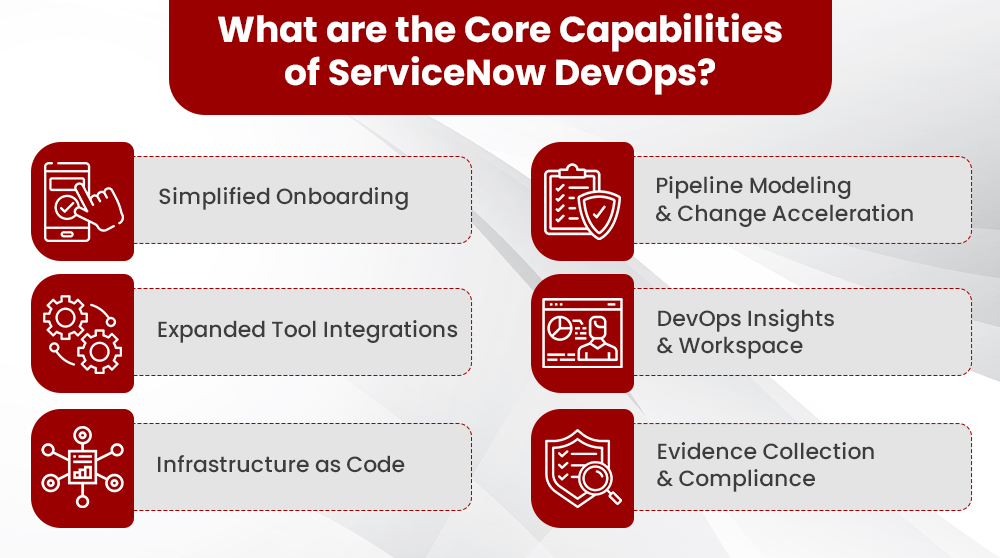
ServiceNow has rolled out significant upgrades that streamline enterprise DevOps adoption, improve cross-toolchain visibility, and drive faster, more reliable software delivery. These updates focus on automation, compliance, and end-to-end traceability, enabling IT and development teams to align better with business goals.
1. Simplified Onboarding
The DevOps Change Velocity app (v1.31) now comes with pre-installed dependencies, including the DevOps Data Model, Integrations, Insights, and Workspace. This unified installation process reduces friction for administrators, cutting down the setup effort that previously required multiple configurations. Enterprises benefit from faster onboarding, lower technical debt, and quicker realization of DevOps value.
2. Pipeline Modeling and Change Acceleration
ServiceNow supports direct modeling of pipelines from popular CI/CD platforms such as Jenkins, GitLab, and Azure DevOps. Automated Change Requests (CHG) are generated at critical stages, such as build, test, or deploy that ensure compliance with ITIL change processes without slowing down delivery. This automation bridges the gap between high-velocity DevOps practices and enterprise-grade governance, reducing both manual overhead and risk.
3. Expanded Tool Integrations
To address diverse enterprise ecosystems, ServiceNow now offers connectors for third- party tools. For example, GitLab is fully supported via the DevOps Integrations app. These connectors enable bidirectional data flow across systems, reducing silos and creating a “single pane of glass” for development and operations teams. This results in fewer context switches, faster collaboration, and improved productivity. However, not all connectors are plug-and-play, and some may require advanced configurations.
4. DevOps Insights and Workspace
With integrated dashboards, teams can monitor both key flow metrics and industry-standard DORA metrics1, lead time for changes, deployment frequency, mean time to restore (MTTR), and change failure rate. This provides real-time traceability across the software delivery lifecycle. By correlating pipeline activity with change records and incident data, enterprises can pinpoint bottlenecks, improve reliability, and accelerate continuous improvement initiatives.
5. Infrastructure as Code (IaC)
Manual server or cloud configuration is replaced with automated provisioning through IaC templates. This reduces configuration drift, enhances reliability, and ensures that environments remain consistent across development, testing, and production. With ServiceNow’s governance overlay, enterprises gain visibility into IaC-driven changes, ensuring both agility and compliance in hybrid cloud environments.
6. Evidence Collection and Compliance
The latest release introduces an import-based evidence collection framework that automatically gathers data from pipelines, commits, and deployments. This strengthens audit readiness by providing traceable proof of compliance, which is especially valuable for enterprises in regulated industries such as BFSI, healthcare, and telecom. Compliance teams can now reduce manual reporting, minimizing gaps in evidence collection, and align more closely with SecOps practices.
How to Enhance the ServiceNow DevOps Lifecycle?
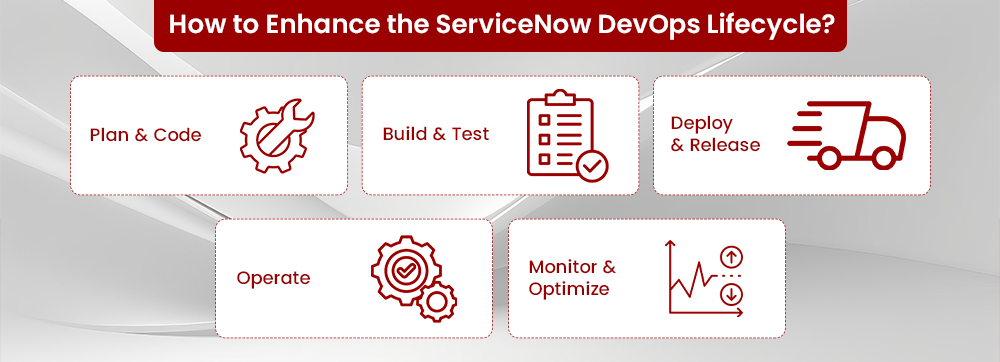
ServiceNow DevOps is designed to complement, not replace, the tools enterprises already use in their software delivery pipelines. By integrating seamlessly with industry-standard platforms, it brings governance, automation, and compliance into every stage of the DevOps lifecycle. This ensures faster delivery, improved reliability, and enterprise-grade control without disrupting existing workflows.
1. Plan and Code
Through integrations, ServiceNow connects planning, issue tracking, and version control directly with enterprise workflows. This ensures that development activities are aligned with change management processes and business objectives.
- Synchronize user stories and tasks between Jira and ServiceNow.
- Link code commits to change requests for full traceability.
- Ensure visibility of development progress across both engineering and IT teams.
2. Build and Test
With Jenkins and GitLab integrations, ServiceNow enables continuous testing and automated quality checks. These integrations provide development teams with fast feedback while embedding governance into the CI/CD pipeline.
- Trigger automated tests with policy-based approvals.
- Enforce quality gates before moving to deployment.
- Capture build and test results for audit and compliance reporting.
3. Deploy and Release
ServiceNow accelerates deployments without sacrificing compliance. Automated Change Requests (CHG) are generated for deployment stages, ensuring that all releases meet enterprise governance and risk control requirements.
- Automate approvals for low-risk changes.
- Reduce manual intervention while maintaining audit readiness.
- Align DevOps speed with ITIL-compliant change management.
4. Operate
By integrating with ITSM (IT Service Management) and ITOM (IT Operations Management), ServiceNow connects DevOps pipelines to operational workflows. This improves incident resolution, SLA adherence, and overall resilience.
- Automatically link incidents to recent deployments for faster root cause analysis.
- Improve MTTR with real-time operational insights.
- Ensure that service reliability is maintained even as release velocity increases.
5. Monitor and Optimize
ServiceNow’s dashboards provide deep visibility into performance, using DORA metrics (lead time, deployment frequency, change failure rate, and MTTR) as benchmarks. Advanced capabilities like Value Stream Management and process mining help enterprises identify inefficiencies and continuously refine delivery.
- Track flow metrics and deployment success rates.
- Identify bottlenecks across planning, coding, and release pipelines.
- Drive continuous improvement with actionable insights.
Read More on Top 5 Must Have ServiceNow Developer Skills
Business Outcomes of ServiceNow DevOps
Enterprises adopting ServiceNow DevOps can achieve tangible improvements across both agility and governance. By embedding automation, integration, and compliance into the delivery pipeline, enterprises gain the speed of modern DevOps while maintaining the control required in complex enterprise environments. The key outcomes include the following:
- Faster Time-to-market: Automated pipelines and streamlined approvals shorten release cycles that enable teams to deliver features and updates to customers more quickly.
- Reduced Lead Time for Changes: Integrated planning and development workflows eliminate handoffs and silos, allowing code to move from idea to deployment in significantly less time.
- Lower Change Failure Rates: Proactive monitoring, automated testing and quality gates ensure that only validated, high-quality code reaches production.
- Audit-ready Compliance: Built-in evidence collection and automated audit trails simplify regulatory reporting and ensure traceability of every change, significantly reducing manual efforts.
- Automated Scaling and Resilience: ServiceNow’s Infrastructure as Code (IaC) combined with policy-driven automation provides oversight, visibility, and compliance.
- Operational Efficiency: Dashboards, flow metrics, and data-driven insights provide teams with real-time visibility into bottlenecks and performance, driving continuous optimization.
Conclusion
ServiceNow DevOps makes it possible for enterprises to deliver software faster without losing sight of governance and reliability. By bringing automation, compliance, and full lifecycle traceability into existing CI/CD toolchains, it eliminates silos that usually slow down large enterprises.
Features like Change Velocity for automated change requests, Infrastructure as Code governance for consistent environments, and evidence collection for audit readiness directly address the most common challenges IT teams face when scaling DevOps.
Instead of adding another layer of complexity, ServiceNow integrates with tools such as Jenkins, GitLab, Jira, and Azure DevOps to create a single source of truth across development and operations. This means developers can focus on writing and testing code, while IT leaders gain the visibility needed to manage risk, ensure compliance, and measure performance with metrics like deployment frequency and mean time to restore.
This results in faster releases, reduced lead times, fewer failed changes, and audit-ready compliance built into the process. For enterprises balancing speed with accountability, ServiceNow DevOps offers a practical way to modernize software delivery while keeping control in place.
If your enterprise is looking to adopt or scale ServiceNow DevOps, contact inMorphis today to learn how ServiceNow DevOps can accelerate your enterprise delivery pipeline.
