Enterprise GRC teams today face mounting pressure to manage evolving data privacy, cybersecurity, and global compliance mandates with unique reporting and control requirements. Regulatory checks are more frequent, complex often conflicting, demanding real-time monitoring and precise interpretation.
Every day, 402.74 million terabytes of data are generated1, dramatically increasing the volume of sensitive information that requires governance. This data explosion intensifies the need for robust data protection and comprehensive compliance frameworks.
Even advanced tools can lag behind the pace of regulatory updates. Manual tracking increases audit risk, errors, and the chance of penalties. For most enterprises, this complexity is now a core technical challenge.
This blog explores how ServiceNow GRC addresses these challenges by automating compliance, managing risk, and simplifying audit readiness. From GDPR to HIPAA and India’s DPDP Act, we dive into practical strategies that emphasize the value of a modern GRC approach. Let’s start with understanding what ServiceNow GRC is and its role.
What is ServiceNow GRC and its Role in Ensuring Effective Data Compliance?
ServiceNow GRC (Governance, Risk, and Compliance) is a cloud-based suite of integrated applications designed to unify, automate, and streamline governance, risk, and compliance processes across an enterprise. It provides a centralized platform that helps enterprises efficiently manage risk assessments, policy management, compliance activities, and audit tracking, replacing traditional manual or fragmented tools.
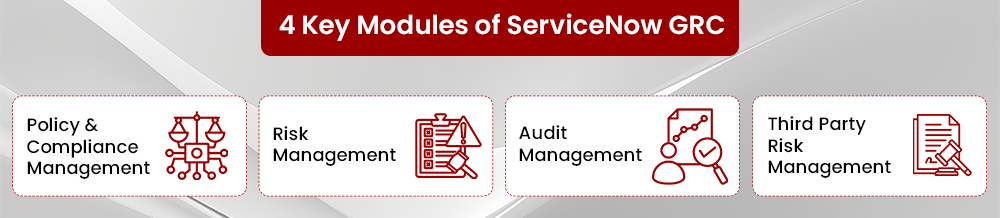
ServiceNow GRC delivers this through four key modules:
- Policy and Compliance Management: Automates policy lifecycles and compliance tracking.
- Risk Management: Enables real-time risk scoring and remediation workflows.
- Audit Management: Streamlines audit scoping, fieldwork, and evidence collection.
- Third Party Risk Management (TPRM): Evaluates and manages third-party risks efficiently.
Technically, ServiceNow GRC connects these modules to core IT systems such as CMDB, Security Incident Response, and ITSM, ensuring real-time monitoring, accountability, and continuous control automation (CCM). This eliminates silos, reduces manual errors, and improves audit readiness.
Exploring Key Legal Considerations for Data Compliance
With data at the core of digital operations, global regulations are tightening around privacy, data flows, and ethical tech use. For enterprise IT and compliance teams, this means adapting infrastructure, updating policies, and managing risks more actively.
Due to its adaptability, ServiceNow GRC helps enterprises configure the platform through custom policies, control libraries, and workflows tailored to their regulatory needs.
Here’s a look at the key regulations and their impact on compliance strategy leading to the requirement of robust governance.
1. GDPR – General Data Protection Regulation (EU & Global)
The General Data Protection Regulation (GDPR)2 is a comprehensive data privacy law that governs the processing of personal data of individuals within the European Union. It applies globally to any organization handling EU citizens' data and sets the gold standard for privacy rights, transparency, and accountability.
Key Requirements of GDPR Compliance:
- Enterprises must ensure that personal data is collected and processed lawfully, fairly, and transparently.
- Data subjects must be able to access, correct, delete, or transfer their data upon request.
- Businesses are required to notify regulators and affected individuals of data breaches within 72 hours.
- Personal data should only be retained for as long as necessary and collected for specified, legitimate purposes.
How ServiceNow GRC Helps with GDPR Compliance:
- The platform automates workflows for consent tracking, breach notification, and data subject access requests.
- It maintains detailed records of processing activities and provides audit-ready documentation for Data Protection Officers (DPOs).
- ServiceNow GRC supports alignment between GDPR and emerging EU regulations like the AI Act and Digital Services Act.
- Real-time dashboards help monitor the effectiveness of privacy controls and streamline compliance management. (Please note, ServiceNow GRC requires setting up Performance Analytics, dashboards, and automated workflows for real-time monitoring).
2. HIPAA – Health Insurance Portability and Accountability Act (USA)
HIPAA3 is a U.S. law that mandates the protection of Protected Health Information (PHI). It applies to healthcare providers, insurers, and business associates, ensuring the confidentiality, integrity, and availability of patient health data.
Key Requirements of HIPAA Compliance:
- Enterprises must implement administrative, technical, and physical safeguards to secure PHI (Protected Health Information).
- Regular risk assessments and strict access controls are required to identify and mitigate vulnerabilities.
- Breaches involving PHI must be reported promptly to the Department of Health and Human Services (HHS) and affected individuals.
- Workforce training and encryption of sensitive data are critical to maintaining compliance.
How ServiceNow GRC Helps with HIPAA Compliance:
- ServiceNow maps HIPAA controls into a unified policy framework and tracks adherence across departments.
- It automates recurring risk assessments and ensures timely escalation and resolution of security incidents.
- The platform supports centralized logging of HIPAA-related activities, including those governed by 42 CFR Part 2 (for substance abuse data).
- Built-in policy enforcement and automated documentation simplify compliance audits and reviews.
3. ISO/IEC 27701 – Privacy Information Management System (Global)
ISO/IEC 277014 is an international extension of ISO/IEC 27001, providing a structured framework for managing personally identifiable information (PII). It helps enterprises design, implement, and maintain a robust Privacy Information Management System (PIMS) aligned with global privacy regulations.
Key Requirements of ISO/IEC 27701 Compliance:
- Enterprises must clearly define and document roles and responsibilities for data controllers and processors.
- A comprehensive PIMS should include policies, procedures, and technical controls for protecting PII.
- The framework must support alignment with multiple privacy laws, such as GDPR, CCPA, and LGPD.
- Ongoing audits, risk assessments, and process improvements are essential for maintaining certification.
How ServiceNow GRC Helps with ISO/IEC 27701 Compliance:
- ServiceNow automates the documentation of PIMS and facilitates the mapping of privacy controls across different standards.
- It enables a centralized view of privacy risks, audit logs, and control status, making compliance easier to manage.
- Enterprises can use the platform to track certification milestones and prepare for ISO/IEC 27701 and 27001 audits.
- Continuous monitoring ensures alignment with evolving regulatory requirements and reduces compliance fatigue.
4. EU AI Act – Artificial Intelligence Regulation (EU)
The EU AI Act5 is a pioneering regulatory framework designed to govern the development and use of artificial intelligence across the European Union. It categorizes AI systems by risk level and imposes stricter obligations on high-risk and general-purpose AI (GPAI) models to ensure safety, fairness, and accountability.
Key Requirements of EU AI Compliance:
- AI systems classified as “unacceptable risk” are prohibited, while high-risk systems must meet rigorous compliance standards.
- Transparency obligations include clear disclosures when users interact with AI systems.
- Developers of GPAI systems must maintain documentation, ensure traceability, and disclose risks.
- Lifecycle management, human oversight, and regulatory reporting are mandatory for high-risk AI.
How ServiceNow GRC Helps with EU AI Compliance:
- ServiceNow maintains an inventory of AI systems and categorizes them according to the risk levels defined by the EU AI Act.
- It automates documentation, audit trails, and approval workflows for GPAI and high-risk AI systems.
- Built-in governance modules integrate AI-specific controls into broader IT and compliance operations.
- Compliance milestones, assessments, and reporting can be tracked in real time across departments.
Key Legal Considerations to Navigate Data Compliance in Indi
India’s data protection laws have changed with the Digital Personal Data Protection (DPDP) Act6, 2023, which applies to any entity processing the personal data of individuals in India. The Act emphasizes accountability, consent, and lawful processing.
Key requirements under the DPDP Act:
- Explicit consent for collecting and processing personal data.
- Purpose limitation and data minimization principles.
- Mandatory data breach notifications.
- Localization for certain sensitive data categories.
- Appointment of Data Protection Officers for significant data fiduciaries.
Beyond DPDP, Indian enterprises must also navigate:
- IT Rules, 2011 – Establish minimum security practices for sensitive data.
- UIDAI (Aadhaar) Act – Governs biometric identity data use.
- Digital India Act (upcoming) – Expected to regulate AI, cross-border data flows, and platform accountability.
How ServiceNow GRC helps with DPDP Compliance:
- Automates consent and breach workflows using Flow Designer.
- Maps Indian regulations across policies and risk frameworks.
- Provides dashboards for real-time compliance visibility.
- Centralizes vendor and third-party risk management with tailored configuration.
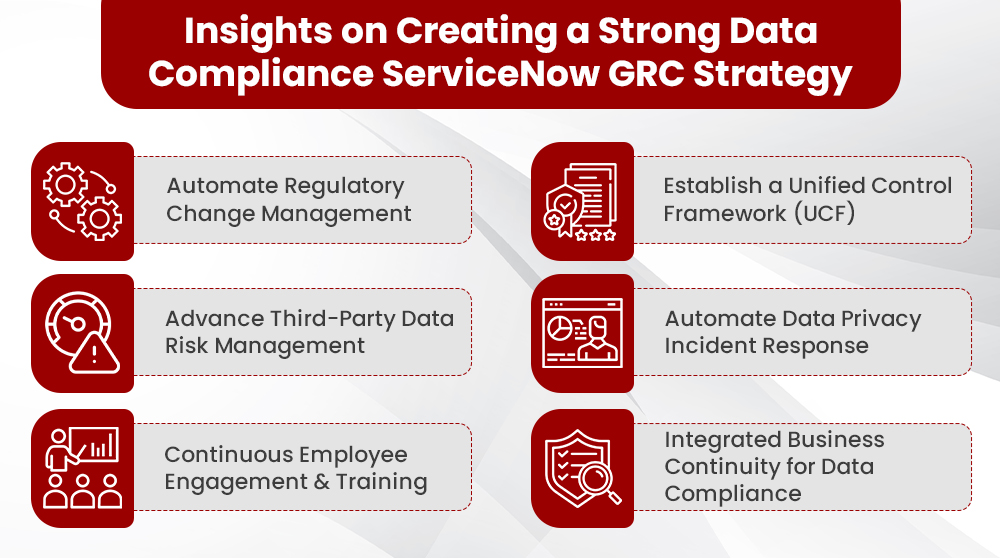
Insights on Creating a Strong Data Compliance ServiceNow GRC Strategy
Here are several actionable strategies for creating a strong Data Compliance GRC program using ServiceNow GRC, based on actual implementation practices observed in leading enterprises:
1. Automate Regulatory Change Management
Set up ServiceNow GRC to continuously monitor for updates to key regulations (such as GDPR, CCPA, HIPAA). Use regulatory change management modules to create automated alerts and tasks when laws or requirements change. Assign compliance owners to review, assess, and update internal controls and policies in response to these alerts. This ensures you never miss a regulatory update and remain continuously compliant.
2. Establish a Unified Control Framework (UCF)
Map all applicable compliance regulations and standards in ServiceNow’s Unified Control Framework. This prevents duplication (e.g., if GDPR and SOX require similar encryption controls) by establishing a single, harmonized set of controls. Regularly review and update this framework for control gaps, using ServiceNow’s control mapping features to align requirements across geographies and business units.
3. Advance Third-Party Data Risk Management
Implement ServiceNowTPRM modules to automate onboarding, due diligence, and continuous monitoring of third parties that handle your data. Use built-in surveys and risk assessments to evaluate suppliers. Collect regular attestation from vendors on their data security posture and track remediation of identified risks using ServiceNow workflows.
4. Automate Data Privacy Incident Response
Configure incident response workflows in ServiceNow so that data privacy events (like breaches or unauthorized access) trigger:
- Automated alerts to relevant teams and compliance officers.
- Task assignment for investigation, root cause analysis, and legal/PR review.
- Tracking of regulatory notification deadlines (e.g., 72-hour GDPR notification).
- Documentation of evidence for compliance and audit purposes.
- All actions, communications, and resolutions are logged in a single system for traceability.
5. Continuous Employee Engagement and Training
Use ServiceNow’s policy management and automated notification features to push mandatory policy acknowledgements, compliance quizzes, and role-based training to employees handling sensitive data. Automate reminders, track completion, and escalate overdue actions which ensures your workforce stays current on data protection obligations.
6. Integrated Business Continuity for Data Compliance
Use BCM (Business Continuity Management) and GRC modules together so that compliance requirements are part of your disaster recovery planning. Run regular business impact analyses in ServiceNow to ensure that critical data services and regulatory obligations are prioritized during incidents, and recovery plans are compliant and always up to date.
Conclusion
As enterprise data continues to grow exponentially and regulatory environments become more demanding, organizations can no longer afford to manage compliance through manual processes or siloed tools.
ServiceNow GRC provides a centralized, automated platform that addresses these challenges by streamlining compliance, managing risk, and enabling faster, more confident decision-making.
By integrating policy management, risk assessment, audit tracking, and third-party oversight into a unified ecosystem, ServiceNow GRC equips enterprises to respond dynamically to evolving regulations like GDPR, HIPAA, India’s DPDP Act, and the EU AI Act. Instead of reacting to regulatory changes after the fact, businesses can use real-time dashboards, automated workflows, and unified control frameworks to stay continuously compliant and audit ready.
Partner with inMorphis to implement and optimize ServiceNow GRC for your enterprise. Our experts help you translate complex regulations into smart, automated workflows that drive lasting value.
