As enterprises increasingly adopt Gen AI capabilities into their ServiceNow environments to provide enhanced service delivery and support intelligent decision-making, ensuring the accuracy and trustworthiness of AI-generated outputs becomes crucial. One problem that continues to stand out is GenAI hallucinations. These are the responses generated by the GenAI systems that are plausible but factually inaccurate or contextually misleading.
In platforms like ServiceNow, where accuracy and trust in automation are crucial, Gen AI hallucinations can undermine confidence, create confusion, and cause operational risks. In ServiceNow, automation often interacts with operational and compliance-critical processes (incident management, change management, and knowledge management); the hallucinated responses can result in poor decision making, escalations, and even cause regulatory norms breaches.
For enterprises using GenAI in ServiceNow, reliability is non-negotiable. This blog explains how hallucinations emerge, why RAG-based architecture is essential to reduce misinformation, and how adding governance ensures your AI delivers value with accuracy and accountability.
What Causes GenAI Hallucinations in ServiceNow?
In general, hallucinations in GenAI occur when the AI generates content that is not grounded in factual or relevant data. In ServiceNow, where workflows are represented as structured JSON documents, hallucinations can occur as incorrect steps, references to non-existent tables or fields, or illogical workflow sequences. Such errors can lead to failed processes, data inconsistencies, and operational inefficiencies. The potential causes of GenAI hallucinations include:
1. Missing Domain-specific Contextual knowledge:
Large language Models (LLMs) are trained on large datasets, and they often lack access to real-time information from specific knowledge bases. So, when workflows are generated using natural language inputs, an LLM may invent steps or entities that are not present in ServiceNow Schema, leading to errors. They often produce responses that sound reasonable but do not align with organizational data or policies.
2. Out of Domain Scenarios:
3. Complexity of Structured Outputs:
4. Disconnected Knowledge Silos:
The ServiceNow environment may contain critical information across various modules, such as ITSM, HRSD, and SecOps. If GenAI is not configured to access all relevant sources, it may fill in the gaps with assumptions, leading to a higher chance of GenAI hallucination.
5. Ambiguous Prompts:
When users provide input that is often unclear or lacks sufficient context, this may result in a generic or hallucinated response from GenAI systems in ServiceNow. For example, if a question, “Why the change was rejected?” is asked without providing context can trigger speculative GenAI behaviour leading to incorrect responses.
6. Incorrect Assumptions:
Research report2 from ServiceNow provides information that indicates that without intervention, hallucination rates in structured outputs can reach up to 16% for steps and 21% for tables in certain evaluation scenarios. A screenshot showing the results of hallucination rates is provided below.
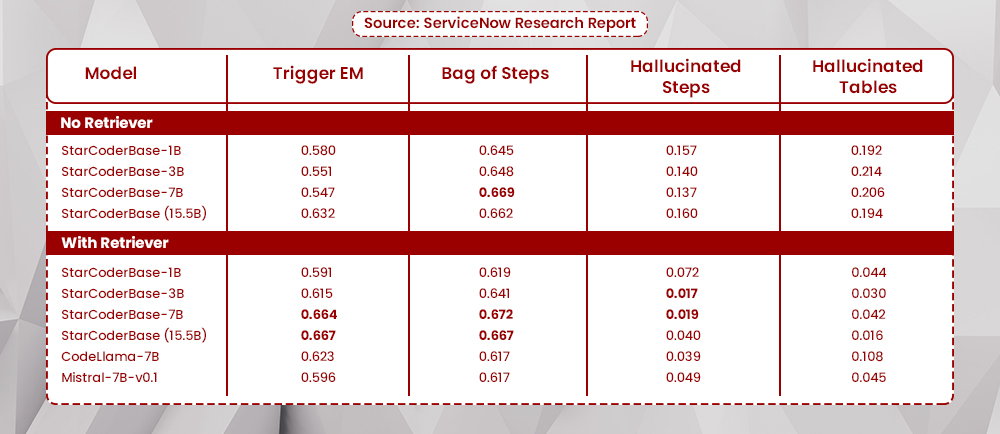
This highlights the need for a solution that ensures GenAI outputs are accurate and aligned with the ServiceNow platform.
Introducing RAG (Retrieval-Augmented Generation)
Retrieval-Augmented Generation (RAG)3 is a hybrid approach that mitigates Gen AI hallucinations and enhances LLMs by integrating a retrieval mechanism that fetches relevant information from trusted sources or a knowledge base before generating outputs.
In ServiceNow, RAG can be applied to generate workflows from natural language requirements, producing JSON outputs. This process will involve the following two essential components:
- Retriever Component: This will query a knowledge base, CMDB, or a policy document repository in ServiceNow for the most relevant context related to the prompt.
- Generator Component: This uses the retrieved document to generate contextually aware and accurate responses.
Implementing GenAI in ServiceNow with RAG helps significantly reduce the likelihood of hallucinations. And because of this, now the GenAI responses can be:
- Aligned with the latest knowledge base article.
- Verified against updated approval workflows or security policies.
For instance, if the user asks, “How do I escalate a P1 incident ticket?” in this scenario, a RAG-enabled GenAI model will now retrieve the exact/latest escalation policy from the ServiceNow Knowledge Base before responding. This ensures that the guidance provided by the GenAI model is accurate and compliant with the latest organizational policies.
Building a Governance Model for GenAI in ServiceNow
Building a governance model for GenAI in the ServiceNow environment will involve establishing policies, processes, and controls to manage the development, deployment, and usage of AI. The following are the key components that should be included in the governance model:
1. Data Management
The knowledge base used for retrieval must be accurate and contain the latest and most up-to-date information. Regular updates to the ServiceNow Schema and validation of retrieved information are critical to prevent inaccuracies that could lead to GenAI hallucinations.
2. Model Selection and Training
Choosing the right LLMs and retriever model is essential, as it can result in achieving low hallucination rates. The training should focus on aligning the models with ServiceNow’s domain-specific requirements.
3. Monitoring and Evaluation
It is necessary to continuously monitor the RAG system using metrics such as hallucination rates, accuracy, and user satisfaction. The ServiceNow research reports also highlight the importance of evaluating models across in-domain and out-of-domain scenarios to ensure the system's robustness.
4. Security and Privacy
The RAG system must adhere to security best practices, ensuring that the retrieved data is handled securely and complies with privacy standards.
5. Setting up Feedback Loops
In the RAG system, users can rate or flag GenAI responses. These low-confidence responses can then be routed to human agents or used in retraining the datasets.
This governance model will ensure that RAG-based GenAI systems are reliable, scalable, and aligned with organizational policies, thereby fostering trust and promoting widespread adoption.
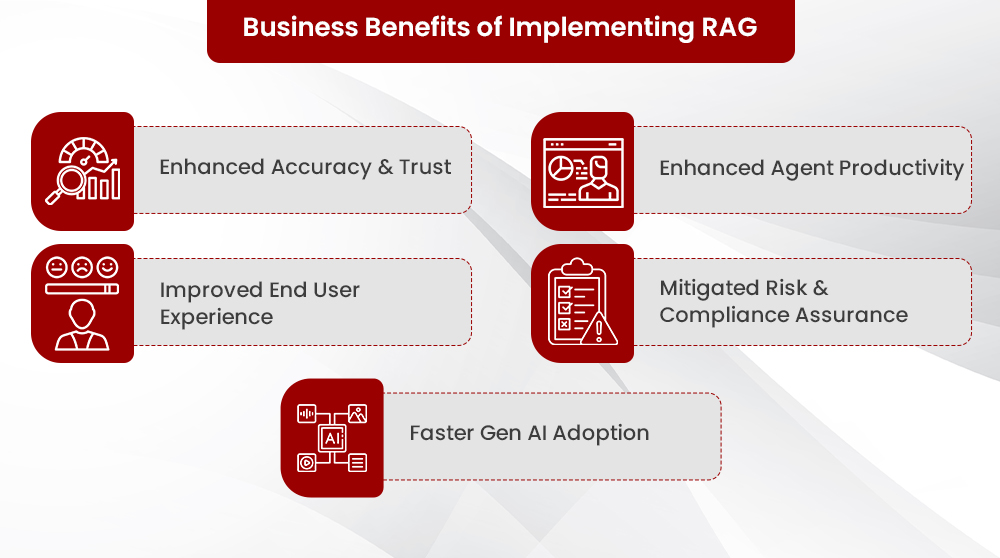
Business Benefits of Implementing RAG
By implementing a RAG-based governance model in ServiceNow, the organization can have tangible benefits beyond just hallucination reduction:
1. Enhanced Accuracy and Trust
RAG ensures more reliable AI-generated workflows, increasing user confidence and adoption.
2. Enhanced Agent Productivity
By reducing the time spent on validating AI responses, agents can now focus on high-value tasks, such as critical incident response or stakeholder engagement.
3. Improved End User Experience
In a scenario where a virtual agent handles HR queries or knowledge article summarization for field agents, a RAG-based GenAI model will produce reliable AI responses, resulting in improved service delivery and faster resolution times.
4. Mitigated Risk and Compliance Assurance
The RAG-based GenAI system provides a traceable, policy-backed response that helps organizations in reducing the risk of compliance violations or misinformed actions taken due to hallucinated data.
5. Faster Gen AI Adoption
With a RAG-based system and a governance model supporting these models, organizations will have more confidence in rolling out GenAI capabilities across modules like ITSM, HRSD, CSM, SecOps, and many more. This practice further helps in faster digital transformation.
Conclusion
Reducing GenAI hallucination is critical for ensuring the reliability and adoption of Gen AI in enterprise environments, such as ServiceNow. By adopting a RAG-based approach, organizations can achieve grounded, accurate, and context-aware AI responses.
Together, RAG and governance models can not only reduce hallucinations but also build a scalable, trusted AI ecosystem within ServiceNow. This approach will provide enhanced productivity and trust for enterprises in their adoption of GenAI.
And here, inMorphis, a ServiceNow-invested partner, can help with the adoption of these new GenAI innovations using a RAG-based approach, establishing step-by-step achievements while keeping an eye on your organization’s future goals.
