
Are traditional GRC tools slowing down your business, creating duplication, and failing to scale with your enterprise? For many IT enterprises, integrating governance, risk, and compliance into existing workflows remains a major challenge. Legacy systems and manual processes often:
Operate in silos which are disconnected from IT operations, security functions, and vendor ecosystems. and leads to fragmented visibility, delayed risk response, and a heavy reliance on human effort.
As regulatory demands rise and digital environments grow more complex, enterprises need more than just compliance; they need a unified, intelligent GRC framework that adapts, integrates, and scales. Alternatively, ServiceNow GRC transforms traditional GRC into real-time, AI-assisted capabilities that deliver measurable business value.
In this blog post, we will discuss the challenges faced by IT enterprises, what ServiceNow GRC is, its modules, how to integrate it, and the future of GRC.
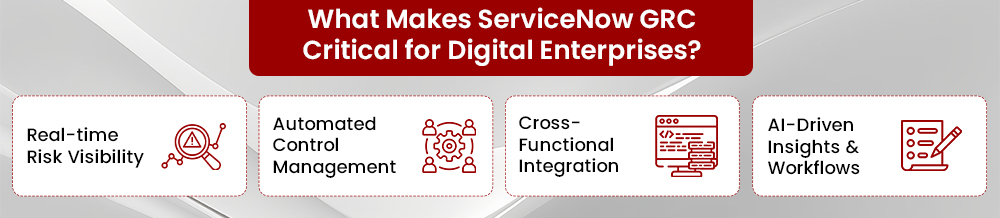
What Makes ServiceNow GRC Critical for Digital Enterprises?
ServiceNow GRC transforms traditional frameworks into a unified, data-driven architecture that leverages automation, real-time analytics, and system integrations to deliver the following core capabilities:
- Real-time Risk Visibility: Live dashboards track risks, compliance gaps, and policy violations across IT, security, and business domains.
- Automated Control Management: Automation streamlines evidence collection, control testing, and policy reviews, reducing manual workload.
- Cross-Functional Integration: Sync across ITSM, SecOps, cloud environments, and external systems to operationalize GRC within enterprise-wide processes.
- AI-Driven Insights and Workflows: Uses AI to recommend risk responses, trigger smart approvals, and flag anomalies, enhancing accuracy and speed.
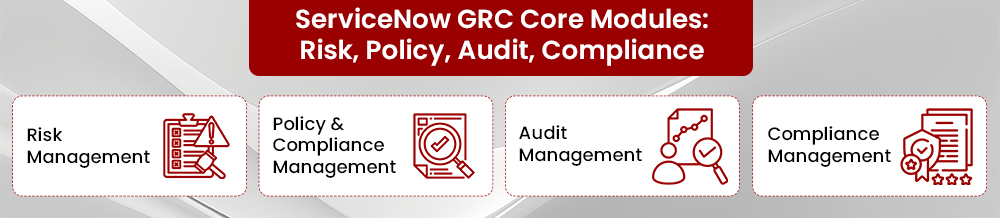
ServiceNow GRC Core Modules: Risk, Policy, Audit, Compliance
ServiceNow GRC is organized into four core modules, designed for seamless collaboration and centralized governance. Each module supports a different aspect of the GRC lifecycle while feeding into a unified risk and compliance dashboard.
1. Risk Management
ServiceNow GRC provides a structured and automated approach to an enterprise’s integrated risk management by consolidating risk data, enabling intelligent assessments, and integrating with leading frameworks. It allows enterprises to shift from reactive risk reporting to proactive risk mitigation and the key capabilities include:
- Centralized Risk Register with Real-time Tracking:
It maintains a unified repository that captures all enterprise risks across business units, geographies, and assets. It offers real-time updates and audit-ready records throughout the risk lifecycle.
- Customizable Risk Scoring and Assessment Models:
Through integrated risk modeling, ServiceNow GRC quantifies both inherent and residual risks using qualitative descriptors and numerical values. These models can be configured based on several factors such as likelihood, impact, velocity, and control strength to prioritize risks effectively.
- Automated Risk Response Workflows with Control Mapping:
Dynamic workflows are triggered automatically when risk thresholds are breached, or control failures occur. The system assigns responsibility, initiates mitigation plans, and tracks remediation progress to fully integrated with control libraries and incident data.
Also, read Guide to Risk Management in ServiceNow GRC
2. Policy and Compliance Management
ServiceNow GRC simplifies and standardizes policy and compliance operations by automating the entire policy lifecycle, ensuring alignment with regulatory standards, and reducing manual compliance efforts. This enables enterprises to maintain governance at scale with traceable, auditable processes. The key capabilities include:
- Supports Policy Lifecycle: Creation → Review → Approval → Publication
ServiceNow GRC facilitates end-to-end policy lifecycle management by integrating workflow automation, access controls, and digital signatures to meet regulatory and internal audit standards.
- Maps Policies to Authoritative Sources (e.g., ISO 27001, GDPR, SOX)
Policies can be directly linked to regulatory and industry standards, allowing enterprises to demonstrate compliance alignment and track the impact of regulatory changes on internal controls.
- Automates Control Testing and Evidence Collection:
Scheduled control tests are executed automatically, with the platform collecting and storing required evidence.
- Provides Exception Handling Workflows and Renewal Reminders:
The system supports workflows for managing policy exceptions, including risk assessments and approvals. It also triggers automated reminders for policy reviews and renewals to keep governance documentation current.
3. Audit Management
ServiceNow enables audit modernization by aligning planning with risk profiles, automating execution, and consolidating audit artifacts for end-to-end traceability. It eliminates manual processes and silos, allowing audit teams to focus on assurance and continuous improvement. The key capabilities include:
- Risk-based Audit Planning with Automated Scoping:
The platform enables audit teams to prioritize audits based on risk scores, control failures, or compliance gaps. Automated scoping tools help define the audit scope dynamically, ensuring relevance and efficiency.
- Tracks Fieldwork, Findings, And Evidence in a Single Platform:
All audit activities, starting from fieldwork documentation to issue logging and evidence collection are captured and managed within a unified workspace, providing transparency and accountability throughout the audit lifecycle.
- Integrates Risk and Compliance Data to Eliminate Duplication:
Audit plans and findings are informed by existing risk and compliance data, reducing redundant testing and improving alignment across GRC functions.
- Supports Auditor Collaboration, Approvals, and Final Report Generation:
The system facilitates real-time collaboration among audit team members, manages approval workflows, and automates the generation of final audit reports for distribution and archival.
4. Compliance Management
ServiceNow GRC enables enterprises to proactively manage compliance by centralizing regulatory obligations, linking them to controls, and providing real-time visibility into compliance posture. The key capabilities include:
- Maintains a Library of Obligations and Regulatory Mappings:
The platform houses a centralized repository of regulatory requirements, industry standards, and internal policies. These obligations are mapped to relevant controls, creating traceability across compliance frameworks.
- Dynamically Adjusts Compliance Status Based on Control Performance:
Compliance status is automatically updated based on real-time control testing results. This dynamic linkage ensures that any control degradation is immediately reflected in compliance posture.
- Provides Compliance Dashboards with Drill-down to Violations:
Interactive dashboards offer high-level compliance overviews and allow users to drill down into specific frameworks, domains, or violations for detailed investigation and reporting.
- Sends Real-time Alerts on Non-compliance and Remediation Delays:
The system generates immediate alerts when a compliance breach is detected or when remediation deadlines are missed, enabling timely corrective action and improved accountability.
ServiceNow GRC Dashboards: Building Real-Time Risk and Control Visibility
ServiceNow GRC dashboards are designed to deliver real-time, comprehensive visibility into an enterprise’s risk and control environment, empowering leadership and stakeholders to make informed, risk-aware decisions. It consolidates data from risk management, compliance, audit, and policy processes, presenting them through interactive dashboards and reports. These dashboards can:
- Centralize Risk Insight: Users gain a unified, executive view of enterprise, IT, and operational risk, tracking both inherent and residual risk across business units.
- Provide Actionable, Real-Time Data: Dashboards update dynamically with the latest data from assessments, incidents, and control tests, allowing enterprises to monitor risk posture, compliance status, and open issues as they evolve.
- Enhance Control Monitoring: Easily track the status of key controls, upcoming attestations, overdue tasks, and recent control test results, helping teams quickly address control weaknesses.
- Support Risk-Informed Decisions: By visualizing risk trends, high-priority threats, compliance gaps, and audit findings all in one place, leaders can prioritize mitigation actions and resource allocation.
- Automate Reporting: ServiceNow GRC automates the generation of regulatory and internal reports, streamlining audit preparation and compliance reviews while ensuring transparency for regulators and auditors.
- Foster Collaboration and Accountability: Dashboards provide individualized and group task views, outlining pending actions and enabling better collaboration across GRC teams.
- Enable Scalability and Adaptability: As enterprises grow or undergo regulatory changes, dashboards can be tailored and scaled to accommodate evolving GRC requirements.
Integrating ServiceNow GRC with IRM, TPRM, and ITSM
For GRC to drive real business value, it must be connected with systems that include operational, strategic, and compliance-related data. ServiceNow GRC enables seamless integration across these domains, transforming governance from a siloed function into an enterprise-wide capability.
1. Integrated Risk Management (IRM)
ServiceNow GRC extends its capabilities through IRM to provide a holistic view of enterprise risk beyond regulatory compliance.
- Integrates Operational and IT Risk Domains for Unified Governance
IRM enables enterprises to unify risk domains, such as cybersecurity, operational continuity, and finance under a single governance framework, ensuring that risk management supports business outcomes.
- Captures Risk Events from Across Departments in Real-time:
The platform ingests risk signals from various sources including incident records, audit findings, and user-submitted risk events, providing a continuously updated enterprise risk profile.
- Aligns Risk Appetite with Business Objectives and Performance Metrics:
By mapping risks to KPIs and strategic goals, IRM ensures that risk response is consistent with executive risk tolerance and corporate performance targets.
2. Third-Party Risk Management (TPRM)
ServiceNow TPRM module integrates external vendor assessments directly into the enterprise risk ecosystem, enabling better oversight of third-party exposures.
- Automates Vendor Risk Assessments During Onboarding:
TPRM streamlines due diligence through automated questionnaires, document uploads, and scoring models as part of the procurement process.
- Connects Third-party Risks to Internal Policies and Controls:
Identified vendor risks are directly mapped to internal control requirements, ensuring third-party compliance with standards and regulations.
- Monitors TPRM KPIs such as SLA breaches, security incidents, and contract expirations:
Real-time monitoring tracks operational risk indicators and escalates risks tied to vendor performance or security events.
Also, read Guide to Master ServiceNow TPRM
3. IT Service Management (ITSM)
Integrating ServiceNow GRC with ITSM enables real-time risk detection and faster remediation within IT operations.
- Links Change Requests and Incidents to Impacted Controls:
Each IT change or incident is evaluated for its impact on governance controls, ensuring traceability and risk-aware decision-making.
- Auto-Generates Risk or Policy Violations from Failed IT Operations:
When an incident breach defined thresholds, the platform can automatically flag risk events or policy violations, reducing manual oversight.
- Syncs CMDB to Dynamically Assess Risk Exposure of IT Assets:
The Configuration Management Database (CMDB) feeds asset data into GRC, helping quantify the risk posture of critical infrastructure.
- Enables Closed-loop Remediation Between ITSM and GRC Workflows:
Control failures or audit findings in GRC can trigger tasks in ITSM for remediation, with bi-directional status updates to ensure issue closure.
AI‑Assist and Automation in GRC Tasks
AI and automation are transforming GRC from a labor-intensive discipline into an agile, self-optimizing system. ServiceNow uses artificial intelligence into its GRC suite to improve decision-making, reduce manual effort, and accelerate governance processes.
AI Use Cases
- Gen AI to Generate Policy Drafts, Risk Mitigation Plans, or Audit Reports:
ServiceNow’s version of GenAI Copilot, Now Assist, can help draft policies, suggest risk responses, and summarize audit findings, accelerating traditionally manual GRC processes.
- Predictive Risk Scoring Based on Past Incidents and Trends:
Machine learning models analyze historical data to predict potential risks, helping teams preempt issues before they escalate.
- Auto-Categorization of Policy Violations Based on Historical Data:
Using past violation patterns, the system can automatically classify new compliance breaches and suggest appropriate actions.
- NLP-Based Parsing of Regulatory Updates for Faster Impact Analysis:
With NLP, regulatory documents are scanned for semantic changes, linked to internal compliance controls, and routed to relevant stakeholders for review.
Automation Use Cases in ServiceNow GRC
- Control Testing Automation Via Integrations with AWS Config, Azure Policy, and M365:
Continuous control monitoring is enabled by connecting ServiceNow to cloud-native tools, ensuring that compliance checks run automatically at defined intervals.
- RPA bots for Evidence Collection, Review Reminders, and Approvals:
Robotic Process Automation (RPA) handles repetitive GRC tasks like fetching audit logs, sending attestation reminders, or routing requests for sign-off.
- Automated Risk Assessments Using Scoring Models and External Feeds:
Risk assessments can be auto triggered based on real-time data from threat intelligence platforms, incident feeds, or internal changes.
Common ServiceNow GRC Implementation Challenges and Solutions
Implementing ServiceNow GRC1 requires more than just platform configuration; it demands alignment between governance strategy, data architecture, and user adoption. Below are common challenges enterprises face during implementation, along with recommended workarounds:
- Siloed Data Across IT, Audit, and Legal Teams
Challenge: Data fragmentation hinders enterprise-wide visibility and creates inconsistencies in risk and compliance reporting.
Solution: Build CMDB maturity to establish a single source of truth for IT assets and dependencies. Leverage ServiceNow IntegrationHub and APIs to ingest data from audit tools, legal systems, and third-party risk platforms into a unified GRC environment.
- Limited Stakeholders Buy-in Or Unclear Ownership
Challenge: Without clear accountability, GRC initiatives often stall or fail to scale across departments.
Solution: Establish defined roles and responsibilities for risk, compliance, audit, and IT teams. Roll out GRC in phases, starting with high-impact use cases like policy management or IT risk to demonstrate value and build momentum.
- Heavy Reliance on Manual Checks Increases the Chances of Error
Challenge: Manual control validation slows audit readiness and increases human error.
Solution: Automate control testing using integrations with cloud-native tools (e.g., AWS Config, Azure Policy) and endpoint security platforms. This reduces manual workload while improving testing frequency and consistency.
- Underutilized Dashboards and Reporting
Challenge: GRC dashboards often go unused due to generic design or misaligned metrics.
Solution: Develop role-based dashboards tailored to specific audiences such as executives, auditors, risk managers, and conduct workshops to improve understanding of key risk and compliance KPIs.
- Compliance Overload for Large Enterprises
Challenge: Managing overlapping requirements across regions and frameworks can overwhelm compliance teams.
Solution: Implement control inheritance models to avoid redundancy, apply dynamic risk scoring to prioritize actions, and use template-driven policy creation to scale governance efficiently.
Case Study: Improving Regulatory Efficiency with ServiceNow GRC
A global IT services provider with 29,000+ employees across 30 offices in 19 countries, serving 750+ enterprise clients worldwide, required a scalable and secure approach to compliance and audit management.
Challenges
- Migration from HP Service Desk to ServiceNow IT Service Management.
- Compliance efforts were dependent on spreadsheets, emails, and manual data collection.
- Disconnected cross-functional processes lead to delays and inefficiencies.
- High risk exposure due to a recent breach and ongoing non-compliance.
Solutions
- Automated GRC with ServiceNow:
Digitized compliance and risk workflows across business units using a centralized platform.
- Unified Compliance Framework
Mapped and deployed 327+ compliance controls using UCF for ERP (NIST 800-53) and Data Center (ISO 27001).
- Efficient Audit Workbench
Enabled structured, year-round internal and external audits for 9 internal departments and 18 vendors.
- Controlled Risk Exposure
Integrated dynamic scoring models to proactively identify and manage enterprise risks.
- Real-Time Dashboards and Automated Workflows
Delivered in a 3-month rollout with CMDB setup, performance analytics, and a vendor compliance portal.
Outcomes
- 75% reduction in time spent collecting audit-related data.
- Thousands of monthly emails were eliminated with automated compliance workflows.
- Centralized control monitoring and custom risk registers.
- Integrated Unified Compliance Framework across departments and vendors.
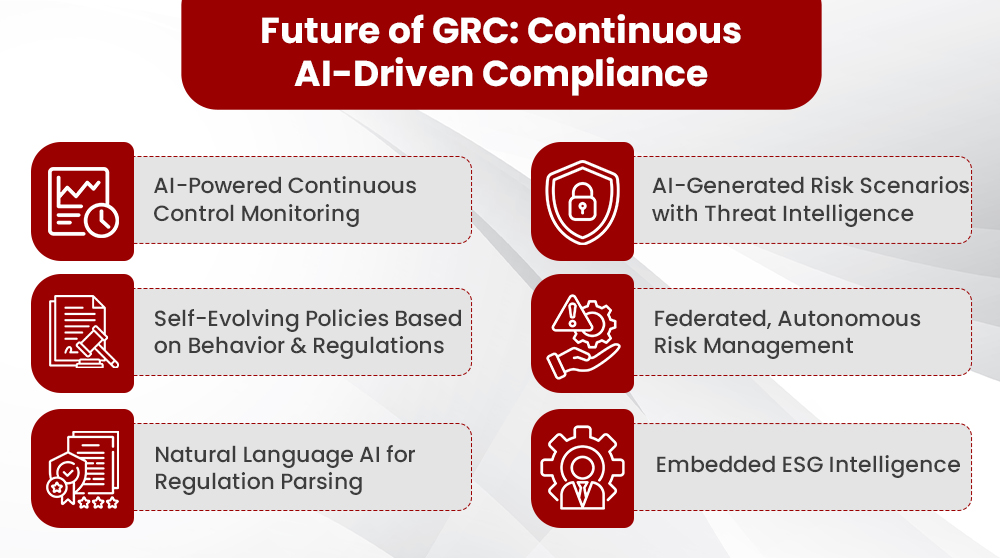
Future of GRC: Continuous AI‑Driven Compliance
With advancements in AI, GRC platforms are shifting from periodic, reactive systems to intelligent, autonomous frameworks that continuously interpret data, simulate risks, and use compliance in real time in capabilities such as:
- AI-Powered Continuous Control Monitoring (CCM)
Replacing traditional, periodic audits, CCM uses AI to monitor key controls in real time. It automatically detects anomalies, compliance lapses, and controls failures as they occur, which ensures immediate visibility and faster response.
- AI-Generated Risk Scenarios with Threat Intelligence
GRC platforms are increasingly integrating third-party threat intelligence feeds. AI uses real-time data to simulate potential risk scenarios, generating risk profiles based on evolving cyber risks, geopolitical changes, and supply chain disruptions.
- Self-Evolving Policies Based on Behavior and Regulations
Instead of manual updates, policies are becoming dynamic. AI assesses behavioral patterns, audit results, and regulatory updates to automatically refine or suggest policy adjustments which helps enterprises to stay continuously aligned with regulatory expectations.
- Federated, Autonomous Risk Management
AI empowers business units to self-manage risk through guided, low-code/no-code workflows. This federated model distributes risk ownership across the enterprise, reducing load on central GRC teams while maintaining oversight and consistency.
- Natural Language AI for Regulation Parsing
GRC systems now use natural language processing (NLP) to interpret new regulations and compare them against existing controls and policies. This accelerates regulatory change management and reduces human interpretation errors.
- Embedded ESG Intelligence
Advanced GRC solutions now integrate AI-driven ESG (Environmental, Social, and Governance) metrics by standardizing data collection, mapping ESG regulations, and automating ESG impact assessments alongside financial and risk reports.
Conclusion
ServiceNow GRC goes beyond traditional compliance to become a strategic pillar of enterprise resilience and performance. In a business landscape defined by rapid digital transformation, expanding regulatory requirements, and escalating cyber threats, static and siloed GRC models simply don’t scale. ServiceNow empowers enterprises to unify governance processes, automate risk and compliance workflows, and make informed decisions based on real-time data and AI-driven insights.
The true value lies in transforming GRC from a cost center into a value-generating function by reducing audit effort by up to 75%, minimizing risk exposure through dynamic scoring, and accelerating time to compliance with intelligent automation. By integrating GRC with ITSM, TPRM, IRM, and ESG frameworks, enterprises build a connected ecosystem where risk ownership is distributed, compliance is continuous, and accountability is embedded into every workflow.
inMorphis, a ServiceNow Invested Partner, we help enterprises design, implement, and scale modern governance programs that deliver measurable impact. With deep domain expertise and end-to-end ServiceNow capabilities, we turn GRC complexity into business value. Partner with inMorphis to scale your ServiceNow GRC journey for growth.
