Enterprise IT operations are under constant pressure from growing complexity and data volume. Hybrid cloud, microservices, and SaaS applications generate millions of events and alerts daily, creating noise that makes it challenging to isolate critical issues. This often results in delayed responses, unexpected outages, and higher operational costs. Traditional monitoring tools are insufficient for managing this scale and speed, leaving enterprises in need of a more intelligent, proactive approach.
AIOps offers a structured solution by applying artificial intelligence and machine learning to IT operations. It enables early detection of anomalies, predictive analysis of potential failures, and automated remediation of recurring issues. By shifting from reactive troubleshooting to proactive management, AIOps enables enterprises to enhance service reliability, optimize resources, and align IT performance with business outcomes.
This blog explains how ServiceNow AIOps addresses these challenges, the capabilities it brings, and the steps enterprises can take to implement it effectively.
Understanding ServiceNow AIOps
ServiceNow AIOps is an AI-driven platform that utilizes machine learning and big data analytics to collect and analyze IT operational data in real-time, enabling proactive detection and resolution of IT issues within complex enterprise environments.
Why IT Enterprises Need ServiceNow AIOps?
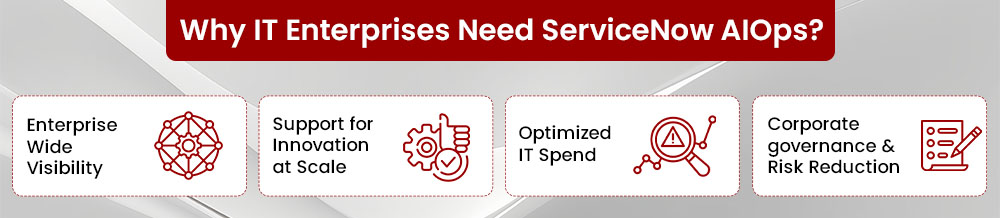
Enterprises today must address IT complexity and corporate governance to ensure growth, compliance, and resilience. ServiceNow AIOps addresses these enterprise-level needs that go beyond traditional operations.
1. Enterprise-Wide Visibility
IT teams often operate in silos across infrastructure, applications, and business units. ServiceNow AIOps offers end-to-end observability, creating a unified operational view that directly links IT performance to business services.
2. Support for Innovation at Scale
Enterprises adopting edge computing, IoT, and multi-cloud architectures need intelligent operations that can scale with innovation. ServiceNow AIOps ensures operational stability while enabling rapid adoption of emerging technologies.
3. Optimized IT Spend
Rising infrastructure and cloud costs make efficiency a board-level priority. By reducing mean time to resolution (MTTR), minimizing service disruptions, and automating repetitive work, ServiceNow AIOps lowers operational costs without compromising performance.
4. Corporate Governance and Risk Reduction
CIOs and CISOs must report uptime, business risk, compliance posture, and SLA performance. ServiceNow AIOps connects operational metrics with business KPIs, providing leadership with the insights they need for governance and investment decisions.
Also, read AIOps Guide: What Enterprises Need to Know
What are the Core Capabilities of ServiceNow AIOps for IT Enterprises?
The fundamental objective of AIOps is to enable predictive, autonomous, and business-aware IT operations by applying AI, machine learning, GenAI, and agentic automation across complex digital ecosystems.
1. Real-Time Anomaly Detection
Unsupervised learning and dynamic baselining identify deviations in metrics, traces, and events. ServiceNow AIOps correlates anomalies across hybrid cloud, network, and application layers to accelerate root cause isolation.
2. Agentic Automation and Remediation
ServiceNow AIOps utilizes agentic AI1 to run self-healing workflows such as restarts, scaling, rerouting, and ticketing, while orchestrating decisions across monitoring and remediation. These agents collaborate with humans for escalations, ensuring adaptive, policy-driven operations that cut MTTR and reduce overhead costs.
3. Business Impact Correlation
Operational events are mapped to business services and SLAs, ensuring that incidents with financial or regulatory implications are prioritized and resolved first.
4. Continuous Model Evolution
Closed-loop learning pipelines retrain detection and remediation models with fresh telemetry and resolution outcomes, minimizing false positives and adapting to shifting IT architectures.
5. Generative AI for RCA and Insights
GenAI synthesizes event data, incident histories, and dependency maps into natural language explanations, enabling faster root cause analysis and contextual recommendations for IT teams.
Implementing AIOps in Your IT Environment
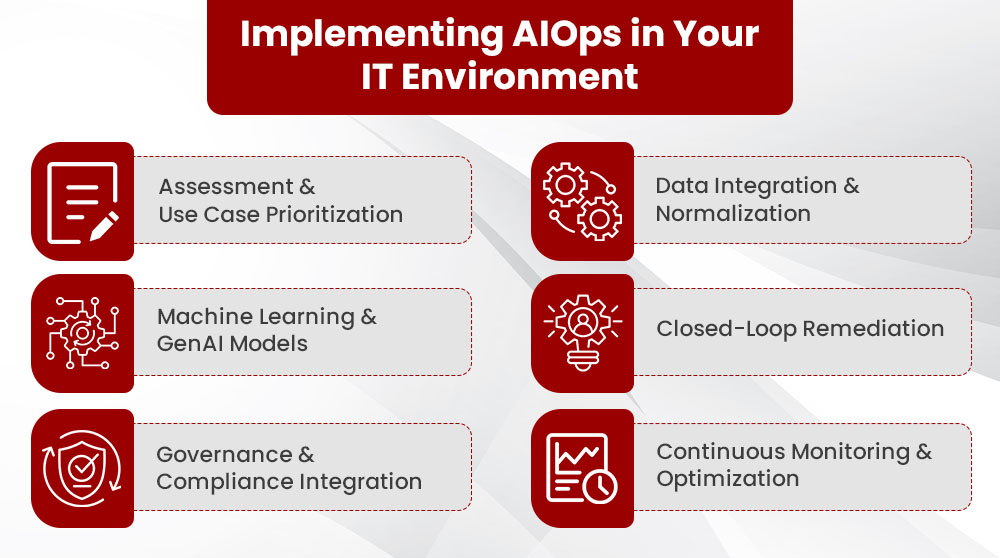
Implementing AIOps in an enterprise requires a structured approach that combines data integration, machine learning, automation, and governance. ServiceNow AIOps provides the tools to achieve this through a step-by-step deployment.
1. Assessment and Use Case Prioritization
Enterprises should begin by assessing their IT environment and selecting specific use cases such as incident noise reduction, predictive capacity planning, or automated remediation. Clear KPIs should be defined to measure success.
2. Data Integration and Normalization
Telemetry from logs, metrics, traces, and events across cloud, on-premises, and SaaS systems must be ingested and normalized. ServiceNow CMDB provides a unified view of services and dependencies for correlation.
3. Machine Learning and GenAI Models
Machine learning models detect anomalies, forecast potential issues, and identify root causes. GenAI enhances these models by generating contextual insights and natural language explanations for faster decision-making.
4. Closed-Loop Remediation
AIOps must include feedback loops where incident outcomes retrain models and refine automation rules. This ensures continuous improvement and reduces the number of false positives over time.
5. Governance and Compliance Integration
All automation and remediation workflows must adhere to enterprise risk, compliance, and change management frameworks, ensuring secure, policy-driven operations that promote accountability, auditability, and regulatory standards. AI-driven decisions must remain transparent and explainable with proper audit trails.
6. Continuous Monitoring and Optimization
The environment should be continuously monitored, with dashboards linking business KPIs to system health. Models, workflows, and policies must be refined as infrastructure evolves.
Challenges and Considerations for Implementing ServiceNow AIOps
While ServiceNow AIOps offers significant advantages, successful adoption requires addressing several technical and organizational challenges.
1. Data Quality and Normalization
AIOps accuracy depends on clean, consistent data. Incomplete CMDB records, noisy telemetry, or siloed monitoring tools can lead to false positives or missed incidents.
2. Model Accuracy and Drift
Machine learning models must be retrained regularly to reflect evolving IT architectures. Without ongoing calibration, prediction accuracy declines over time.
3. Organizational Change and Team Adaptation
Successful ServiceNow AIOps adoption starts with organizational readiness. IT teams must embrace AI-driven workflows, adjust existing processes, and undergo training for automated and agentic operations to ensure smooth adoption and effective collaboration.
4. System Integration and Interoperability
AIOps must be seamlessly integrated with legacy systems, third-party monitoring tools, and hybrid cloud environments. Proper integration ensures consistent data flow, reduces operational friction, and supports accurate AI-driven insights.
Conclusion
AIOps enables enterprises to shift from reactive IT operations to proactive and automated management. By applying machine learning, anomaly detection, and agentic AI within the ServiceNow platform, enterprises can minimize downtime, optimize resources, and safeguard business-critical services. Success depends on addressing data quality, integration, and governance challenges, but the payoff is higher reliability, reduced costs, and improved business agility.
inMorphis, a ServiceNow Invested Partner, helps enterprises implement AIOps in a structured way, ensuring measurable improvements in IT performance and business outcomes. Contact us today to learn how inMorphis can accelerate your AIOps journey and build a more resilient IT foundation.
