In today’s digital landscape, as organizations move away from centralized data centers toward highly distributed, hybrid-cloud, and microservices-based architectures, the sheer volume of operational data has exploded. IT operations teams are no longer just managing servers; they are managing a living, breathing ecosystem of interconnected services. In this environment, the "human-only" approach to monitoring is not just inefficient; it is impossible.
This is precisely where an AIOps platform becomes the spine of the new-age enterprise. AIOps, or Artificial Intelligence for IT Operations, is the application of machine learning (ML), natural language processing (NLP), and advanced analytics to the massive datasets generated by IT infrastructure. By shifting, an organization can transition from a reactive, firefighting approach to a semi-autonomous, policy-driven remediation management process, thereby allowing a business to remain operational 24/7 while leveraging its most precious resource: human talent.
Why is an AIOps Platform Essential for Modern Enterprise Scale?
The fundamental challenge of modern IT is the "Data Blizzard." Every click, every API call, and every heartbeat of a virtual machine generates a log entry or a metric. Traditional IT Operations Management (ITOM) systems were designed for a previous generation of IT applications and data, an era when you could just state a threshold (something like, 'Notify me when CPU usage reaches 90%') and expect a human to respond.
An AIOps platform solves this issue by acting as an intelligent filter. It doesn't just collect data; it understands the relationship between data points. By ingesting telemetry from across the entire stack from the physical hardware and network layers to the application and end-user experience, the platform creates a consolidated, service-centric operational view. This visibility is the first step toward maturity. Without it, teams remain siloed.
If you’re looking for a deeper foundation on what AIOps is and why it matters, read our comprehensive guide to AIOps.
How Does an AIOps Solution Revolutionize Incident Management?
Incident management is the heartbeat of IT operations, yet often the most broken process in the organization. The traditional lifecycle of an incident: Detection, Identification, Categorization, Prioritization, and Resolution, is prone to manual delays.
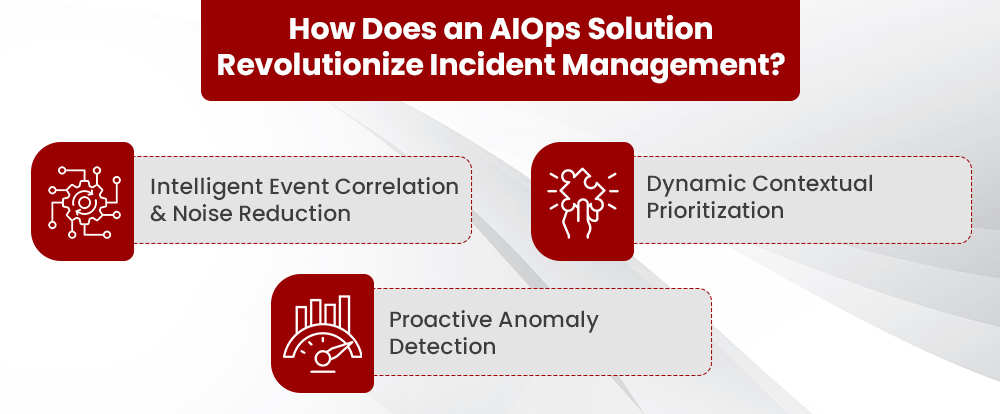
A robust AIOps solution re-engineers this entire lifecycle through three critical capabilities:
1. Intelligent Event Correlation and Noise Reduction
The most immediate win of an AIOps rollout is the reduction of noise. When a core switch fails, it might trigger 1,000 alerts across 100 different applications. An AIOps engine uses ML to recognize if these 1,000 alerts are actually symptoms of a single root cause. It then groups them into a single incident, which often reduces alert noise by 70–90% in mature environments. This allows the service desk to focus on the problem rather than the notifications.
2. Dynamic Contextual Prioritization
An AIOps platform understands business context. It maps technical failures to business services, ensuring that the team is always working on the issue with the highest potential impact on revenue and customer satisfaction. For instance, a server failure in a development environment is a low priority; a slight latency increase in the Payment Gateway during a flash sale is a Tier-1 emergency.
3. Proactive Anomaly Detection
The goal of an IT team is to resolve an incident before the user even knows it exists. AIOps moves beyond up/down monitoring to behavioral monitoring. This means it establishes a baseline of what’s normal in your environment, so that the platform can detect subtle deviations that signal a looming failure. This proactive detection is the difference between a 5-minute fix and a 5-hour outage.
Can Predictive Analytics in AIOps Enable Proactive Maintenance?
Predictive analytics transforms IT operations from a reactive state to a predictive one. While traditional monitoring reports on events that have already occurred, an AIOps solution leverages historical data to identify the subtle patterns and behavioral signatures that precede system failures. By recognizing these early indicators, the platform issues actionable warnings, allowing teams to intervene, such as migrating workloads or replacing failing hardware, well before a service disruption impacts the end-user.
This capability extends to capacity planning. Instead of buying hardware based on "gut feel" or annual cycles, an AIOps platform provides data-driven forecasts. Helping prevent outages and also ensuring that the IT budget is optimized by avoiding over-provisioning.
What Role does Intelligent Root Cause Analysis Play in an AIOps Solution?
While correlation reveals related events, Intelligent Root Cause Analysis (RCA) identifies the root cause of the failure. In a microservice architecture, finding the root cause is a significant challenge for human operators. An AIOps solution automates RCA by tracing infrastructure dependencies and correlating incidents with recent changes, including code deployments, configuration updates, or security patches.
Instead of manual investigation, the platform provides a definitive, evidence-based report identifying the exact trigger. This reduces time spent on diagnosis and accelerates resolution—supported by our case study on major reduction in critical business outages, which reports a 40% reduction in incident MTTR..
Why is Contextual Insight Critical for an AIOps Solution?
A common failure in legacy monitoring is the creation of data silos: technical metrics that have no clear connection to business processes. A modern AIOps solution provides contextual insights by bridging the gap between infrastructure health and business outcomes.
Through dynamic dependency mapping, the platform visualizes how every configuration item (CI) supports a specific business service. This allows for service-centric management. For example, if a database experiences latency, the platform doesn't just show a technical alert; it demonstrates that the ‘Mobile Banking App’ is experiencing a delay for users in a specific region. This context allows stakeholders from IT managers to C-suite executives to make informed decisions based on real-world business impact rather than abstract technical data.
How to Ensure Seamless Integration of AIOps with Existing IT Tools?
The value of an AIOps platform depends on its ability to integrate with the existing IT ecosystem. Modern enterprises utilize a heterogeneous mix of legacy on-premises systems, multiple public clouds, and specialized monitoring tools. A high-level AIOps solution must be tool-agnostic, designed to ingest and normalize data from multiple sources into a single, coherent data lake.
Furthermore, seamless integration must extend to ITSM and DevOps workflows. When the AIOps engine identifies an issue, it should automatically generate a ticket in the service management system, attach the relevant RCA data, and notify the appropriate engineer. This end-to-end integration ensures that the intelligence provided by AI is translated into immediate, effective action.
How inMorphis Delivers Measurable Outcomes?
Implementing an AIOps platform is a strategic transformation that requires a partner capable of navigating the complexities of technology, process, and organizational culture. At inMorphis, we focus on delivering tangible business outcomes, not just implementation projects.
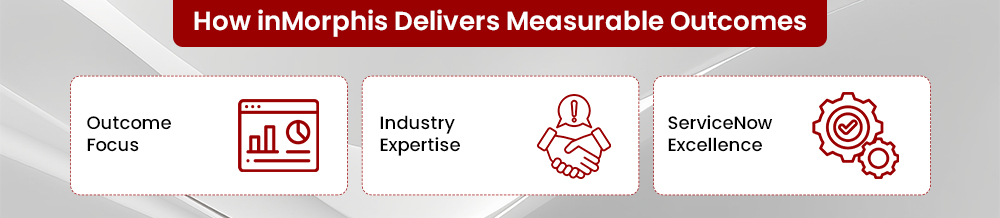
Our approach to AIOps is built on three pillars:
-
1. Outcome Focus: We align the platform with your specific business KPIs, such as achieving a 70-90% reduction in outages or a 50% improvement in end-to-end order turnaround times.
-
2. Industry Expertise: With 750+ certified ServiceNow practitioners, inMorphis brings proven delivery strength across enterprise engagements.
-
3. ServiceNow Excellence: As a ServiceNow Elite Partner, we specialize in unlocking the full potential of the ServiceNow AIOps and ITOM suite, ensuring your investment delivers maximum ROI and long-term scalability.
The Path to Autonomous Operations
The complexity of modern IT isn't going away, but the chaos can. By moving to an AIOps solution, you stop fighting fires and start driving growth through predictive, self-healing infrastructure.
Connect with the inMorphis team today for a comprehensive readiness assessment of your environment. Let’s build your autonomous future together.
Reference:
1. What is Mean Time To Repair - ServiceNow
