What happens when your cloud provider goes down for six hours, right in the middle of your financial closing cycle?
For most enterprises, the answer is uncomfortable silence. Because while risk registers and Recovery playbooks exist somewhere in the system, they’re often outdated, disconnected, or untested. And when disruption hits, what should be a rehearsed response quickly turns into reactive chaos.
This is where modern Business Continuity Management (BCM) steps in. With ServiceNow GRC’s integrated BCM capabilities, enterprises can map critical dependencies, automate recovery actions, and leverage GenAI-powered insights to respond faster, recover smarter, and sustain operations.
In this blog, we’ll explore how BCM has evolved, how to build a robust ServiceNow Business Continuity Plan (BCP), and how enterprises can move from reactive firefighting to proactive resilience.
What is Business Continuity Management (BCM)?
BCM is a structured management process that identifies potential threats to an enterprise and their impacts on business operations. It provides a framework for building organizational resilience by enabling a timely response and recovery. ServiceNow’s BCM module enables resilience by:
- Linking business services, IT infrastructure, and third-party dependencies via the ServiceNow CMDB and service maps.
- Automating workflows for continuity planning, task orchestration, exercise scheduling, and recovery activities.
- Providing dashboards and analytics for continuity-related KPIs, test results, scenario outcomes, and plan status.
- Ensuring traceability between risks, controls, policies, and continuity plans through its GRC linkage.
Also, read 5 Benefits of Business Continuity Management
What are Core Components of a Business Continuity Plan?
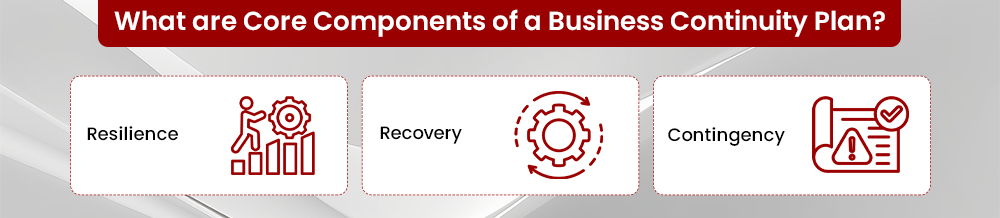
A well-structured business continuity plan includes three foundational elements: resilience, recovery, and contingency.
1. Resilience
Resilience focuses on building enterprise and infrastructural strength to withstand disruptions. Enterprises can increase resilience by:
- Automating risk identification and business impact analysis to detect vulnerabilities early.
- Using Service Mapping to visualize dependencies and eliminate single points of failure.
- Integrating workflows across ITSM, CMDB, and GRC for faster, coordinated responses.
In ServiceNow, resilience is achieved through the Configuration Management Database (CMDB) integration, which maps assets, services, and interdependencies. Continuous Control Monitoring automatically tests preventive measures, helping enterprises maintain essential services even during adverse events.
2. Recovery
Recovery emphasizes rapid restoration of operations after a disruption. This includes setting up RTO (Recovery Time Objectives) and RPO (Recovery Point Objectives) for each critical service. With ServiceNow’s automated recovery workflows, enterprises can:
- Conduct Business Impact Analyses (BIA) to determine recovery priorities.
- Use Continuity and Crisis Workspaces to manage incidents and track recovery progress.
- Leverage dashboards that display recovery timelines, dependencies, and key metrics in real time.
The latest ServiceNow release enhances these capabilities with standardized BIA and BCP reporting, providing clarity and consistency across global teams.
3. Contingency
Contingency planning ensures the enterprise is prepared for unforeseen events through predefined procedures and response playbooks. A robust contingency plan should include:
- Defined command hierarchies and role assignments.
- Vendor and third-party coordination strategies.
- Communication channels for timely stakeholder updates.
In ServiceNow, contingency management is streamlined with automated task assignments, integrated collaboration tools (Microsoft Teams, Slack), and AI-based event triggers that activate relevant continuity workflows as soon as an incident is detected.
How to Integrate BCM with ServiceNow GRC and IRM?
The strength of business continuity management1 lies in its integration with broader governance and risk frameworks. ServiceNow provides a unified GRC ecosystem that connects continuity planning with:
- Policy and Compliance Management: Links BCM procedures to regulatory controls and policies such as ISO 22301 and NIST 800-34.
- Risk Management: Identifies and quantifies continuity risks, aligning them with enterprise risk appetites.
- Vendor Risk Management: Ensures supply chain continuity through third-party risk visibility.
- Operational Resilience: Provides a single view of dependencies across IT, business services, and external entities.
This integration ensures that every continuity plan is traceable, testable, and aligned with compliance requirements. Automated workflows trigger continuity of actions when risk thresholds are breached, ensuring timely mitigation.
How to Develop a ServiceNow Business Continuity Plan?
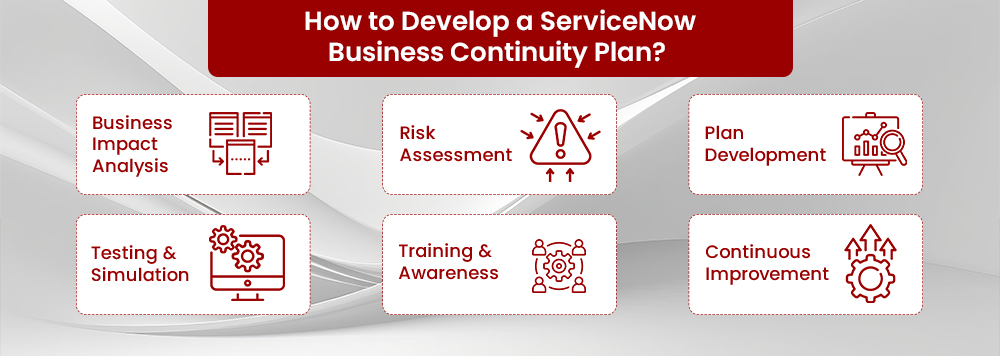
Creating an effective ServiceNow Business Continuity Plan involves structured steps that combine planning with technology automation. ServiceNow connects these steps through an integrated platform that aligns business processes, risk data, and recovery operations for end-to-end continuity management.
- Business Impact Analysis (BIA): Identify time-sensitive business functions and dependencies using the CMDB. ServiceNow’s BIA templates help quantify financial and operational impacts of disruptions.
- Risk Assessment: Map risk continuity across the enterprise risk register. ServiceNow IRM Framework links these risks to existing controls and mitigation plans.
- Plan Development: Use guided plan templates in the Continuity Workspace to create response playbooks, assign roles, and define recovery processes.
- Testing and Simulation: Conduct periodic scenario-based tests to validate the effectiveness of continuity plans. The Zurich release enables automated test scheduling and post-test analytics to identify areas for improvement.
- Training and Awareness: Assign BCM training modules and conduct employee simulations through ServiceNow Learning capabilities.
- Continuous Improvement: Review past incidents and test results. ServiceNow GenAI suggestions recommend playbook and risk control updates based on emerging trends.
What are the Benefits of Implementing ServiceNow BCM?
Implementing ServiceNow BCM creates tangible value by combining automation, governance, and resilience within a single connected platform. It transforms continuity planning from a compliance requirement into a strategic advantage that strengthens business trust and operational agility.
- Continuous Resilience: Real-time dashboards offer visibility into service availability, recovery progress, and control performance.
- Regulatory Compliance: Automated documentation and audit trails ensure alignment with ISO 22301 and other industry standards.
- Faster Recovery: AI-powered analytics recommend recovery priorities and resource allocations for efficient restoration.
- Improved Collaboration: Integrated communication tools keep cross-functional teams aligned during crises.
- Enhanced Trust: Transparent governance builds confidence among employees, partners, and regulators.
- Data-Driven Decisions: Unified reports and insights help leadership make informed continuity decisions with minimal delay.
What are the Challenges and Best Practices for ServiceNow BCM?
While ServiceNow BCM adoption delivers measurable resilience, several challenges often emerge during implementation and maturity phases. These challenges typically stem from fragmented ownership, limited automation, and inconsistent governance, all of which can undermine the effectiveness of continuity efforts.
Common Challenges:
- Lack of unified governance or ownership.
- Outdated or untested continuity plans.
- Manual tracking of incidents and responses.
- Limited visibility into third-party dependencies.
Best Practices:
- Automate testing, reporting, and control monitoring.
- Conduct frequent Business Impact Analyses.
- Integrate BCM with ITSM, GRC, and AIOps for faster response.
- Maintain transparent communication with all stakeholders.
- Review and update continuity of plans based on real-time insights and regulatory changes.
Conclusion
Business Continuity Management (BCM) is a critical capability for ensuring uninterrupted operations in the face of disruptions. Modern enterprises can no longer rely on manual recovery plans or isolated response teams. ServiceNow GRC suite provides a unified, automated, and data-driven approach to continuity planning. It enables real-time visibility into service dependencies, automates recovery workflows, and uses GenAI insights to predict and mitigate disruptions before they escalate.
Integrating ServiceNow BCM with ServiceNow GRC and IRM ensures that continuity strategies are aligned with enterprise policies, regulatory frameworks, and operational goals. This integration not only accelerates recovery but also strengthens overall resilience and audit readiness.
inMorphis helps enterprises design and implement robust BCM frameworks within ServiceNow, enabling seamless automation, standardized testing, and data-backed decision-making. Our expertise ensures that business continuity becomes an operational strength rather than a compliance formality.
To establish a resilient enterprise ecosystem and ensure uninterrupted service delivery, connect with us to deploy a comprehensive business continuity management strategy powered by ServiceNow GRC.
