Service disruptions rarely start with a “big failure.” They start small: a dependency nobody documented, a change that has not been assessed end-to-end, a service owner who can’t see what’s truly tied to the customer experience.
That’s why service mapping matters more than ever. When your services span hybrid cloud environments, SaaS integrations, and legacy core systems, the operational risk of unmanaged dependencies is a liability no enterprise can afford.
Service mapping helps you build and maintain a live view of how business services are delivered—what they depend on, what depends on them, and what breaks when something changes. If you’re using ServiceNow ITOM, this capability becomes practical at scale through ServiceNow’s approach to mapping and service visibility.
What is Service Mapping, and What Does a “Service” Mean?
Let’s clean up the terminology, because this is where many programs drift.
A “service” isn’t a server, a queue, or a single app. Today, a service is what the business can’t afford to lose, which is customer onboarding, payment processing, claims intake, employee access, and order fulfillment. Each of those services is delivered through a chain of components: applications, middleware, databases, computers, network paths, integrations, and third-party dependencies.
Service Mapping focuses on making relationships visible, so teams stop operating in silos. It’s how you move from “we manage tools” to “we manage services.”
Why Do Service Mapping Initiatives Fail Despite Automated Discovery
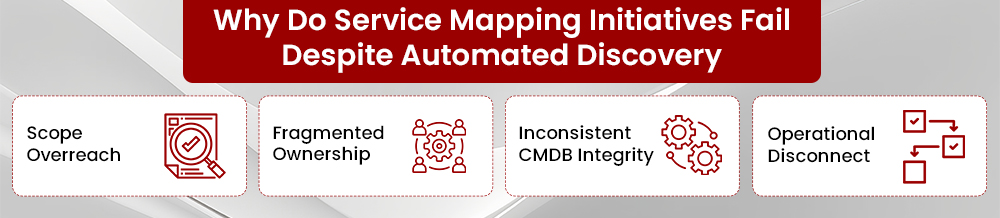
Turning on discovery doesn’t automatically create trusted service maps. Without a rigorous governance framework and service-centric alignment, discovery data remains a collection of disconnected configuration items (CIs) rather than a reliable operational map. The typical failure trajectory for most enterprises follows a predictable pattern:
- Scope Overreach: Organizations attempt to map the entire IT estate simultaneously. The result is data saturation—maps become cluttered, unmanageable, and ultimately ignored by the teams who need them most.
- Fragmented Ownership: Without clearly defined Service owners accountable for accuracy and lifecycle management, service maps degrade into static artifacts. No ownership means no accountability, and no accountability means stale data.
- Inconsistent CMDB Integrity: When the underlying Configuration Management Database lacks relational discipline, service impact analysis becomes speculative rather than definitive. A weak foundation cannot support a reliable service architecture.
- Operational Disconnect: If Incident, Change, and Problem Management teams don't integrate service maps into their daily workflows, the initiative becomes non-impactful.
Service Mapping is an operational discipline that requires continuous governance, stakeholder engagement, and alignment to real-world IT workflows. inMorphis's approach to Service Mapping integrates technical discovery with operational governance - designed to be leveraged during critical change windows, major incident bridges, and executive-level service health reporting.
How Does Service Mapping Accelerate Incident Response?
When a critical system falters, the primary barrier to restoration is the time wasted identifying the root cause.
With Service Mapping, you move from reactive troubleshooting to contextualized response. It allows your operations teams to answer the high-stakes questions that prevent an incident from escalating into a headline:
- Which service is impacted, business-wise?
- What is the blast radius across dependent apps and infrastructure?
- Who should be engaged first, based on upstream/downstream dependencies?
By eliminating the "triage loop," service maps significantly shorten the "Time to Certainty." The result is faster routing, surgical handoffs, and the elimination of parallel teams chasing the same symptoms.
How Does Service Mapping Mitigate Change Risk and Drive Success?
In a modern enterprise, risk is rarely the result of negligence; it is the byproduct of architectural complexity. As environments become more interconnected, the "blind spots" between systems grow.
Service Mapping transforms Change Management from a reactive approval process into a proactive risk-mitigation strategy. It enables Change Advisory Boards (CAB) to move beyond the CIs and evaluate the business service’s impact. Instead of approving a change in isolation, teams can definitively assess:
- Which business services may be affected?
- Which downstream systems rely on the component?
- What does operational health look like after implementation?
Today, where CI/CD pipelines and high-velocity releases are the standard, the margin for error has vanished. Service mapping provides a service-first checkpoint—ensuring you aren't declaring a "successful" technical deployment while your customers are experiencing a service-level failure.
To know how service mapping supports business optimization, explore Mastering Service Mapping.
How Does Service Mapping Drive Secure, Service-Aware Automation?
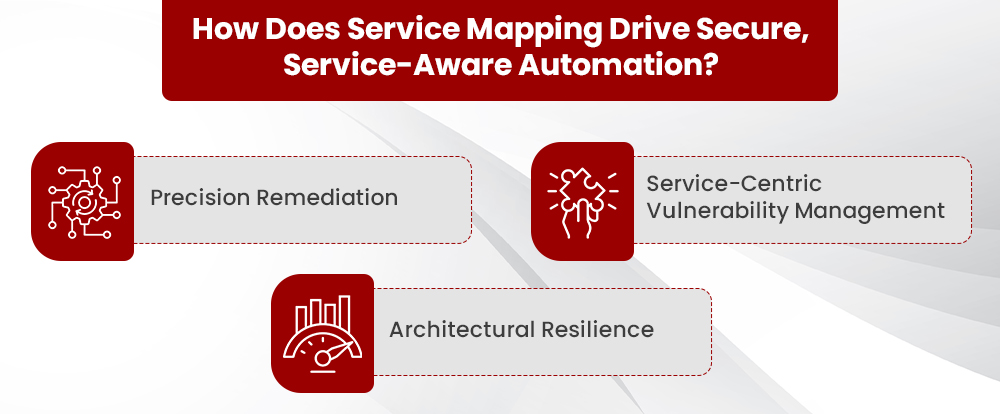
In a complex digital ecosystem, safe automation requires an intimate understanding of service dependencies. Without Service Mapping, automation is blind—risking unintended disruptions to critical business value chains.
By anchoring your automation and security strategies in service context, you move from reactive firefighting to proactive resilience:
- Precision Remediation: Focus automated workflows on the specific components that reside on the critical service path, eliminating technical noise and prioritizing what truly impacts the business.
- Service-Centric Vulnerability Management: Security teams no longer just manage asset lists. They manage Service Risk. Mapping allows you to identify which critical services rely on an exposed component, enabling smarter, risk-based patching.
- Architectural Resilience: Identify single points of failure across your service delivery paths before they become outages. This shift from asset-centric reporting to service-centric visibility simplifies compliance and fortifies your disaster recovery posture.
Why Partner with inMorphis for Your Service Mapping Strategy?
Plenty of teams can produce a service map. However, an important question is whether that map becomes a trusted part of operations. This is where inMorphis provides a distinct advantage. As a ServiceNow Elite Partner, with a deep focus on ITOM and Enterprise Service Management, we architect for service-aware ecosystems. Our approach ensures that your Service Mapping initiative is:
- Outcome-Driven: We align technical discovery with your most critical business value chains, ensuring immediate impact on MTTR and change success rates.
- Governed for Longevity: We implement the rigorous data discipline and ownership frameworks required to keep your service maps accurate as your infrastructure evolves.
- Integrated for Excellence: We ensure your maps aren't static diagrams, but active intelligence engines used daily by your Incident, Change, and Security teams.
With the strategic backing of ServiceNow Ecosystem Ventures, inMorphis is uniquely positioned to help you turn infrastructure data into a strategic asset.1 We don't just deliver visibility; we deliver the trusted intelligence that drives decision-making across the enterprise.
Elevating Operational Maturity through Service-Aware Intelligence
Business excellence today is not defined by how much infrastructure you manage, but by how clearly you understand its connection to the customer experience. ServiceNow Mapping is the definitive bridge between raw technical data and strategic operational control.
If your teams are still troubleshooting in silos, you are carrying unnecessary operational risk. Transitioning from component-centric to service-aware operations is the critical step toward a resilient, automated, and high-performing IT organization.
Partner with inMorphis to architect a Service Mapping strategy that delivers trusted intelligence, not just diagrams. Let’s move beyond discovery and start driving Business Excellence through architectural integrity.
Reference:
