
Many organizations still operate in hybrid and multi-cloud environments with only a partial understanding of their digital landscape. Most of the core business transactions function on the back of hundreds or even thousands of configuration items, applications, databases, or network infrastructure.
This visibility gap becomes a critical barrier when organizations attempt to integrate new platforms, scale operations, or adopt GenAI‑driven automation. Within the ServiceNow ecosystem, Service Mapping, when properly implemented, closes this gap by transforming fragmented technical data into an accurate, dynamic view of how services truly run in production.
Service Mapping is no longer a “nice-to-have” capability. It is the structural foundation for reliable integration, sustainable scalability, and resilient service delivery on the Now Platform.
Why is Service Mapping the Foundation of ServiceNow Integration?

ServiceNow delivers its highest value when multiple modules operate on a single, trusted system of record. Service Mapping is fundamental to achieving that state.
1. Unifying Data for Integration
Service Mapping leverages Discovery data and correlates it into service models and their dependencies. Instead of having isolated CI records and incomplete infrastructure inventories, enterprises gain a contextual, service-centric view.
This integrated model ensures that all functions of Incident, Problem, Change, ITOM, and ITAM share the same reliable representation of the environment.
2. Enabling Cross‑Module Consistency
Without Service Mapping, integrations often depend on static lists, manual documentation, or outdated diagrams. These quickly become misaligned with reality. By contrast, Service Mapping keeps the relationship between business services and underlying CIs current, which:
- Reduces misrouting of incidents and requests.
- Improves the accuracy of impact analysis during changes.
- Ensures that CMDB data used by integrations remains consistent and trustworthy.
3. Supporting Near Real‑time, Event‑driven Operations
As infrastructure evolves, Service Mapping works with ServiceNow Discovery to reflect these changes. This helps prevent integration breakdowns caused by moved workloads, decommissioned servers, and components that existed and were never documented.
The result is a more stable, predictable integration landscape, even in highly dynamic environments.
How does Service Mapping Enable Enterprise‑Wide Scalability?
As enterprises grow, they confront not only a volume problem (more CIs, more services) but also a complexity problem (more interdependencies and shared components). Service Mapping directly addresses both.
1. Scaling with Automated CI Discovery and Correlation
Service Mapping automates Discovery to identify CIs automatically across data centers, cloud platforms, and networks, then correlates them into end‑to‑end service topologies. This automation is essential when the environment spans:
- Thousands of servers and virtual machines.
- Multiple public cloud regions and services.
- Distributed applications with microservice architectures.
2. Elevating from Technical Components to Business Services
Scalability is the ability to maintain service quality while the technology stack grows. Service Mapping links lower‑level CIs to the business services they support, enabling IT to understand:
- Which services are critical to customers or revenue?
- Which underlying components constitute those services?
- How does a change or outage in one element affect business outcomes?
3. Managing Hybrid and Multi‑Cloud Environments
For organizations operating across on‑premises, private, and public cloud platforms, Service Mapping provides a unified view of dependencies. This allows an organization to scale its services across regions or cloud providers while still maintaining control and governance.
New services introduced or migrated are also included in the existing maps, preserving continuity instead of fragmenting the ecosystem.
Can Service Mapping Drastically Reduce MTTR in Incident Management?
Incident and problem management depend on one fundamental capability: the ability to quickly understand what is failing and what it is impacting. Service Mapping plays a decisive role in reducing Mean Time to Resolution (MTTR).
1. Accelerating Root Cause Identification
When a critical service is degraded, Service Mapping allows IT teams to trace the affected user-facing service down through application tiers, databases, and network paths to identify the likely failure point.
Instead of manually checking multiple systems or relying on tribal knowledge, teams can see a visual, accurate representation of dependencies and focus their investigation on potential causes.
2. Enabling Proactive Impact and Blast‑radius Analysis
Service Mapping not only supports reactive handling. By clearly modelling dependencies, it empowers operations teams to assess the potential impact of emerging issues or degraded components before they become major incidents.
Combined with monitoring and Event Management, Service Mapping helps answer questions such as:
-
- Which business services will be affected if this database becomes unavailable?
-
- Which customers or business units depend on this integration point?
3. Preparing the Environment for AIOps and GenAI
Advanced analytics, AIOps, and GenAI capabilities depend on accurate, contextual data. Service Mapping provides the structural context required for intelligent correlation, automated recommendations, and predictive insights.
When incident data, event streams, and telemetry are contextualized through service maps, GenAI‑driven operations can propose more precise remedial actions and reduce human effort in both detection and resolution.
Is Service Mapping Essential for ITIL Alignment and Change Governance?
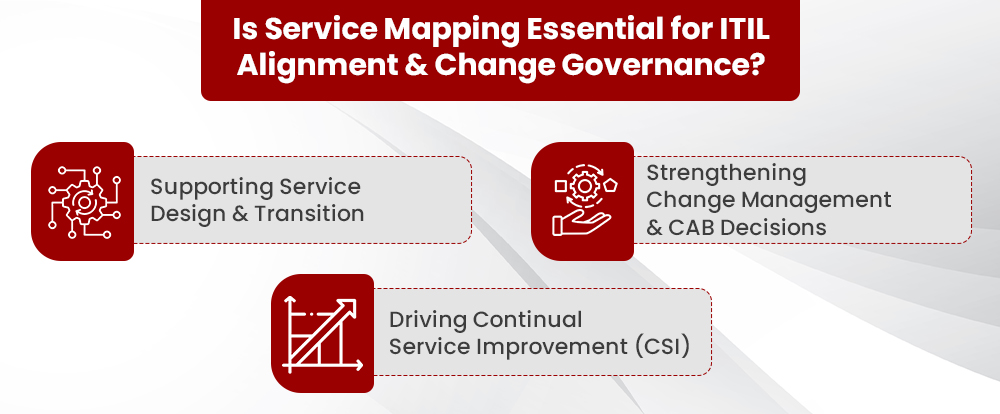
For organizations adopting or maturing ITIL‑aligned practices, Service Mapping acts as a critical enabler across multiple lifecycle stages.
1. Supporting Service Design and Transition
ITIL emphasizes designing services with a clear understanding of their components and dependencies. Service Mapping provides this blueprint, ensuring that new services introduced into production are fully represented in the CMDB.
This reduces the risk of undocumented dependencies and helps avoid surprises during go‑live and subsequent scaling.
2. Strengthening Change Management and CAB Decisions
When planning changes such as patching, upgrades, migrations, or decommissioning, Service Mapping enables precise impact analysis for the Change Advisory Board (CAB). As the cross-functional group responsible for reviewing and prioritizing changes to minimize business risk, the CAB depends on accurate data to make informed approvals. Service Mapping provides this by allowing members to see exactly which services will be affected, and which stakeholders must be informed before a change is executed.
This level of visibility:
- Lowers the likelihood of unintended outages.
- Improves confidence in approving changes.
- Encourages more responsible, data‑driven risk assessment.
Driving Continual Service Improvement (CSI)
Over time, Service Mapping builds a rich dataset of how services are structured and how they behave under different conditions. This supports continual service improvement initiatives by highlighting:
- Repeated points of failure.
- Over‑complex or fragile service designs.
- Opportunities to simplify or standardize architectures.
By embedding Service Mapping within ITIL processes, organizations can better align IT operations with business expectations and regulatory requirements.
What is the inMorphis Advantage in Service Mapping for ServiceNow?
Service Mapping delivers business outcomes only when it is implemented with clear governance, service prioritization, and CMDB discipline. As an ServiceNow Elite Partner, inMorphis approaches Service Mapping as a strategic enabler across ITOM, Enterprise Service Management, and transformation programs.
inMorphis helps enterprises:
- Prioritize what to map first by focusing on critical business services, accelerating time-to-value while reducing mapping sprawl.
- Improve operational outcomes by building accurate dependency models that strengthen incident triage, root-cause analysis, and change impact decisions.
- Build future operations by designing service maps that support observability, automation, and GenAI/AIOps-ready workflows.
This ensures Service Mapping becomes a scalable capability embedded into operating models, not a static artifact owned by a single team.
Is Service Mapping Now a Strategic Mandate for ServiceNow Customers?
For organizations maximizing their ServiceNow investment, Service Mapping is no longer optional; it is a strategic mandate. It provides the essential visibility required for:
- Scalable Integrations: Ensuring unified data flow across the Now Platform.
- Operational Precision: Accelerating MTTR through automated root-cause identification.
- Future-Readiness: Providing the structural context necessary for GenAI and AIOps.
inMorphis transforms fragmented infrastructure data into a service-centric roadmap aligned with your business goals. We help you move from reactive troubleshooting to proactive, intelligent service delivery.
Consult with an inMorphis Strategist to schedule a Service Mapping Maturity Assessment and secure the foundation of your digital transformation.
