
In the modern enterprise, visibility is far from only being a technical metric—it is the foundation of operational resilience. As organizations accelerate their digital transformation, the underlying infrastructure has become a complex web of hybrid clouds, microservices, and distributed applications. Managing this "engine room" manually is no longer an option.
When a critical service fails, the question isn't just "which server is down?" but "which business process is dying?
With Service Mapping you can move from a technical exercise to a strategic business imperative. At inMorphis, we have seen that the most successful organizations are those that move beyond a static inventory to a dynamic, service-aware view of their entire ecosystem.
What is the "Context Gap" Between a CMDB and Service Mapping?
A common misconception we encounter is that a robust Configuration Management Database (CMDB) is enough. While a CMDB is essential, it functions primarily as a "parts list"—an inventory of your hardware, software, and cloud assets.
ServiceNow itself emphasizes that a CMDB becomes truly valuable when it is service-aware, meaning configuration data is mapped to real business services and processes rather than existing as isolated records.¹
ServiceNow Service Mapping provides the "wiring diagram." It connects those individual parts to the specific business outcomes they deliver, such as processing a payment or onboarding an employee. By closing this "context gap," the platform turns raw configuration data into actionable intelligence, allowing IT teams to see exactly how a single component failure ripples through the entire business.
For deeper evaluation, you can read our blog on Whether ServiceNow CMDB and Service Mapping are Right for Your Business.
What Are the Three Dimensions of Service Mapping?
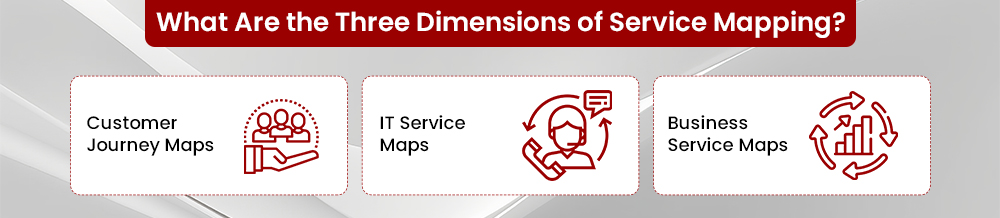
The mapping process isn't a single-layer exercise. To drive real business outcomes, organizations need to approach it across three distinct dimensions each serving a different stakeholder, yet all feeding into the same goal: operational clarity.
1. Customer Journey Maps
Success starts with the user. Customer Journey Maps visualize the end-to-end experience, identifying every touchpoint where a user interacts with your services. In the context of ServiceNow, this dimension helps teams:
- Identifies every interaction point between the user and the service.
- Highlights technical dependencies that affect customer experience.
- Enables teams to prioritize fixes based on customer impact, not just ticket volume.
- Supports faster resolution by connecting front-end symptoms to back-end root causes.
2. IT Service Maps
This is the core of ServiceNow Service Mapping. IT Service Maps provide a real-time, auto-discovered view of the infrastructure and applications that power a service.
- Automatically discovers and maps relationships between CIs in the CMDB.
- Provides a live topology of how applications, servers, and network components connect.
- Reduces manual documentation effort through continuous, automated discovery.
- Enables faster incident triage by showing exactly which components are affected.
3. Business Service Maps
Business Service Maps elevate the conversation from infrastructure to outcomes. They connect technical assets to the business services they support giving leadership a clear view of operational risk in business terms.
- Maps IT components directly to revenue-generating or mission-critical business services.
- Helps leadership understand the business impact of a technical failure before it escalates.
- Supports change risk assessment by showing downstream dependencies.
- Aligns IT operations with strategic business priorities.
How Does Service Mapping Strengthen Business Success?
By connecting people, processes, and technology into a single visual framework, service aware visibility delivers measurable outcomes across the organization. Here are the five core pillars:
1. Enhanced Service Visibility
This capability gives organizations a comprehensive, real-time view of their entire service landscape. Rather than reacting to alerts in isolation, teams can see how services relate to each other and where vulnerabilities exist.
- Provides end-to-end visibility across hybrid and multi-cloud environments.
- Reduces blind spots in the CMDB by continuously validating CI relationships.
- Enables proactive identification of single points of failure before they cause disruptions.
2. Faster Incident Resolution
When an incident occurs, time is the most expensive variable. Dependency visualization shortens the path from alert to resolution by showing exactly which services are affected and how.
- Reduces Mean Time to Resolve (MTTR) by eliminating guesswork during triage.
- Automatically surfaces impacted business services when a CI goes down.
- Helps teams prioritize response based on business criticality, not just technical severity.
3. Smarter Change Management
Every change carries risk. Mapping makes that risk visible before a change is approved, not after it causes an outage.
- Enables comprehensive change impact analysis across dependent services.
- Reduces change-related incidents by surfacing hidden dependencies.
- Supports CAB decisions with accurate, real-time service relationship data.
4. Improved Cross-Team Collaboration
Service maps create a shared language between IT operations, development, and business stakeholders. When everyone is looking at the same map, accountability becomes clearer and escalations become fewer.
- Aligns IT and business teams around a common view of service ownership.
- Reduces war-room time by eliminating the "whose problem is it?" debate.
- Promotes transparency in service delivery and dependency management.
5. Stronger Customer Experience
Ultimately, the benefits of this visibility flow downstream to the customer. Reliable services, faster resolutions, and fewer disruptions translate directly into higher satisfaction and lower churn.
- Minimizes service disruptions that impact customer-facing applications.
- Enables proactive communication during incidents based on known service impact.
- Supports SLA adherence by maintaining a clear view of service health at all times.
To know more, read our blog on Discovering the Power of Service Mapping in Business Excellence.
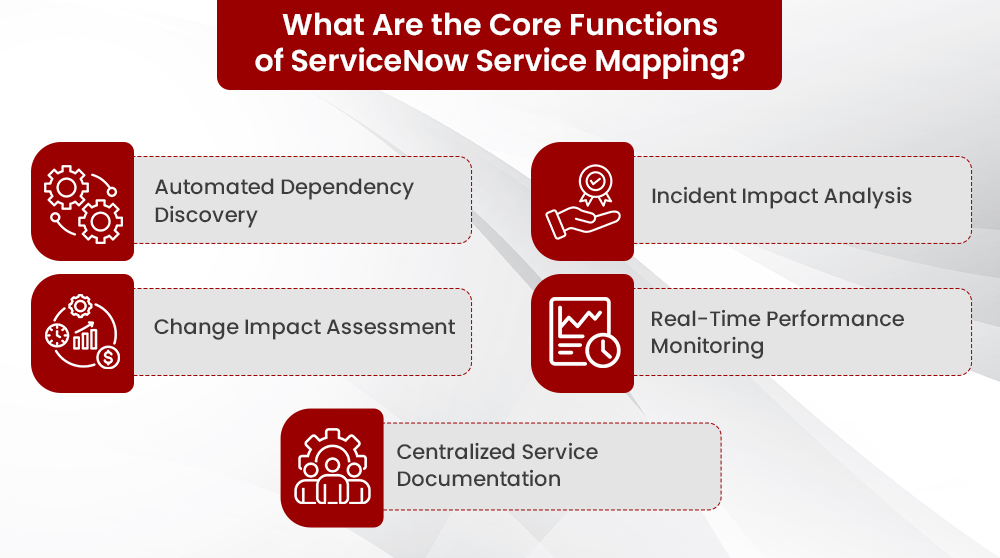
The solution goes beyond static diagrams. It is a dynamic, continuously updated operational tool that supports several critical IT functions:
1. Automated Dependency Discovery
The platform automatically discovers and maps relationships between configuration items eliminating the need for manual documentation and ensuring the map stays accurate as the environment evolves.
2. Incident Impact Analysis
When a service disruption occurs, the platform instantly surfaces all affected downstream services and business processes, enabling teams to assess impact and prioritize response in real time.
3. Change Impact Assessment
Before any change is implemented, the tool provides a clear picture of what else could be affected — reducing the risk of unintended outages and supporting more informed change approvals.
4. Real-Time Performance Monitoring
Service health is monitored continuously, with alerts triggered when performance thresholds are breached. This enables teams to act before issues escalate into full-scale incidents.
5. Centralized Service Documentation
ServiceNow Service Mapping maintains an always-current record of services, their dependencies, ownership, and health status — serving as a single source of truth for IT operations and governance teams.
How Does inMorphis Help You Get Service Mapping Right?
Getting the solution deployed is one thing. Getting it to reflect your real environment and keep reflecting it as things change is where most organizations struggle.
Master Service Mapping as a Key to Business Optimization to unlock deeper cost, performance, and process improvements.
At inMorphis, as a ServiceNow elite partner, we bring focused expertise in designing, implementing, and optimizing ServiceNow Service Mapping for enterprises across industries. From aligning your CMDB foundation to configuring service-aware discovery patterns, we ensure your service maps are accurate, actionable, and built to scale.
Whether you are starting from scratch or looking to improve an existing implementation, inMorphis works with you to turn this capability from a documentation exercise into a live operational asset.
Connect with inMorphis today to explore how ServiceNow Service Mapping can strengthen your IT operations and drive measurable business outcomes.
Reference:
