In today’s digital landscape, the complexity of IT environments has reached an all-time high. With the explosion of microservices, serverless architectures, and hybrid cloud ecosystems, the traditional methods of managing IT infrastructure are no longer sufficient.
In this blog post, we will show you how to leverage Artificial Intelligence (AI) and automation in Service Mapping to transform your IT operations, deliver real-time visibility, enable faster incident resolution, improve compliance, and achieve cost efficiencies.
The Critical Role of Service Mapping
Service mapping is the process of creating a comprehensive view of all the components that make up a business service and their interdependencies. It provides IT teams with the visibility they need to understand how different assets, such as servers, applications, databases, and network devices, work together to deliver a service.
However, as IT environments become more dynamic, manual service mapping has become an impossible task. This is where AI and automation come into play. By leveraging these technologies, businesses can automate the discovery and mapping of their IT assets and ensure that their service maps are always accurate and up to date.
Check out our blog on ServiceNow CMDB & Service Mapping: Is It the Right Fit for Your Business?.
Why Static Mapping is a Business Risk in the Era of Autonomous IT
We’ve moved past the era where a "monthly update" to your CMDB was acceptable. In today’s hyper-connected world, having a static map is a liability. If your service map isn’t showing the change that occurred five minutes ago in a Kubernetes cluster, your incident response team might as well be blindfolded.
As of early 2026, Gartner’s projections have materialized: over 50% of enterprise service desks have now deployed AI-powered autonomous agents. The impact is no longer theoretical.Organizations are currently seeing a 40% reduction in mean time to resolution (MTTR) and a 30% surge in SLA adherence by moving away from manual mapping toward AI-validated visibility.1
The Role of AI in Service Mapping
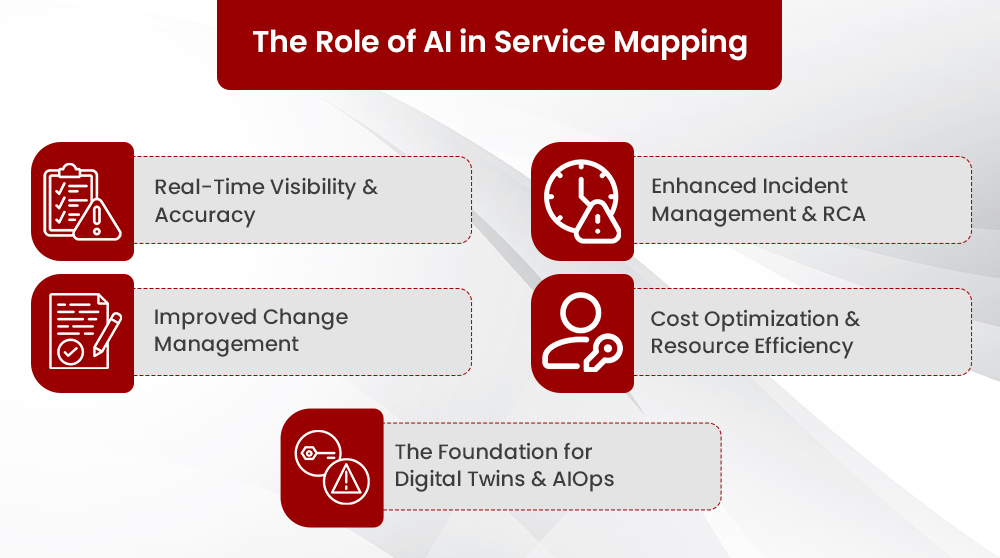
Traditionally, service mapping was labor-intensive, relying on manual data collection and analysis. However, with the rise of Artificial Intelligence (AI), things are changing rapidly. AI is crucial for in-service mapping, acting like a robust magnifying glass that helps you see your business landscape with greater clarity and detail.
1. Real-Time Visibility and Accuracy
One of the primary benefits of using AI and automation in service mapping is real-time visibility. Automated tools can continuously scan the IT environment, identifying new assets and changes in dependencies as they happen. This ensures that IT teams always have an accurate view of the service landscape, reducing the risk of errors and improving decision-making.
2. Enhanced Incident Management and RCA
When a service outage occurs, the mean time to resolve is crucial. AI-powered service mapping can significantly speed up the incident management process by providing IT teams with instant insights into the root cause of the problem. By understanding dependencies among components, teams can quickly identify which asset is causing the issue and take corrective action.
In 2026, we are seeing the rise of Agentic AI— AI-assisted recommendations combined with automated workflows can accelerate diagnosis and remediation.2 Continuously updated service maps provide near real-time visibility when Discovery is properly configured.
3. Improved Change Management
Change is a constant in IT, but it also carries risk. Automated service mapping helps mitigate this risk by providing a clear understanding of the potential impact of a change. Before implementing a change, IT teams can use the service map to identify all affected components, allowing them to plan and execute the change with greater confidence.
4. Cost Optimization and Resource Efficiency
Manual service mapping is a labor-intensive process that consumes valuable IT resources. By automating this task, businesses can free up their IT teams to focus on more strategic initiatives. Additionally, accurate service maps can help identify redundant or underutilized assets, enabling businesses to optimize their IT spending and improve resource efficiency.
Read our blog on Mastering Service Mapping: A Key to Business Optimization.
5. The Foundation for Digital Twins and AIOps
As we look toward the future of IT operations, the concept of Digital Twin is becoming a reality. A digital twin is a virtual representation of your entire IT ecosystem. High-fidelity service mapping is the "data fabric" that makes this possible. By integrating service mapping with Predictive AIOps, businesses can move from reactive firefighting to proactive incident management by assessing the potential impact radius of an incident using real-time service dependency mapping.
Why is the inMorphis Approach to Service Mapping Different?
At inMorphis, we recognize that service mapping is more than just implementing a solution. It is a process of transformation design. As a ServiceNow elite partner, we harness the full potential of the Now Platform, including Now Assist and Gen AI Solutions, to enable our customers to create a service-focused CMDB that serves as a source of truth.
Our latest strategic growth investment by ServiceNow Ecosystem Ventures and Capital Square Partners has also enhanced our capacity to deliver innovative solutions in IT Operations Management (ITOM) and Enterprise Service Management (ESM). We do not merely map your services; we assist you in integrating your IT infrastructure with your business strategy.
Also, read our detailed blog on What Role Does Service Mapping Play in ServiceNow Integration and Scalability.
How Does Service Mapping Support GRC and Regulatory Compliance?
One of the most important strategic changes that needs to be made is the connection between service mapping and Governance, Risk, and Compliance (GRC). With new regulations around digital operational resilience, having an automated, audit-ready map of your service delivery chain is no longer a "nice-to-have." It is a regulatory requirement.
Service mapping strengthens audit readiness by providing visibility into service dependencies and infrastructure relationships that can support risk assessments. By connecting service mapping to your GRC strategy, you turn a technical exercise into a strategic defense for your business.
What are the Best Practices for Implementing AI-Driven Service Mapping?

To successfully leverage AI and automation in service mapping, businesses should follow these best practices:
- Start with a Clear Strategy: Define your objectives and identify the key services that will benefit most from automated mapping.
- Ensure Data Quality: The accuracy of your service maps depends on the quality of your data. Invest in data cleansing and normalization to ensure a solid foundation.
- Choose the Right Tools: Select a service mapping tool that is scalable, flexible, and integrates seamlessly with your existing IT management ecosystem.
- Foster a Culture of Automation: Encourage your IT teams to embrace automation and provide them with the training and support they need to succeed.
Future-Proofing Your Digital Journey
The future of IT is autonomous, and service mapping is the roadmap that will get you there. By leveraging AI and automation, businesses can achieve the visibility, agility, and resilience they need to thrive in an increasingly complex digital world.
At inMorphis, we are committed to helping our clients navigate this journey. Our expertise in ServiceNow and our focus on innovation make us the ideal partner for businesses looking to future-proof their operations.
Contact inMorphis today and let’s build a resilient, AI-driven future together.
