Enterprises today are dealing with an increasingly complex digital ecosystem, an often-siloed team, and rising employee expectations. To meet these demands, they turn to platforms that can seamlessly blend productivity, automation, and artificial intelligence into their existing workflows. ServiceNow’s Generative AI capabilities, when combined with Microsoft Teams and Copilot, create a powerful synergy that elevates the enterprise’s workflow.
This integration delivers a seamless experience where the two industry-leading Gen-AI platforms work in unison, enabling organisations to achieve an unprecedented level of automation, efficiency, and employee satisfaction.
In this blog, we will explore how ServiceNow GenAI integrates with Microsoft 365 and how Teams and Copilot workflows help organizations in driving productivity, collaboration, and efficiency across IT, HR, procurement, and beyond.
What is ServiceNow GenAI?
ServiceNow GenAI is a comprehensive tool built natively into the Now Platform, designed to enhance enterprise workflows across IT, HR, customer service, and beyond. It brings natural language understanding, generative responses, and intelligent recommendations directly into the workflows.
At its core, ServiceNow GenAI consists of two primary components:
-
a) Now Assist: This serves as a collection of LLM-enabled features that increase productivity across multiple user personas, including admins, developers, and service agents. It provides capabilities like generating case summaries, text-to-code assistance for developers, and context-aware recommendations for incident tickets and their approvals.
-
b.) Generative AI Controller: This allows organizations to integrate with large language models like OpenAI and Azure OpenAI, which enables custom GenAI functionalities tailored to specific business needs. This controller enables organizations to build solutions that leverage capabilities like code generation, sentiment analysis, and content summarization.
ServiceNow GenAI goes beyond the rule-based actions. It differs from generic AI solutions by utilizing the Now LLM (a domain-specific large language model trained on enterprise workflow data). This ensures more context-accurate and cost-effective results compared to generic LLMs.
Why Microsoft Teams and Copilot are Critical for Enterprises?
Microsoft Teams has evolved from a simple messaging app into the central nervous system for communication and collaboration in enterprises, with over 30 million monthly active users as of June 20251. It integrates chat, video meetings, file sharing, and third-party apps, serving as the digital workplace where employees spend 70% of their day. In hybrid work models, Microsoft Teams bridges remote and in-office teams, providing real-time communication and reducing email overload.
Microsoft Copilot amplifies these benefits by integrating AI capabilities directly into the Microsoft 365 applications that the organisation uses daily. Forrester Studies shows that Copilot can deliver ROI ranging from112% to 457% with organizations experiencing a 20% reduction in operational cost and 6% increase in the net revenue2. The real-world implementation shows a significant time savings with employees saving an average of 30 hours per month.
Core Capabilities of ServiceNow GenAI in Microsoft 365
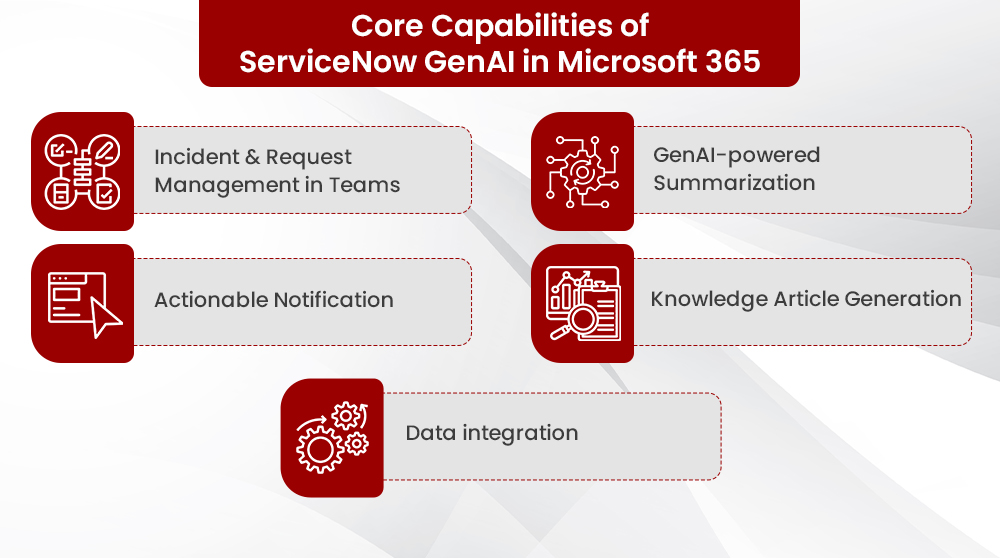
ServiceNow GenAI integrates with Microsoft Teams and Copilot, providing a robust ecosystem of AI-driven capabilities that transform how employees interact with enterprise systems. The following are the key core capabilities:
- Incident and Request Management in Teams: Employees can create, track, and update tickets without leaving Teams. ServiceNow GenAI auto-classifies issues, recommends resolutions, and helps close tickets faster.
- GenAI-powered Summarization: Employees can use GenAI to condense lengthy incident logs or Teams meeting notes into actionable summaries for faster decision making.
- Actionable Notification: Approvals and tasks are no longer buried in email inboxes. A manager can receive an actionable notification card in Teams to approve requests. They can review the details and approve or reject them with a single click.
- Knowledge Article Generation: The Copilot, powered by ServiceNow data, can generate draft responses or a knowledge base from historical resolution.
- Data integration: ServiceNow brings enterprise context, such as IT asset details, HR policies, or procurement details, into Microsoft 365, providing Copilot with richer data to work with.
These capabilities ensure that employees don’t have to switch between applications. This helps the organisation in saving time and reducing friction.
Unified Productivity: ServiceNow GenAI + Microsoft Copilot
This collaboration enables the creation of a unified and intelligent experience. Microsoft Copilot acts as a conversational interface, while ServiceNow GenAI serves as a powerful action engine that executes the underlying business process. This integration creates a unified productivity loop:
- In Microsoft Teams: An employee mentions a recurring software crash. Copilot leverages ServiceNow GenAI capabilities to suggest creating an incident report. It pre-populates the form with details from the conversation. The employee can approve it with one click
- In Microsoft Outlook: A manager needs to onboard a new hire. They CC the ServiceNow HR portal on an email. ServiceNow GenAI interprets this email, creates the onboarding ticket, and triggers the workflow. The manager receives all status updates within their inbox.
- In ServiceNow: For an IT agent resolving a case, ServiceNow GenAI summarizes the case history and suggests a resolution. The agent approves and the resolution is automatically posted back to the original Teams channel where the issue was first reported, thus closing the loop for every persona involved.
The unified productivity model eliminates the silos between communication and enterprise workflow automation.
How Workflow Automation Transforms Teams Collaboration?
ServiceNow GenAI helps in Teams collaboration by providing intelligent automation that goes beyond the traditional rule-based systems. The platform AI capabilities enable the following automation enhancements:
- Predictive Workflow Management: GenAI analyzes historical data to anticipate potential issues and trigger proactive workflows, with Teams serving as the channel to notify IT teams and accelerate response.
- Context-aware Task Assignment: GenAI considers incident history, agent expertise, and contextual data to optimize task assignment, ensuring faster and more accurate resolutions.
- Collaborative Problem Solving: Through integration with Teams, ServiceNow GenAI brings enterprise context into real-time collaboration (chat, calls, screen sharing), allowing agents to resolve issues more efficiently without switching platforms.
Key Benefits of the ServiceNow GenAI, Microsoft Copilot, and Teams Integration for Enterprises
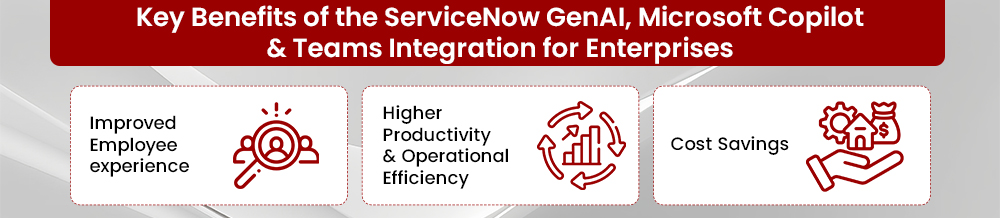
- Improved Employee Experience: This integration simplifies the complexity of traditional ticketing systems by providing a familiar Teams interface, which removes barriers to accessing IT support. This enhanced accessibility leads to improved employee satisfaction
- Higher Productivity and Operational Efficiency: Automation of routine tasks allows the support agents to focus more on complex, value-added tasks rather than mundane tasks
- Cost Savings: Reduced manual work, faster resolution, and automation translate into measurable operational efficiency. According to reports, the ServiceNow digital technology team registered annualized savings of $5.5 million through case and incident avoidance3. Microsoft’s own deployment of Copilot delivered $500 million in annual savings across various operations4.
Real World Use Cases: ServiceNow GenAI Integration with Microsoft
- In the IT environment, the integration transforms incident management and knowledge sharing. ServiceNow GenAI automatically generates incident summaries based on the resolution notes and details of the incident record. This reduces the time agents spend on documentation. ServiceNow AI-powered virtual agents can handle routine IT requests with natural language understanding.
- The HR department can leverage the integration for streamlined employee onboarding, policy management, and service delivery. ServiceNow AI agents can autonomously handle the complete onboarding process- from triggering processes to assigning tasks across IT, HR, and other departments. The system can automatically send welcome emails, order equipment, and follow up on delayed steps.
ServiceNow GenAI helps create templates, automate initial drafts, and maintain consistent documentation. This enables the HR staff to focus on employee engagement and talent development initiatives.
- For procurement, a project manager can leverage the integration to submit a request for a new software license in the procurement team's channel. The workflow will automatically get created in ServiceNow. Once it reaches the approval stage, the finance director will get an adaptive card in their personal Teams chat. Once reviewed, the finance director can click on the “Approve”. The integration automatically updates the request and moves it to the fulfilment stage.
Conclusion
The fusion of ServiceNow GenAI with Microsoft Teams and Copilot represents a paradigm shift in enterprise workflows, where previously disconnected applications are unified by an intelligent workflow engine that meets employees where they are.
The future of organizational productivity lies in intelligent collaboration between specialized AI systems. Organizations should embrace this integrated approach to better position themselves to meet the challenges of modern business while empowering their workforce to achieve more with less effort.
And here, inMorphis, a ServiceNow-invested Elite partner, can help in the integration and adoption of ServiceNow Gen AI with Microsoft Teams and Copilot workflows, establishing step-by-step achievements while keeping an eye on your organization’s future goals.
References:
1. Microsoft Statistics 2025: Revenue, Cloud, AI & Workforce Insights • SQ Magazine
2. New Technology: The Projected Total Economic Impact™ Of Microsoft Copilot For Microsoft 365
3. https://www.servicenow.com/blogs/2024/generative-ai-use-cases
4. Microsoft Copilot: Case studies of enterprise AI deployments and lessons learned
