
In today’s era of IT-OT convergence, operational technology environments have moved beyond isolated, proprietary systems and air-gapped networks. They are now deeply integrated into enterprise digital ecosystems, making them increasingly attractive targets for cyberattacks.
With the rapid rise of AI-driven operations, hyperconnected industrial ecosystems, and Industry 4.0/5.0 initiatives, OT environments are no longer just connected, they are intelligent, autonomous, and continuously evolving. This shift has significantly expanded the attack surface, introducing risks such as AI model manipulation, supply chain compromises, and ransomware targeting critical infrastructure.
IEC 62443 series is the globally recognized standard for industrial cybersecurity, offering a structured framework to secure Industrial Automation and Control Systems (IACS) from emerging threats. In the following comprehensive guide, we have outlined the essentials of IEC 62443, aligned with its official parts, into actionable steps you can integrate into your governance, engineering, and operations practices today.
What is IEC 62443?
The IEC 62443 series, developed by the International Electrotechnical Commission (IEC), is a globally recognized framework for securing Industrial Automation and Control Systems (IACS). Covering every layer of an Industrial Control System (ICS), from operator interfaces to enterprise-level systems, it addresses components such as programmable logic controllers (PLCs), network devices, SCADA software, and human-machine interfaces (HMIs) that operators use to manage critical processes.
Industry-agnostic by design, IEC 62443 applies to any sector that depends on ICS, including manufacturing, energy, water treatment, and transportation. Its adaptable structure accommodates diverse risk profiles and evolving cyber threats, ensuring relevance across varied industrial environments.
More than a technical standard, IEC 62443 takes a holistic approach to operational technology security, blending technical controls with governance, processes, and procedural best practices. It spans the full security lifecycle, from risk assessment and secure system design to incident response and recovery, offering a clear roadmap for building resilient, secure OT ecosystems.
Why IEC 62443 Matters for OT Security?
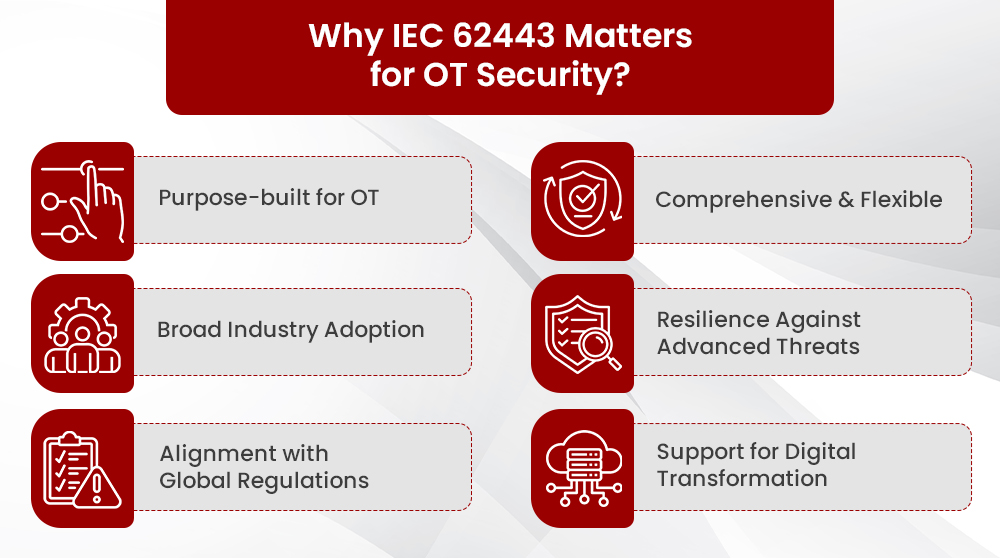
As cyber threats grow more sophisticated and industrial environments become increasingly interconnected, organizations need a structured, risk-driven approach to secure their OT systems. IEC 62443 is essential for OT security due to the following aspects:
-
Purpose-built for OT: Unlike generic IT standards, IEC 62443 addresses the unique challenges of industrial environments, including long equipment lifecycles, safety-critical operations, and minimal downtime requirements.
-
Comprehensive and Flexible: Supports risk-based, adaptable strategies rather than rigid, one-size-fits-all mandates, making it suitable for varied operational levels, threat profiles, and industry contexts.
-
Broad Industry Adoption: Widely implemented across utilities, manufacturing, transportation, and other critical infrastructure sectors, establishing it as a trusted, cross-industry security benchmark.
-
Resilience Against Advanced Threats: Helps defend against ransomware-as-a-service (RaaS) and nation-state attacks targeting critical infrastructure.
-
Alignment with Global Regulations: Acts as a strong foundation for evolving global cybersecurity and critical infrastructure compliance mandates.
-
Support for Digital Transformation: Enables secure adoption of cloud-connected OT, edge computing, and AI-driven monitoring systems.
Together, these capabilities position IEC 62443 as a forward-looking framework that not only addresses today’s security challenges but also prepares organizations for the evolving demands of digital and industrial transformation.
Key IEC 62443 Requirements for OT Security Leaders
To secure modern OT environments, leaders must focus on key IEC 62443 requirements that drive strong governance, system security, and operational resilience. Hence, the key IEC 62443 requirements include:
-
Establish a Cybersecurity Management System (CSMS) (IEC 62443-2-1): Define governance structures, policies, and procedures to ensure sustained OT security across the organization.
-
Define Security Levels (SL1–SL4) (IEC 62443-3-3, IEC 62443-2-4): Align system protection levels with the sophistication and likelihood of potential threats, from basic protection (SL1) to advanced persistent threat resistance (SL4).
-
Implement Zone and Conduit Segmentation (IEC 62443-3-2): Isolate critical systems and control communication flows to prevent the spread of cyberattacks.
-
Adopt a Secure Development Lifecycle (SDLC) (IEC 62443-4-1): Integrate security into every stage of product design, coding, testing, deployment, and maintenance.
-
Fulfil Foundational Security Requirements (FR1-FR7) (IEC 62443-3-3): Enforce access control, data integrity, confidentiality, availability, and overall system resilience.
-
FR1: Identification and Authentication Control
-
FR2: Use Control
-
FR3: System Integrity
-
FR4: Data Confidentiality
-
FR5: Restricted Data Flow
-
FR6: Timely Response to Events
-
FR7: Resource Availability
-
Conduct Regular Risk Assessments (IEC 62443-3-2): Continuously identify, analyse, and address vulnerabilities in OT environments.
-
Maintain Timely Patching and Updates (IEC 62443-2-3): Protect OT assets by applying security updates as soon as vulnerabilities are discovered.
-
Strengthen Vendor and Supply Chain Security (IEC 62443-2-4, IEC 62443-4-1): Require third-party products and services to comply with IEC 62443 guidelines.
-
Enable Continuous Monitoring and Incident Response (IEC 62443-2-1, IEC 62443-3-3): Proactively detect, respond to, and recover from cybersecurity incidents.
Promote Training and Awareness (IEC 62443-2-1): Equip teams with the knowledge and skills necessary to maintain strong OT cybersecurity practices.
Adopt Modern Security Enhancements: Extend IEC 62443 with Zero Trust principles, secure remote access (MFA, session monitoring), and AI-driven threat detection for real-time anomaly identification.
Combined, these requirements turn compliance into a structured, execution-ready OT security strategy.
Who Should Follow IEC 62443 in Operational Technology Environments?
IEC 62443 is relevant to a wide range of stakeholders across the industrial ecosystem. However, the following stakeholders must strictly follow the IEC 62443 in operational technology environments:
-
Asset Owners / Operators: Oversee the deployment, management, and protection of operational technology (OT) infrastructure.
-
System Integrators: Design and implement secure architectures, ensuring that integrated solutions align with IEC 62443 requirements.
-
Product Manufacturers / Vendors: Incorporate secure design principles and robust development practices into industrial products and components.
-
Service Providers & Auditors: Deliver ongoing monitoring, patch management, and compliance validation for control systems.
A collaborative effort across these stakeholders is essential to build a secure, compliant, and resilient OT ecosystem aligned with IEC 62443.
Core IEC 62443 Requirements for Securing Operational Technology Systems

IEC 62443 is organized into four primary categories, each focusing on distinct aspects of Operational Technology (OT) security:
1. General & Policy (Parts 1 & 2)
-
Part 1-1: Defines core terminology, concepts, and security models.
-
Parts 2-1 to 2-5: Establish governance frameworks through a Cybersecurity Management System (CSMS), covering patch management, vendor obligations, and operational best practices.
2. System-Level (Part 3)
-
Part 3-1: Outlines applicable security technologies such as authentication, encryption, and monitoring.
-
Part 3-2: Provides guidance for risk assessment and secure system design, including zone and conduit definitions and Security Level Targets (SL-T).
-
Part 3-3: Defines seven foundational requirements, such as access control and integrity and specifies system security levels (SL-C).
3. Component-Level (Part 4)
-
Part 4-1: Details the secure product development lifecycle (SDLC), from design and coding to patching, validation, and end-of-life considerations.
-
Part 4-2: Specifies technical requirements for individual components, including common security constraints like least privilege and compensating controls.
These layers work together to ensure consistent security from policy to components, closing gaps that often exist across OT environments.
Common Compliance Gaps in Operational Technology Security
Security leaders frequently face recurring challenges when aligning with IEC 62443. These challenges include:
-
Limited Asset Visibility: Untracked or unidentified devices create dangerous blind spots in the OT environment.
-
Vendor Non-compliance: Equipment or software that fails to meet IEC 62443 standards1 can introduce exploitable weaknesses.
-
Poor Network Segmentation: Flat network designs make it easier for attackers to move laterally once inside.
-
Lack of Continuous Monitoring: Relying solely on periodic audits leaves organizations exposed to emerging threats.
-
IT-OT Disconnect: Siloed teams, policies, and governance models prevent a unified, end-to-end security posture.
-
Insecure IoT Expansion: Rapid deployment of IoT devices without proper controls introduces vulnerabilities.
-
Lack of OT-Specific Threat Intelligence: Absence of real-time, contextual threat intelligence weakens response capabilities.
-
Over-reliance on Legacy Security Models: Perimeter-based approaches fail in modern, distributed OT environments.
Step-by-Step Implementation of IEC 62443 in OT Environments
Implementing IEC 62443 requires a structured, step-by-step approach that aligns security with operational priorities and supports broader integrated risk management solutions across OT environments. The following steps help organizations translate the framework into practical actions across their OT environments:
1. Baseline and Risk Assessment (IEC 62443-3-2): Begin by mapping all assets, defining zones and conduits, and performing a thorough risk analysis. Use these insights to determine the target security level (SL-T) for each zone.
2. Establish a Cybersecurity Management System (CSMS) (IEC 62443-2-1): Define governance structures, policies, and procedures aligned with integrated risk management solutions to ensure sustained OT security across the organization.
3. Architect a Defence-in-Depth Strategy (IEC 62443-3-3): Deploy layered security through network segmentation, strict access controls, and continuous monitoring technologies, aligned with foundational requirements and defined security levels.
4. Standardize Secure Product Development (IEC 62443-4-1, IEC 62443-4-2): Require vendors to follow a secure software development lifecycle (SDLC) and meet IEC 62443 component-level requirements. Use audits and certifications like ISA Secure to verify compliance.
5. Train and Align Teams (IEC 62443-4-1, IEC 62443-4-2): Bridge the IT-OT divide by educating both groups on security best practices and fostering shared responsibility across departments.
6. Continuous Monitoring and Improvement (IEC 62443-2-1, IEC 62443-3-3): Implement real-time monitoring tools such as SIEMs, conduct regular audits, validate security zones, and periodically reassess SL-T as threats evolve.
7. Adopt Zero Trust and Identity-Centric Security: Shift from perimeter-based security to identity-driven controls, ensuring continuous authentication and strict access governance across OT systems.
8. Integrate AI-Driven Security Operations: Enhance OT security and monitoring with AI-powered SOC capabilities to enable predictive threat detection, automated response, and faster incident resolution.
By following these structured steps, organizations can move from fragmented security practices to a unified, resilient OT security framework aligned with IEC 62443.
Final Words
IEC 62443 is a globally recognized, comprehensive framework designed to align people, processes, and technology in securing critical industrial operations.
As OT ecosystems become AI-driven, autonomous, and hyperconnected, IEC 62443 is evolving from a compliance framework into a strategic enabler of secure digital transformation. Organizations that combine their principles with Zero Trust and AI-driven security will be better equipped to anticipate threats and scale securely.
By adopting its core requirements, organizations can also strengthen resilience, enhance safety, and build long-term trust. Hence, inMorphis enables real-world adoption of IEC 62443 for resilient OT environments. What’s holding you back, then? Contact us today!
Reference:
