In today’s distributed IT environment, hardware assets are no longer confined to a single office; they're procured globally, shipped directly to employees, reassigned, serviced by third parties, and retired under stringent security and compliance demands. In this complex reality, Hardware Asset Management (HAM) must evolve beyond simple asset lists. It requires comprehensive lifecycle visibility, robust operational control, and auditable governance.
ServiceNow HAM provides a unified platform to manage hardware assets end-to-end. It connects procurement, deployment, service, and retirement through standardized workflows and a trusted system of record. When implemented strategically, ServiceNow HAM significantly reduces avoidable spending, enhances service experience, and minimizes risk across the entire asset lifecycle.
What Hardware Asset Management (HAM) Covers and Why It Breaks Down in Practice
Hardware Asset Management is a core part of IT Asset Management (ITAM). It focuses on governing and tracking the lifecycle of physical assets such as laptops, desktops, mobile devices, peripherals (with consumables typically managed at a stock or quantity level)
Effective HAM supports four outcomes:
- Cost control through accurate inventory, utilization, and refresh planning
- Operational efficiency through automated tracking and standard workflows
- Service quality through faster request fulfillment and fewer disruptions
- Compliance and risk reduction through auditable controls and secure disposal
Yet, in practice, HAM often breaks down for predictable reasons:
1. Fragmented Data and Disconnected Tools
Procurement systems, spreadsheets, discovery tools, and service desk platforms sit in separate silos. This leads to conflicting asset information and low confidence in reports.
2. Manual Processes that Do Not Scale
Spreadsheet-based tracking and email approvals create delays, errors, and inconsistent updates, especially as assets move across locations, cost centers, and roles.
3. Higher Cost and Higher Risk
Limited visibility drives excess purchasing, unused inventory, missed refresh windows, and weak controls around lost assets. Unmanaged or improperly retired devices also increase security exposure and audit issues.
How ServiceNow HAM Transforms Lifecycle Control and Visibility
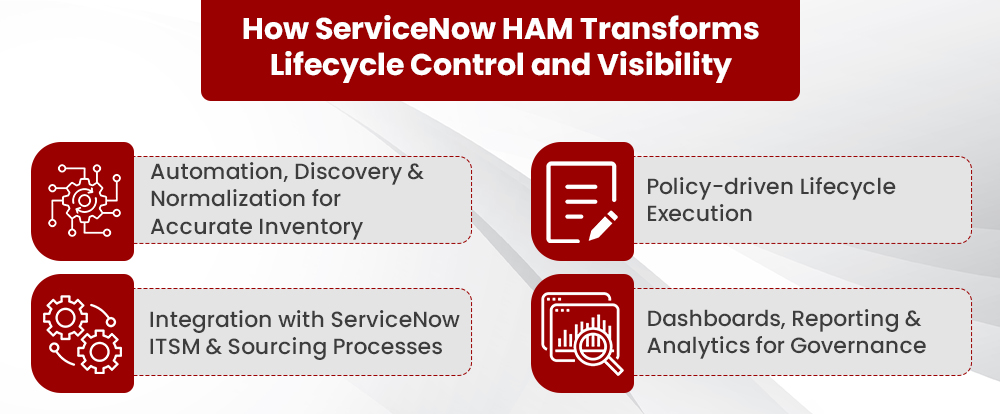
Effective HAM requires a unified platform that seamlessly integrates inventory accuracy, lifecycle governance, and service execution. ServiceNow HAM delivers this by replacing fragmented tracking with a structured, end-to-end approach to hardware lifecycle management—from request and procurement through deployment, support, refresh, and retirement. It leverages standardized workflows, automated updates, and outcome-aligned reporting to overcome traditional HAM breakdowns.
Key ways ServiceNow HAM achieves this include:
1. Automation, Discovery, and Normalization for Accurate Inventory
ServiceNow combines discovery, CMDB integration, and hardware normalization to improve visibility of deployed assets and keep inventory accurate with minimal manual reconciliation.
2. Policy-driven Lifecycle Execution
HAM operationalizes policies via prescriptive workflows and Asset Tasks for all activities such as deploy, repair, refresh, and dispose. This automation reduces manual updates, enforces approvals, and aligns asset records with real-world changes, eliminating scaling problems.
3. Integration with ServiceNow ITSM and Sourcing Processes
Incidents, requests, changes, and onboarding/offboarding tasks can be tied directly to asset records. HAM also integrates with sourcing and procurement operations to improve visibility into orders, shipments, and stock, without duplicating data.
4. Dashboards, Reporting, and Analytics for Governance
Hardware asset dashboards and performance reports provide insights into utilization, end-of-life exposure, warranty coverage, and total cost of ownership, supporting proactive planning and risk reduction.
Business Outcomes You Can Expect from ServiceNow HAM
A well-executed ServiceNow HAM implementation typically delivers measurable impact across cost, productivity, and risk. Common outcomes include:
-
1. Reduced Downtime and Maintenance Overhead
Better lifecycle visibility enables timely repairs, replacements, and warranty use, cutting disruptions and unplanned outages.
-
2. Improved Spending Discipline and Inventory Utilization
Real-time inventory insight helps avoid unnecessary purchases, reduce “shadow stock,” and plan refresh cycles based on actual use.
-
3. Consistent Disposal and Improved Compliance
Controlled retirement workflows help ensure devices are disposed of securely and in line with internal policies and regulatory expectations, reducing audit risk.
-
4. Faster Fulfillment and Better Employee Experience
Standardized workflows shorten onboarding, allocation, and replacement times—a critical benefit in hybrid and distributed workforces.
A Practical Implementation Approach for ServiceNow HAM
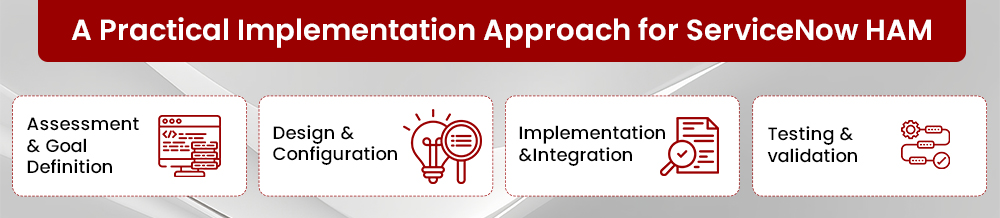
Successful ServiceNow HAM implementation goes beyond module activation. It demands clarity on ownership, lifecycle governance, and robust system integration for accurate asset data.
A practical approach includes:
1. Assessment and Goal Definition
Begin by assessing current hardware lifecycle processes, data sources, and pain points. Define target outcomes (e.g., inventory accuracy, spend reduction) and align stakeholders across IT, procurement, finance, and security.
2. Design and Configuration
Configure asset classes, lifecycle stages, attributes, and workflows. Define policies for procurement, deployment, maintenance, reassignment, and retirement, establishing clear approvals and responsibilities.
3. Implementation and Integration
Set up lifecycle workflows and integrate HAM with ITSM processes for fulfillment and support. To understand how to practically use a Hardware Asset Management application in ServiceNow, you can explore our step-by-step guide.
4. Testing and Validation
Conduct user acceptance testing to confirm workflows and governance. Validate data migration and reporting reliability before broader rollout.
Best Practices to Optimize a ServiceNow HAM Implementation
Once ServiceNow HAM is operational, optimization depends on discipline and governance. The following practices help sustain accuracy and improve outcomes over time:
-
1. Schedule Regular Audits to Maintain Inventory Accuracy
Periodic audits help identify discrepancies, improve data hygiene, and strengthen compliance readiness.
-
2. Automate Lifecycle Updates Wherever Possible
Reduce manual updates by leveraging automated workflows and structured processes for allocation, reassignment, repair, and retirement.
-
3. Standardize Policies and Enforce Accountability
Define policies for procurement, usage, maintenance, and disposal. Ensure ownership is clear and aligned across teams to prevent gaps in lifecycle tracking.
Read our blog post on A Complete Guide to ServiceNow Hardware Asset Management
Case Study: Reducing Asset Management SLA with ServiceNow HAM
A leading Indian private sector bank faced significant HAM governance challenges at scale. Managing over 6,000 servers, 40,000 endpoints, and 30,000+ users, relied on manual spreadsheets and emails for hardware allocation. This resulted in high SLAs, limited transparency, and intensive manual effort.
inMorphis partnered with the bank to implement ServiceNow Hardware Asset Management, establishing an end-to-end HAM lifecycle. From new asset allocation to disposal, including stockroom management and refresh planning.
Key outcomes included:
- Reduced SLA for hardware asset allocation.
- Automated manual, Excel-and-email–based processes.
- Gained transparent, auditable hardware inventory views.
- Improved decision-making for stock utilization versus new purchases.
To explore the full story, including detailed challenges and outcomes, read the complete case study:
Reduction in SLA for Asset Management through HAM
Why Partner with inMorphis for Your ServiceNow HAM Journey?
Implementing and optimizing ServiceNow HAM requires deep platform expertise, a strategic understanding of ITAM best practices, and a proven track record of delivering tangible business outcomes. inMorphis brings all three to the table:
Elite ServiceNow Partnership
As an Elite ServiceNow Partner, inMorphis offers unparalleled platform expertise. Our certified experts align your HAM implementation with best practices, leveraging the latest features for maximum impact.1
Specialized ITAM Practice
Our dedicated ITAM practice, led by industry veterans, focuses exclusively on elevating your ITAM maturity. This specialized focus translates into tailored solutions that deliver measurable, sustained value.
Proven Implementation Methodology
We combine extensive experience with a structured, outcome-centric approach. From assessment to integration and optimization, we ensure a smooth transition and sustained success.
Thought Leadership and Innovation
inMorphis actively shapes ITAM's future, staying ahead of trends like AI and advanced analytics in HAM. Partner with us to ensure your solution is always cutting-edge and future-proof.
Ready to transform your HAM strategy for the evolving IT landscape?
Connect with inMorphis for a personalized ServiceNow HAM assessment today.
