Hardware management has evolved beyond serial numbers. It is about maintaining a seamless flow between service delivery and asset governance. As organizations scale, the gap between "what IT supports" and "what the business owns" often widens, leading to security risks and wasted spending.
Integrating ServiceNow Hardware Asset Management (HAM) with core ITSM modules is the most effective way to close this gap. By connecting asset data with service workflows, businesses can automate the entire lifecycle—from request to retirement.
Partners like inMorphis, a ServiceNow Elite Partner, specialize in these integrations, ensuring that your hardware investments are secure, compliant, and fully optimized.
Why Integrate ServiceNow HAM with ITSM Modules?
Isolating ServiceNow Hardware Asset Management from IT Service Management creates fragmented data silos. The service desk may view a piece of hardware as “active” while it is “retired” in the asset team.
Integration ensures a single source of truth. It empowers the IT teams to make informed decisions based on real-time asset health, warranty status, and lifecycle stage. This alignment reduces manual data entry, eliminates "ghost assets," and ensures that every hardware event triggers the correct service response.
What’s New in ServiceNow Hardware Asset Management?
The way we manage hardware has changed. With hybrid work becoming the standard, verifying asset possession is a major challenge. ServiceNow has introduced enhancements like Asset Attestation to strengthen hardware verification and inventory accuracy. For official details, refer to the ServiceNow Yokohama Release Notes – Hardware Asset Management.1
Asset managers can now trigger automated confirmation requests directly to end users via the Employee Center or Now Mobile app. This is an important integration component, as it enables the organization to ensure the inventory of the remote assets without conducting physical audits. By automating these check-ins, organizations can maintain a high level of inventory accuracy even with a global workforce.
Also read: HAM vs HAM Pro to choose the right fit.
How Does ServiceNow HAM Improve Visibility and Cost?
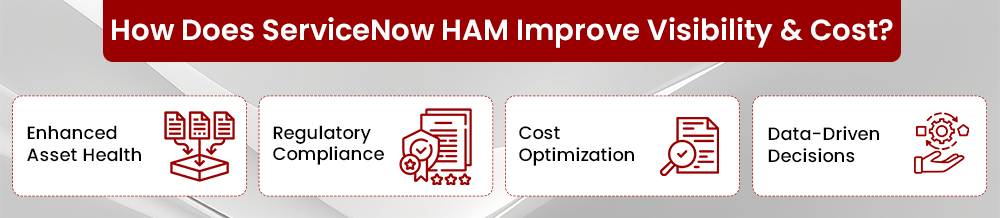
Visibility is the foundation of any successful asset strategy. When you integrate ServiceNow hardware asset management with your broader IT environment, you gain a 360-degree view of your infrastructure.
- Enhanced Asset Health: Tracking maintenance schedules and warranty expirations ensures timely refreshes.
- Regulatory Compliance: Automated audit trails ensure that hardware disposal meets environmental and data security standards.
- Cost Optimization: By identifying underutilized or "lost" assets, organizations can reduce unnecessary procurement spending.
- Data-Driven Decisions: Advanced analytics allow IT leaders to identify high-performing models and predict future hardware needs.
How to Integrate ServiceNow HAM with Incident Management?
When a user reports a hardware issue, the service desk needs immediate context. Integrating ServiceNow HAM with Incident Management allows the system to automatically associate the user’s assigned assets with the incident record.
This integration provides the technician with the device model, repair history, and warranty status instantly. If a device is under warranty, the system can trigger a vendor repair workflow, where integrations or workflows are configured. If it is nearing the end of its life, an incident can trigger an automatic refresh workflow. This proactive approach reduces Mean Time to Resolution (MTTR) and improves the employee experience.
How Should ServiceNow HAM Link with Request Fulfillment?
The request process is where most "shadow assets" are born. Without integration, hardware is often purchased and deployed without proper records in the asset database.
By linking ServiceNow hardware asset management to the Service Catalog, you ensure that every request follows a governed path. When a user requests a new laptop, the system checks local stockrooms first. If an asset is available, it is reserved and assigned. If not, a purchase order is triggered. This ensures that the asset record is created and tracked from the moment it is ordered, not weeks after deployment.
For a step-by-step view, explore how to use a hardware asset management application in ServiceNow.
How Does ServiceNow HAM Support Change Management?
Hardware changes, such as server upgrades or network swaps, carry inherent risks. Integrating ServiceNow HAM with Change Management ensures that every physical change is reflected in the CMDB and the asset repository.
When a change is planned, the system can identify the specific hardware assets impacted. This allows for better impact analysis and risk assessment. Once the change is completed, the asset status is updated automatically through defined workflows (e.g., from "In Stock" to "In Use"). This prevents the "data drift" that often occurs after major infrastructure projects.
What are the Best Practices for ServiceNow HAM Integration?
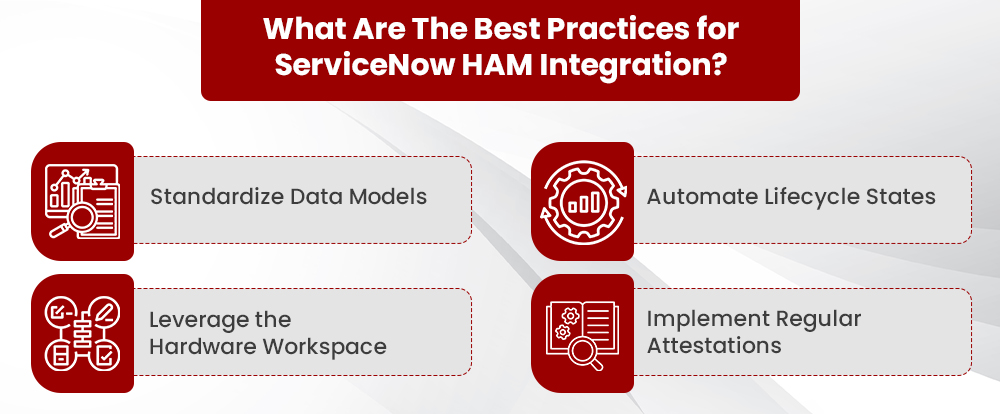
To achieve a high ROI from your ServiceNow hardware asset management investment, implement these industry-proven best practices:
- Standardize Data Models: Standardize hardware data models across all modules to eliminate reporting inaccuracies.
- Automate Lifecycle States: Use workflow automation to move assets through states like "Ordered," "In Use," and "Retired" based on ITSM triggers.
- Leverage the Hardware Workspace: Use the Hardware Asset Workspace (where available) for managing inventory, stockrooms, and other lifecycle-related activities in a single workspace.
- Implement Regular Attestations: Use automated attestation workflows to verify the location and ownership of high-value or remote assets.
What are the Common ServiceNow HAM Integration Challenges?
Even with a powerful platform like ServiceNow, integration can face hurdles. The most common challenges include:
- Data Quality Issues: If your initial asset data is inaccurate, integration will propagate that "bad data" across other modules.
- Process Resistance: Teams may be reluctant to move away from manual spreadsheets or legacy tracking tools.
- Lack of Governance: Without clear ownership of the asset lifecycle, data quickly becomes stale.
Partnering with an expert like inMorphis helps overcome these challenges. We provide tailored frameworks that align your ITSM processes with ServiceNow HAM best practices, ensuring a smooth transition and long-term data integrity.
How can inMorphis Help with Your HAM Strategy?
At inMorphis, we understand that hardware asset management is about more than just inventory—it is about business agility. As a ServiceNow Elite Partner, we help organizations implement and optimize ServiceNow HAM to drive real business value.
Our team of experts ensures a seamless HAM-ITSM integration, providing you with the visibility and control needed to manage your hardware estate effectively. Whether you are looking to reduce costs, improve compliance, or automate your refresh cycles, we have the experience to guide you.
Reference:
