Many contemporary businesses rely on ServiceNow for its optimized business workflows across IT, operations, customer service, HR, and governance. A key enabler of this paradigm shift is the ServiceNow developer: the specialist responsible for implementing business requirements into scalable, automated workflows on the Now Platform.
However, as the platform's functionality expands, the role of a ServiceNow developer also becomes more demanding. From managing complex integrations to ensuring upgrade-safe configurations, developers must navigate multiple challenges while still delivering measurable business value.
This blog post explores who a ServiceNow developer is, the everyday challenges they face, and how the right approach and ecosystem can turn these challenges into opportunities.
Who is a ServiceNow Developer?
Tasks of a ServiceNow developer include designing, configuring, and enabling the Now Platform to support end-to-end business processes. This requires skill beyond simple application development, including:
- Configuring core modules such as IT Service Management (ITSM), IT Operations Management (ITOM), Customer Service Management (CSM), HR Service Delivery (HRSD), and Governance, Risk, and Compliance (GRC).
- Building workflows using Flow Designer, Workflow Editor, and IntegrationHub.
- Writing and maintaining scripts using Glide APIs, Business Rules, Client Scripts, Script Includes, and UI Policies.
- Designing and maintaining data models, including CMDB and custom tables.
- Integrating ServiceNow with third-party tools, legacy systems, and cloud environments.
- Collaborating with architects, process owners, and business stakeholders to align technical solutions with business outcomes.
In short, being a ServiceNow developer is not only about coding but is also about being a platform expert, which impacts service quality, efficiency, and experience.
6 Common Challenges that ServiceNow Developers Face
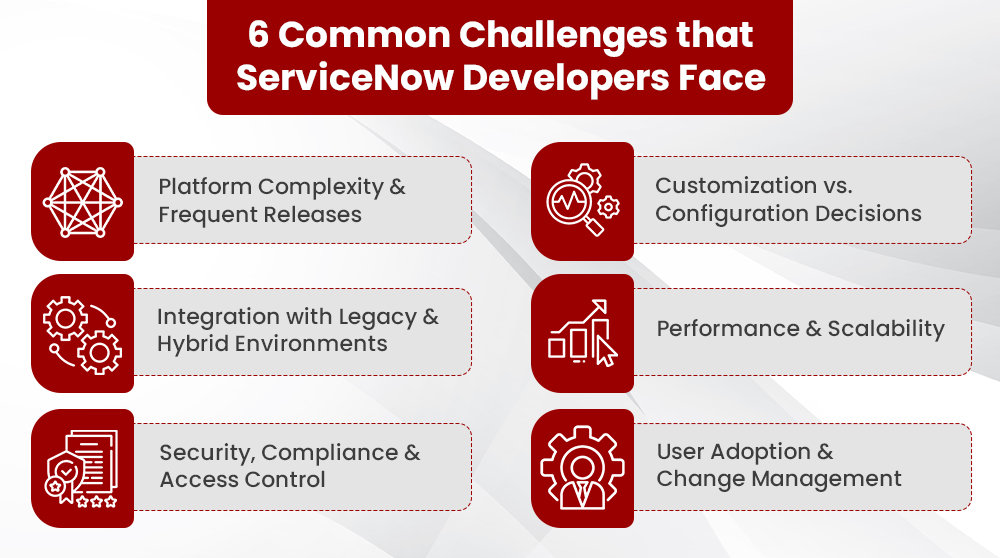
Despite the potential of the platform, a ServiceNow developer typically encounters several recurring challenges, such as:
1. Platform Complexity and Frequent Releases
ServiceNow continuously introduces new capabilities and deprecates old features. Staying current with the latest release notes, best practices, and new modules while managing active projects can be difficult. This creates a constant need for upskilling and re-evaluating existing implementations.
Each major ServiceNow family release introduces new features and retires older patterns, requiring developers to continuously reassess existing implementations, adopt new capabilities, and retire legacy patterns without disrupting business operations.1
2. Customization vs. Configuration Decisions
Over-customization remains one of the most significant risks in ServiceNow projects. Custom scripts, UI changes, and non-standard logic may solve short-term problems but can cause issues during upgrades. Developers must decide when to rely on out-of-the-box functionality and when custom development is truly required.
3. Integration with Legacy and Hybrid Environments
Many organizations are still operating a mix of on-premises systems, legacy applications, and multi-cloud platforms. Integrating the above with ServiceNow requires robust API design, secure authentication, and careful handling of data formats. Any misalignment can lead to data inconsistency or process failures.
4. Performance and Scalability
Inefficient queries, unoptimized scripts, and poorly designed data structures can slow down the platform. In large enterprises with high transaction volumes, this directly impacts user adoption and service quality. Performance tuning becomes a continuous responsibility for developers.
5. Security, Compliance, and Access Control
As ServiceNow expands its use cases across security operations, GRC, and HR, access control becomes more critical. Misconfigured ACLs, roles, or data policies can expose confidential information or block legitimate users from performing their tasks.
6. User Adoption and Change Management
Even the most optimized workflows can fail if end users are not comfortable using them. Developers often face challenges when translating complex processes into intuitive forms and portals that drive higher adoption.
How ServiceNow Developers Overcome These Challenges
Addressing these challenges requires a mix of technical discipline, best practices, and the right ecosystem.
1. Following ServiceNow Best Practices
Adhering to platform guidelines around scripting, table design, and integration patterns is essential. Leveraging out-of-the-box capabilities where possible and limiting customizations helps keep the instance upgrade-ready.
2. Structured Release and Upgrade Management
An efficient release process with cloning, testing, and regression verification or any others, can allow developers to adopt new ServiceNow releases with confidence. Sandbox testing with reduced risk can happen with automated testing.
3. Robust Integration Design
Using IntegrationHub, standard APIs, and secure protocols helps reduce complexity when connecting ServiceNow with external systems. Clearly defined data contracts and error-handling mechanisms ensure reliable integrations.
4. Performance-Aware Development
ServiceNow developers can significantly improve performance by:
- Avoiding unnecessary synchronous calls.
- Optimizing GlideRecord queries.
- Reducing client-side processing where possible.
- Regularly reviewing logs and performance analytics.
5. Security-First Mindset
Embedding security considerations at every stage—design, development, and testing help maintain compliance. Developers must work closely with security and GRC teams to align with organizational policies and regulatory frameworks.
6. Continuous Learning and Certification
Certifications such as Certified System Administrator (CSA) and Certified Implementation Specialist (CIS) across ITSM, ITOM, CSM, HRSD, SAM, or GRC help developers deepen their platform knowledge and stay current.
Business Impact of a Skilled ServiceNow Developer
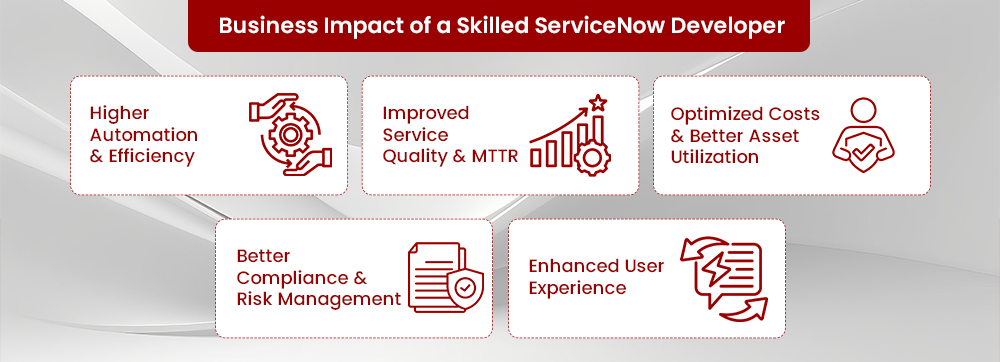
When the above-mentioned challenges are handled well, the impact of a ServiceNow developer is visible across the organization:
1. Higher Automation and Efficiency
Well-designed workflows reduce manual effort, remove process bottlenecks, and enable teams to focus on higher-value work instead of repetitive tasks.
2. Improved Service Quality and MTTR
Accurate routing, automated escalations, and clear visibility into dependencies help reduce incidents’ Mean Time to Resolve (MTTR) and improve overall service quality.
3. Optimized Costs and Better Asset Utilization
When ServiceNow is extended into areas like Software Asset Management (SAM) and IT Asset Management (ITAM), developers help organizations reduce license waste, manage hardware lifecycles, and control operational costs.
4. Better Compliance and Risk Management
By implementing workflows around GRC and security operations, developers support consistent policy enforcement, auditability, and proactive risk mitigation.
5. Enhanced User Experience
Intuitive portals, well-structured forms, and responsive performance drive better user adoption and satisfaction, helping maximize the ROI from the platform.
How inMorphis Empowers ServiceNow Developers
At inMorphis, we recognize that the success of any ServiceNow initiative relies heavily on the developer ecosystem. Our approach is to enable ServiceNow developers with:
1. Exposure to Complex, Real-World Implementations
Developers work on multi-module, multi-geography projects that span ITSM, ITOM, CSM, HR, GRC, AIOps, and more. This accelerates learning and builds strong platform expertise.
2. Mentorship and Frameworks
We provide structured guidance from architects and leverage reusable frameworks, accelerators, and best practices to help developers deliver consistent, high-quality outcomes.
3. Focus on Continuous Upskilling
Developers are encouraged to pursue ServiceNow certifications and explore emerging areas like GenAI, AIOps, and intelligent automation on the Now Platform.
You can read our blog post on Generative AI’s Impact on ServiceNow Developers: Benefit or Barrier?
4. Product and Value-Centric Mindset
Beyond configurations and scripts, inMorphis emphasizes measurable business impact—faster go-lives, reduced MTTR, improved CSAT, and optimized asset usage.
Beyond Code: Enabling Success on ServiceNow
ServiceNow skills remain in strong global demand, with consistent hiring across industries such as telecom, BFSI, manufacturing, and healthcare.2 This sustained hiring trend reinforces how critical the ServiceNow developer role has become in driving modern digital transformation programs.
At inMorphis, we don’t just configure the platform; we architect the future of enterprise workflows. Our ServiceNow developers are adept at delivering complex, global-scale projects, combining deep technical execution with clear business value. We provide the expertise and mentorship required to ensure that every implementation is not just functional, but a strategic asset for the business.
Is your organization ready to unlock the full potential of your ServiceNow investment and push the boundaries of what’s possible? Connect with our experts to start your transformation today.
Reference:
