As manufacturers evolve into connected enterprises, unseen risks are emerging across the intertwined layers of IT, OT, and vendor ecosystems. With this convergence, even a minor configuration drift, an unpatched IoT sensor, or a vendor for API misalignment can escalate into large-scale operational and compliance disruptions.
To navigate this new reality, enterprises are turning to ServiceNow IRM (Integrated Risk Management), a unified platform that helps enterprises shift from reactive risk mitigation to predictive governance, integrating automation and AI across IT and OT environments.
In this blog, we’ll explore how ServiceNow IRM is redefining risk management in the manufacturing domain, examining the evolving risk landscape, the technical foundations of the IRM platform, and how its automation, analytics, and workflow intelligence are driving the next phase of industrial resilience.
As manufacturers advance toward Industry 5.0, the real question is no longer whether risks will evolve, but how prepared your enterprise is to anticipate and neutralize them before disruption strikes. Let’s start by understanding the new challenges of reshaping modern manufacturing.
Why are Traditional Risk Management Methods No Longer Effective for Manufacturers?
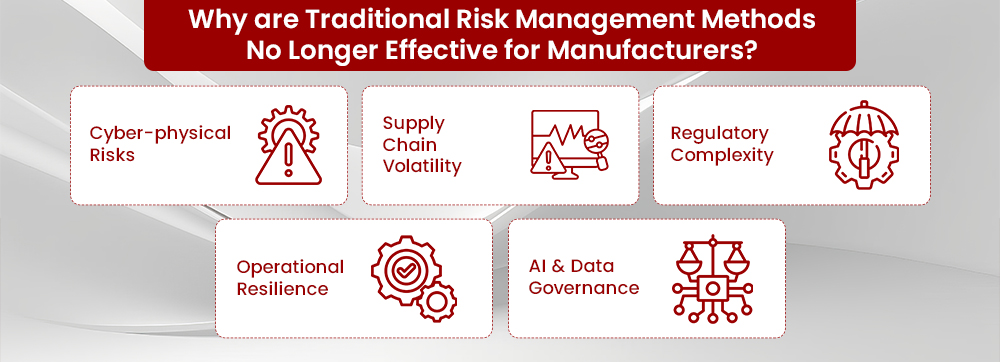
The manufacturing sector has continuously operated under uncertainty. Further, digital transformation has amplified the scale and scope of risks. Managing this expanded threat of enterprises requires a combination of agility, automation, and real-time intelligence. The key risk categories shaping manufacturing include:
- Cyber-physical Risks: The convergence of IT and OT environments exposes production systems, IoT sensors, and machinery to new cyber threats. A compromised PLC or IoT device can now disrupt entire production lines.
- Supply Chain Volatility: Global disruptions, geopolitical tensions, and vendor dependencies introduce critical vulnerabilities that require real-time supplier monitoring and risk scoring.
- Regulatory Complexity: Compliance with frameworks such as ISO 31000, OSHA, REACH, and sustainability standards demands constant monitoring and evidence collection.
- Operational Resilience: Equipment downtime, production inefficiencies, and safety risks impact business continuity and profitability.
- AI and Data Governance: The rise of GenAI and predictive automation requires strong governance around data integrity, bias management, and model validation.
Why is Proactive Risk Management Essential for Manufacturing Enterprises?
Legacy risk management approaches are typically reactive, addressing issues after they occur. ServiceNow IRM introduces a proactive, connected model that enables manufacturers to anticipate, assess, and mitigate risks before they escalate.
ServiceNow IRM integrates with existing enterprise systems, hardware asset data, and compliance frameworks to deliver real-time visibility and automated governance. The platform replaces fragmented risk processes with a unified data model that connects policies, controls, risks, and incidents across departments.
With its GenAI-powered IRM Workspace, manufacturers can now generate automated risk summaries, compliance reports, and recommended actions, accelerating decision-making and improving audit readiness. This represents a shift in how manufacturing businesses perceive and act on risk intelligence.
What are the Core Capabilities of ServiceNow IRM for Manufacturing?
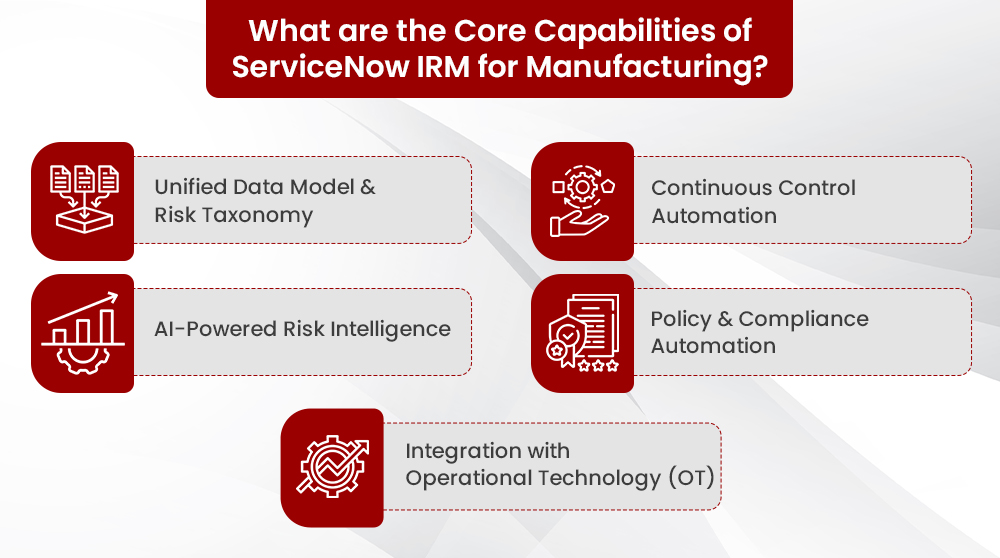
ServiceNow IRM combines automation, intelligence, and integration to create a robust framework for enterprise-wide risk management. The core capabilities of ServiceNow IRM for manufacturing are following:
1. Unified Data Model and Risk Taxonomy
The platform provides a centralized view of all risks, controls, policies, and compliance data. It connects to the CMDB (Configuration Management Database) and integrates with HAM (Hardware Asset Management) and ITAM (IT Asset Management) to align business risks with specific assets or production systems. This unified taxonomy allows manufacturers to understand how each asset impacts organizational risk.
2. Continuous Control Automation
ServiceNow IRM supports CCA (Continuous Control Automation), enabling automatic validation of risk controls using data from connected systems. When an anomaly or compliance deviation is detected, the platform triggers remediation workflows in real time. This reduces manual effort, eliminates human error, and ensures ongoing compliance with global standards such as ISO 45001 and NIST CSF.
3. AI-Powered Risk Intelligence
With GenAI capabilities integrated into the IRM workspace, the platform can emergently summarize risk registers, generate audit-ready documentation, and recommend control improvements. Predictive intelligence algorithms analyze patterns in incidents and operational data to forecast emerging risks, allowing manufacturers to implement preventive measures before failures occur.
4. Policy and Compliance Automation
The platform maps internal policies to external regulations and automates evidence collection during audits. This ensures manufacturers maintain compliance with industry-specific standards while minimizing administrative overhead. Real-time dashboards provide an up-to-date view of regulatory posture and audit progress.
5. Integration with Operational Technology (OT)
ServiceNow IRM integrates with OT systems such as MES and SCADA1 through IntegrationHub and IoT connectors. This connection enables proactive identification of risks related to machinery health, firmware vulnerabilities, or production anomalies. When linked with HAM, these insights allow enterprises to track asset compliance, schedule preventive maintenance, and manage the full lifecycle of hardware assets.
What are the Benefits of ServiceNow IRM and HAM Integration in Manufacturing?
The integration between ServiceNow IRM and HAM represents one of the most significant advancements in modern risk governance. Hardware assets are now directly tied to enterprise risk profiles.
- Real-time Asset Visibility: HAM ensures every physical and digital asset is tracked throughout its lifecycle, providing a foundation for accurate risk assessment.
- Automated Risk Linkage: If a device runs outdated firmware or lacks a critical patch, ServiceNow IRM automatically associates the asset with a risk and triggers a remediation workflow.
- Compliance and Sustainability Tracking: Manufacturers can monitor whether assets meet sustainability and safety standards, ensuring compliance with ESG and industry mandates.
- Operational Resilience: The IRM-HAM integration minimizes unplanned downtime by aligning maintenance schedules with risk indicators, leading to improved asset reliability and cost efficiency.
This convergence of IRM and HAM transforms manufacturing risk management from a reactive compliance task into a proactive, intelligence-driven function that strengthens enterprise resilience.
What is the Implementation Roadmap for Manufacturers?
Manufacturers can implement ServiceNow IRM in a phased approach to ensure scalability and alignment with enterprise goals.
- Phase 1
Asset and CMDB Alignment: Establish a complete inventory of hardware and production assets through HAM and CMDB integration.
- Phase 2
Risk Taxonomy Development: Define enterprise risk categories aligned with manufacturing KPIs and compliance frameworks.
- Phase 3
Policy and Control Mapping: Automate linkage between internal controls and global regulations.
- Phase 4
Continuous Monitoring Enablement: Implement Continuous Control Automation (CCA) and predictive analytics.
- Phase 5
Scale and Optimize: Extend IRM to supply chain partners and leverage GenAI for advanced insights and automation.
Each stage strengthens visibility, governance, and automation, creating a mature risk management framework that scales business growth.
Conclusion
As the manufacturing sector evolves toward connected, intelligent, and sustainable operations, risk management must keep pace. ServiceNow IRM empowers manufacturers to manage risks holistically across IT, OT, and the supply chain environments. Its unified platform transforms fragmented data into actionable intelligence, enabling proactive decisions and continuous compliance.
At inMorphis, we specialize in custom ServiceNow IRM implementations to the unique needs of manufacturing enterprises. Our experts help enterprises integrate ServiceNow IRM with HAM, automate governance workflows, and design risk programs that deliver measurable outcomes, from reduced downtime to faster audit cycles. By combining strategic consulting with deep ServiceNow expertise, inMorphis helps manufacturers move from reactive compliance to proactive resilience.
