
Enterprises may often underestimate the complexity of IRM (Integrated Risk Management) workflows in slowing down compliance. As configurations expand, adapting to regulations, launching risk initiatives, or maintaining a rapid compliance posture becomes harder. This complexity reduces agility and raises a key question: Are traditional, layered processes undermining the value that integrated risk management is designed to deliver?
Modern IRM requires automated workflows that support real-time responses to regulatory changes and emerging risks. When processes are overly complicated, compliance becomes reactive, risk visibility declines, and audit readiness suffers. Simplifying workflows is therefore both a technical necessity and a business priority for maximizing ServiceNow IRM value.
This blog explores how ServiceNow IRM unifies and automates risk, issue, and control management. It highlights core capabilities such as centralized risk data, automated workflows, and real-time compliance monitoring, while showing how risks can be aligned with business objectives. It also outlines the technical framework and a phased approach to implementation.
Understanding the Role of Integrated Risk Management
Enterprises can configure Integrated Risk Management (IRM) to automatically map risk events, like a ransomware incident to relevant assets, assess compliance implications, and trigger predefined containment workflows. Behind the scenes, it consolidates risk, compliance, audit, policy, and vendor risk data into a single platform, providing leaders a single source of truth.
With ServiceNow IRM, real-time risk intelligence flows directly into operational workflows, enabling predictive threat detection, faster mitigation, and proactive regulatory adherence, which turns risk management into a driver of resilience rather than a post-incident checklist.
What is ServiceNow IRM?
ServiceNow IRM is a unified platform that enables enterprises to identify, assess, respond to, and monitor risks across business, IT, and third-party environments. Unlike siloed governance, risk, and compliance (GRC) solutions, IRM is built on a connected framework where risks, controls, and compliance requirements are directly mapped to business services, applications, and assets. This allows enterprises to move beyond manual, reactive risk management and adopt a proactive, automated, and real-time approach.
What are the Core Capabilities of ServiceNow IRM?
ServiceNow IRM delivers a connected set of capabilities that manage the entire risk lifecycle, from identification to resolution within a single platform. At the core of ServiceNow IRM are powerful features that support complete risk lifecycle management:
Risk Registers: A risk register acts as a centralized hub for capturing, categorizing, and tracking risks across the enterprise. By standardizing risk assessment and maintaining a single source of truth, it enables leadership to make informed, timely, and proactive decisions.
- Categorizes risks by type, such as operational, strategic, IT, or vendor.
- Maintains a single, unified repository to avoid duplication or scattered records.
- Uses scoring models based on likelihood, impact, and other custom criteria.
- Supports consistent, objective, and measurable risk evaluations.
- Enables prioritization of risks for better allocation of mitigation resources.
- Offers real-time visibility into the enterprise’s overall risk posture.
Issue Management: Track and resolve control failures, audit findings, or regulatory issues in a structured and auditable way. Issues can be linked to controls and risks, enabling enterprises to assess downstream impacts and strengthen overall compliance posture.
- Centralizes all identified issues in a single repository for easier management.
- Links issues directly to related controls, processes, and risks for traceability.
- Enables automated notifications and task assignments for timely resolution.
- Tracks resolution progress with defined timelines and accountability.
- Maintains a complete audit trail for regulatory and internal reporting.
- Provides dashboards for real-time status monitoring and performance metrics.
Control Frameworks: Define, document, and test internal controls aligned with industryframeworks such as NIST, ISO, or SOX. By centralizing control data and automating evidence collection, enterprises can ensure consistent compliance and readiness for audits.
- Aligns controls with recognized standards to meet regulatory and industry-specific requirements.
- Provides a single repository for all control definitions, owners, and related documentation.
- Automates periodic control testing to reduce manual effort and human error.
- Captures and stores audit evidence within workflows for easy retrieval during inspections.
- Integrates with external systems for real-time control data updates.
- Enables tracking of control effectiveness and remediation progress over time.
How ServiceNow IRM Automates Risk Data, Issues, and Controls?
ServiceNow IRM breaks down silos by aggregating risk data across departments, geographies, and third-party systems into a single source of truth. This allows enterprises to assess risks at both the enterprise level and the granular level of assets or processes.
1. Centralizing Risk Data from Across Enterprises
One of the key strengths of ServiceNow IRM can break down silos and aggregate risk data across departments, business units, geographies, and third-party systems. By creating a single source of truth, enterprises can not only view risk at the enterprise level but also understand how specific incidents or compliance gaps affect broader business objectives.
Through integration with operational tools such as ITSM, SecOps, HR, and Finance, IRM pulls in real-time risk signals. For example:
- Policy Violations: An HR system detects non-compliance in employee background checks and sends alerts directly into IRM.
- Unresolved Incidents: ITSM flags recurring service outages in a critical banking application, triggering a review of associated operational risks.
- Failed Control Tests: Security monitoring tools identify firewall misconfigurations, which are logged as compliance risks in IRM.
The Common Service Data Model (CSDM) enables structured mapping of risks and controls to business services, applications, and enterprise entities. For instance, a failed penetration test on a cloud-hosted CRM system can be linked to its underlying infrastructure, the responsible business unit, and any dependent sales processes. This creates a risk-aware CMDB1, where every asset, service, or process is continuously assessed in terms of:
- Risk exposure
- Compliance status
- Business impact if the risk materializes
Automated Issue Response and Control Workflows
Manual risk tracking is often slow, inconsistent, and prone to human error. ServiceNow IRM addresses this challenge by embedding automation into every stage of the issue lifecycle, ensuring that risks are identified, assigned, and resolved faster.
- Automated Issue Creation: ServiceNow can automatically generate issues when controls fail, audit exceptions are detected, or security tools such as vulnerability scanners flag anomalies.
- Task Assignment and SLAs: The platform routes tasks to the appropriate teams, sets clear deadlines, and enforces service-level agreements with built-in escalation and approval workflows.
- Control Testing Automation: Control tests can be scheduled at defined intervals, with evidence automatically pulled from integrated systems like Active Directory, AWS, or SAP.
By automating detection, remediation, and ongoing tracking, enterprises not only accelerate their response times but also significantly reduce overall risk exposure. This leads to a more resilient, compliant, and audit-ready operational environment.
Aligning Risk Prioritization with Strategic Objectives
ServiceNow IRM bridges the gap between enterprise strategy and risk management by mapping risks and controls directly to objectives and critical business services. This approach ensures that risk mitigation efforts focus on what matters most to the enterprises, rather than solely on regulatory requirements.
For example, if “Customer Data Protection” is a priority, the platform can:
- Identify all associated risks, policies, and controls linked to this objective.
- Provide real-time dashboards showing compliance scores, residual risk ratings, and any overdue issues.
- Highlight gaps and emerging threats that could impact the business goal.
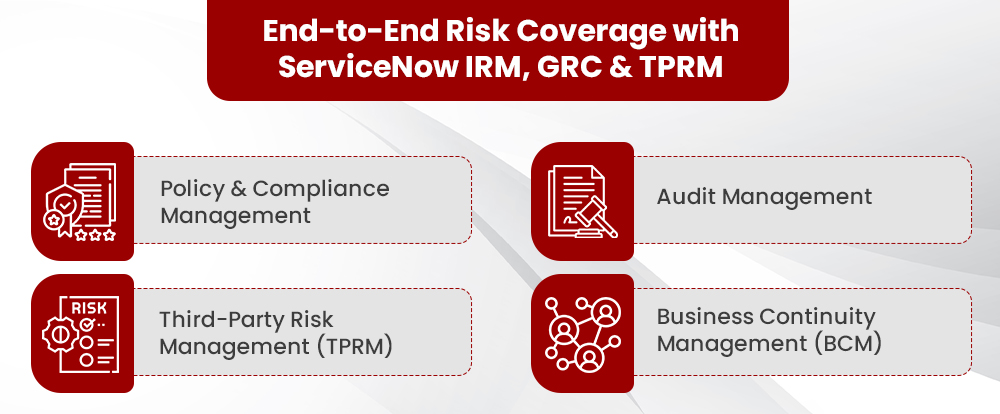
End-to-End Risk Coverage with ServiceNow IRM, GRC, and TPRM
ServiceNow delivers a comprehensive GRC suite, IRM as its foundation. By combining IRM with other specialized modules, enterprises gain visibility and control over risk across both internal operations and third-party relationships.
- Policy and Compliance Management: This capability automatically assesses compliance with internal policies and external regulations by mapping policies directly to associated risks and controls, enabling continuous and proactive compliance monitoring.
- Audit Management: The module streamlines the entire audit lifecycle, encompassing planning, fieldwork, and reporting by pre-populating evidence and linking audit findings to relevant risks and controls, thereby accelerating remediation and enhancing audit accuracy.
- Third-Party Risk Management (TPRM): ServiceNow TPRM facilitates comprehensive vendor risk assessment, onboarding, and ongoing monitoring through structured questionnaires, service-level agreements (SLAs), and real-time continuous risk signals.
- Business Continuity Management (BCM): It enables planning, testing, and recovery strategies to strengthen resilience. It ensures critical services stay operational during disruptions and aligns continuity risks with business objectives.
Expanded IRM Capabilities
Beyond the core modules, ServiceNow has introduced advanced features in recent releases to strengthen governance and resilience:
- Operational Resilience Workspace – new capability that provides a central hub for monitoring resilience metrics across business services.
- Regulatory Change Management – tracks regulatory updates and ensures timely mapping to controls.
- Advanced Risk Assessments – enhanced frameworks for scoring, evaluating, and prioritizing risks with automation.
- IRM Workbench & Workspaces – role-based, intuitive dashboards for risk professionals, auditors, and compliance teams.
ServiceNow IRM Framework and Technical Capabilities
The ServiceNow IRM framework is built on the Now Platform’s data-driven architecture, enabling scalable risk governance across IT, business, and third-party ecosystems. Its technical foundation includes the following core components:
1. Data Model
The IRM data model establishes structured relationships between key entities:
- Risks: Events or conditions with potential impact on business outcomes.
- Issues: Identified deficiencies requiring remediation or corrective action.
- Policies and Controls: Preventive or detective measures aligned with regulatory or internal requirements.
- Relationships: Mappings between risks, controls, issues, and configuration items (CIs) in the CMDB.
This relational model provides traceability from regulatory requirements to affected assets, processes, and services.
2. IRM Workspace
IRM Workspace delivers a centralized, role-based environment for managing risk activities:
- Real-time dashboards with risk heat maps, metrics, and key indicators.
- Workflow automation for risk assessments, attestations, approvals, and issue management.
- Simplified interfaces for end users (e.g., policy acknowledgments, attestations).
3. CMDB Integration
IRM integrates with the ServiceNow CMDB to associate risks directly with IT and business services:
- Cyber risks mapped to specific applications, servers, or infrastructure components.
- Vendor compliance failures linked to dependent supply chain or business services.
- Business continuity risks aligned with critical services and defined SLAs.
- This integration ensures risk context is tied to operational assets and business outcomes.
Also, read Is ServiceNow Service Mapping Right for You?
4. Now Platform Capabilities
IRM leverages native Now Platform features for extensibility and automation:
- Flow Designer: Orchestrates workflows for assessments, issue remediation, and control attestations.
- Integration Hub: Connects IRM with ERP, IAM, vulnerability management tools, and regulatory data providers.
- Performance Analytics: Provides dashboards, trends, and KPI reporting for audits and executive oversight.
- GenAI (Now Assist): Delivers contextual insights, auto-summarization of reports, and recommendations for control design.
5. AI and Automation in IRM
Advanced capabilities extend IRM beyond traditional governance through AI and automation:
- Predictive Intelligence: Forecasts risks and trends using machine learning models.
- Automated Issue Mapping: Correlates incidents, vulnerabilities, and compliance failures to relevant risks and controls.
- Continuous Monitoring: Automates evidence collection and validates controls in real time through connected systems.
Implementation Strategy for ServiceNow IRM
A Successful IRM deployment requires a structured approach. Enterprises should begin by assessing current maturity in compliance and risk management. This includes reviewing policies, controls, ITSM, SecOps, and ERP processes, and identifying gaps in data and workflows. The key steps include:
- Assess Maturity: Identify gaps in compliance frameworks, risk monitoring, and CMDB data.
- Define Use Cases: Prioritize high-impact domains such as IT risk, vendor risk, and compliance. Establish automated workflows and KPIs for risk scoring and control testing.
- Data Readiness: Standardize and map CMDB assets, policies, and controls. Implement automated evidence collection from ITSM, SecOps, HR, and ERP systems.
Next, deploy IRM modules in phases: Policy and Compliance, Risk, Vendor Risk, and Audit. Use ServiceNow’s IRM data model to link risks, policies, controls, and issues. Dashboards and heatmaps provide visibility, while role-based workflows ensure accountability.
Integration and Scaling:
- Integrate with ITSM/SecOps/ERP: Enable real-time evidence collection, trigger risk events, and automate remediation workflows using Integration Hub or APIs.
- Automate & Scale: Extend IRM coverage across Finance, HR, Supply Chain, and Operations. Use AI-driven analytics for predictive insights and automated control testing and audit tracking.
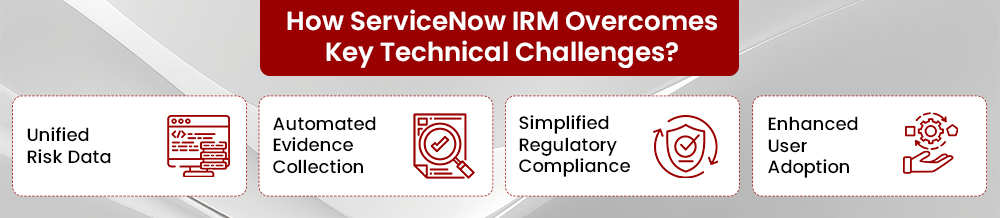
How ServiceNow IRM Overcomes Key Technical Challenges?
Implementing IRM comes with several technical challenges, but these can be effectively addressed with ServiceNow capabilities:
- Unified Risk Data: ServiceNow eliminates data silos across IT, HR, and business systems with CMDB-driven mapping, ensuring assets, policies, and controls are in a unified data model.
- Automated Evidence Collection: Instead of relying on manual, error-prone processes, ServiceNow automates evidence gathering using native connectors and Integration Hub, enabling real-time compliance reporting.
- Simplified Regulatory Compliance: With pre-built content packs like the Unified Compliance Framework (UCF) and external feeds, ServiceNow keeps pace with evolving regulations and simplifies compliance mapping.
- Enhanced User Adoption: IRM Workspace, guided workflows, and mobile approvals make risk management intuitive, driving engagement and sustained adoption.
Conclusion
ServiceNow IRM transforms risk management from a fragmented, manual process into a unified, automated, and intelligence-driven framework. By centralizing risk data, embedding issue and control workflows, and integrating with enterprise systems, it provides continuous visibility and ensures compliance remains proactive rather than reactive.
The platform’s strength lies in its ability to align risks directly with business objectives, enabling leaders to prioritize what matters most while maintaining audit readiness and operational resilience. With its scalable data model, CMDB integration, and AI-driven automation, ServiceNow IRM equips enterprises to adapt quickly to regulatory change, manage third-party risks, and anticipate emerging threats.
At inMorphis, we bring deep expertise in ServiceNow IRM to help enterprises design, implement, and scale risk management programs. Connect with us today to transform risk into resilience.
Reference:
1. https://www.servicenow.com/uk/lpwbr/creating-a-service-aware-process-driven-cmdb.html
