%20Management%20for%20Manufacturers1765779610435.jpg&w=3840&q=75 "The Ultimate Guide to ServiceNow Operational Technology (OT) Management for Manufacturers")
Manufacturing plants rely on operational technology (OT) to run production, maintain quality, and keep lines performing. When OT systems are siloed or outdated, teams lose visibility, downtime increases, and issues are handled through manual workarounds.
As Industry 4.0 initiatives progress, the gap between shop-floor systems and enterprise platforms becomes a real business risk. Order exceptions sit in inboxes, asset data is spread across tools, and vulnerabilities in legacy OT environments remain hard to see and act on.
ServiceNow Operational Technology (OT) addresses this by providing a single platform that connects IT and OT and unifies the munder one operational view. It helps manufacturers manage assets, respond to incidents, secure critical systems, and tie production events directly to business outcomes.
In this blog, we look at how ServiceNow OT supports modern manufacturing operations and the role inMorphis plays in making that implementation successful.
Understanding Operational Technology (OT) in the Modern Enterprise
Operational Technology (OT) includes the hardware and software that monitor and control physical processes in your plants and production lines. Typical OT components include:
-
1. Industrial control systems (ICS) and distributed control systems (DCS)
-
2. SCADA systems used to supervise dispersed equipment and utilities
-
3. Programmable logic controllers (PLC) on lines and machines
-
4. Human–machine interfaces (HMIs) used by operators
-
5. Industrial IoT devices and sensors that capture real‑time data
These systems were built for safety, reliability, and uptime. They usually:
- Run for many years with minimal change
- Operate on specialized protocols
- Sit partially or fully isolated from IT environments
The result is a familiar pattern:
-
1. Limited, fragmented visibility across sites and assets.
-
2. Manual workarounds to connect OT events with enterprise workflows
-
3. Legacy devices that are hard to patch and secure
Also read: Top 5 Benefits of OT Integration with inMorphis
Key Pillars of ServiceNow Operational Technology
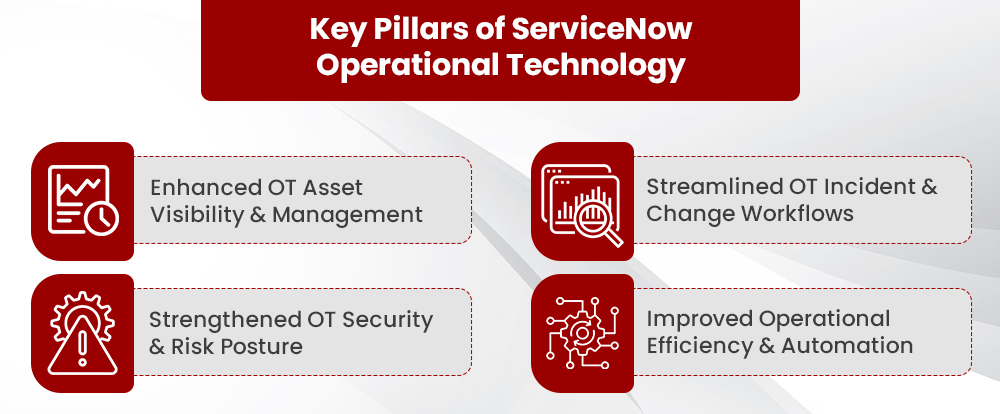
ServiceNow OT leverages the Now Platform's workflow automation and unified data model for operational technology. It serves as a single system of action, connecting people, processes, and technology across manufacturing, to eliminate disconnected tools.
1. Enhanced OT Asset Visibility and Management
The first requirement for effective OT management is a clear view of assets and their role in production.
- ServiceNow OT uses discovery and integrations to identify and map OT devices and systems across plants.
- This creates a central, reliable asset repository for controllers, sensors, machinery, and industrial systems.
- Asset health can be monitored proactively, with alerts that trigger maintenance workflows before failures occur.
- Dependencies are also captured, so the impact of a sensor or controller failure on lines, orders, and services is clearly understood.
2. Streamlined OT Incident and Change Workflows
Production incidents demand a rapid, coordinated response.
- ServiceNow OT replaces the usual phone calls and email chains with structured incident workflows.
- When an issue occurs, the platform creates an incident, routes it to the right team with full asset context and history, and tracks progress in real time.
- Changes to OT systems, such as control logic updates, firmware patches, and configuration adjustments, follow structured workflows with built-in approvals, impact analysis, and documentation.
3. Strengthened OT Security and Risk Posture
IT–OT convergence has increased the attack surface, while many OT systems remain legacy and difficult to patch.
- ServiceNow OT extends vulnerability and risk management into OT environments.
- Vulnerabilities are identified across OT assets, evaluated by criticality, and prioritised by potential impact on safety and production.
- Response is coordinated among IT security, OT engineers, and plant operations to ensure that remediation steps align with operational constraints.
Explore our blog on 5 Strategies to Enhance OT Security
4. Improved Operational Efficiency and Automation
ServiceNow OT also targets the day‑to‑day efficiency of manufacturing operations.
- Routine tasks such as maintenance requests, calibration, inspections, and quality holds are automated through standard workflows.
- OT events are integrated with supply chain, order management, and customer service processes, so production issues immediately trigger the right follow‑up actions.
- AI insights can be applied when OT data is integrated into the Now Platform to predict failures, support predictive maintenance, and optimize scheduling.
3 Strategic Outcomes Manufacturers Can Achieve with ServiceNow OT
With the foundational pillars of ServiceNow OT firmly established, asset visibility, structured incident and change workflows, integrated security, and workflow‑driven automation, manufacturers begin to see impact in three core areas, which are as follows:
Increased Uptime and More Predictable Production
With OT assets discovered and mapped, manufacturers gain a clearer understanding of their plant operations—maintenance shifts from static schedules to real‑time alerts that trigger interventions only when needed. Incidents are automatically routed with full asset context, cutting triage time and handoffs. This shifts operations from constant firefighting to predictable, planned production, leading to significant gains in throughput and on‑time delivery.
Stronger OT Security Without Compromising Operations
ServiceNow OT integrates security into daily operations. It identifies, prioritises, and tracks vulnerabilities across OT systems based on impact to safety, production, and compliance. Security teams, OT engineers, and plant operations share a unified view of risk. Remediation, including patches and configuration changes, is planned using structured workflows that align with production windows. This eliminates the "secure or available" trade‑off, building security into operational decision‑making.
Better Alignment Between Plant Operations and the Business
ServiceNow OT aligns plant operations with business objectives. OT events are linked to orders, customers, and services in a single platform. When something changes on the shop floor, teams can quickly see which orders and SLAs are affected and act through standard workflows. The same data supports better planning, forecasting, and continuous improvement. OT becomes a measurable part of business performance, not an isolated system.
Partnering for Success: The inMorphis and ServiceNow Advantage
Implementing Operational Technology requires deep expertise in both the ServiceNow ecosystem and manufacturing operations.
Why inMorphis is Your Strategic Partner:
- ServiceNow Elite Partner: Recognised for deep expertise across the entire Now Platform, including IT Operations Management, Security Operations, GRC, IT Asset Management, and Enterprise Service Management.1
- Integrated Solutions: We architect solutions that connect OT with IT service management, security, and enterprise workflows, ensuring value across your organisation.
- Manufacturing-Specific Understanding: We respect OT's unique demands—uptime, production schedules, and safety—while leveraging ServiceNow for automation and visibility
- Proven Expertise: Our deep understanding of ServiceNow isn't just theoretical we leverage the platform ourselves to drive efficiency and innovation, ensuring we bring real-world experience to your implementation.1
- Tailored Outcomes: Our approach designs ServiceNow OT solutions specifically for your challenges, whether reducing downtime, improving OEE, or strengthening security.
- Global Delivery: With capabilities across the US, UK, India, and Singapore, we support multi-site operations and provide ongoing managed services.
inMorphis delivers focused, impactful ServiceNow OT implementations that drive measurable results.
Your Next Step Towards Unified Operations
The convergence of IT and OT is reshaping manufacturing. ServiceNow OT provides the foundation for this transformation: a single platform connecting assets, workflows, security, and business processes for measurable improvements in uptime, efficiency, and satisfaction.
The critical question is not whether to unify IT and OT, but how quickly and effectively this transformation can be executed.
inMorphis stands as your partner for this journey. Whether exploring ServiceNow OT for the first time or optimising an existing implementation, inMorphis brings the expertise to help you achieve your operational and business objectives.
