Risk management is essential to protect business continuity and support sustainable growth. As regulatory requirements evolve and third-party dependency increases, organizations need a structured GRC approach to identify risks early, assess impact, and respond consistently.
In this blog post, we will address the strategies needed to meet these modern challenges—from rapidly changing compliance requirements to rising cybersecurity pressure. Our goal is to provide a roadmap for moving beyond periodic, "check-the-box" risk activities toward an audit-ready, continuous risk management framework.
Strategic Approaches to Modernize Your GRC Framework
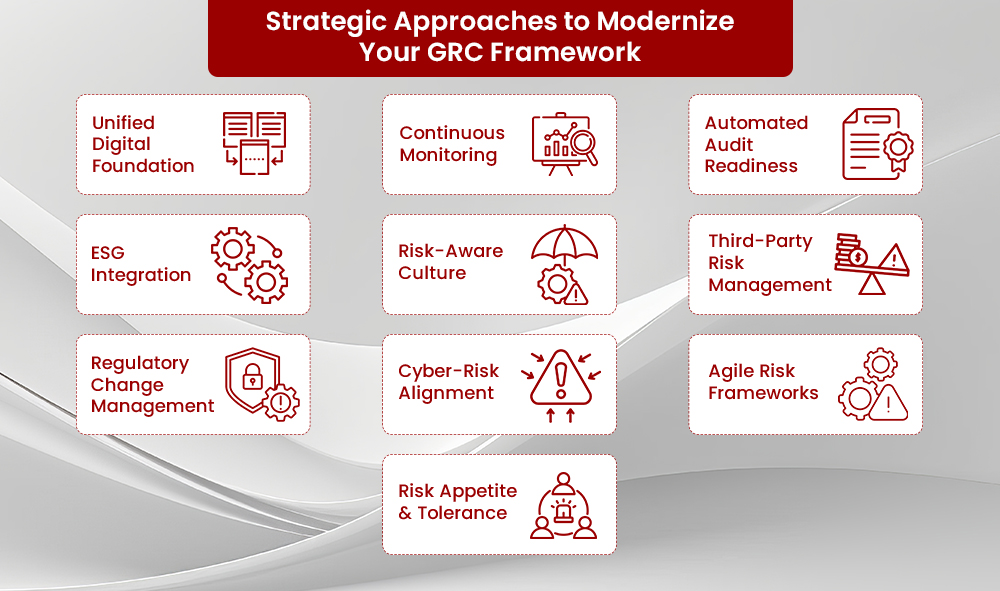
The following ten proven strategies will help you strengthen your risk management framework and build organizational resilience in 2026:
1. Establish a Unified Digital Foundation for Risk Data
Effective risk management becomes difficult when data is fragmented across different departments and formats. To achieve a clear view of your risk posture, you must standardize how risks are identified, owned, and reported within a single system of record. This eliminates the need for manual reconciliation and ensures that leadership is making decisions based on a single version of the truth.
inMorphis supports this transition by implementing ServiceNow GRC applications, including Risk Management and Policy & Compliance, to create a scalable and consistent digital backbone.
2. Transition to Continuous Monitoring and Real-Time Oversight
Relying on annual or quarterly risk assessments creates a "blind spot" between review cycles. A more effective strategy is to implement continuous monitoring, in which key risk indicators (KRIs) are tracked in real-time. This allows the organization to detect anomalies or control failures as they happen, rather than discovering them months later during an audit.
By defining clear thresholds for automated alerts, risk teams can shift their focus from data collection to proactive mitigation and strategic advisory.
For a deeper look at real-time risk analytics and how it supports continuous monitoring, explore ServiceNow GRC Explained: Modules, Benefits, and Real-World Use
3. Prioritize Audit Readiness Through Automated Evidence Collection
Audit cycles are often disruptive because evidence is gathered under pressure. By automating evidence collection and linking it directly to controls, you ensure that the organization supports continuous audit readiness. This reduces the burden on control owners and provides internal and external auditors with immediate, verifiable data.
Leveraging ServiceNow GRC Advanced Audit applications streamlines the audit process, ensuring accuracy and transparency without the typical end-of-quarter scramble.1
4. Integrate ESG Metrics into the Core Compliance Workflow
Environmental, Social, and Governance (ESG) factors are no longer peripheral concerns; they are significant drivers of regulatory and reputational risk. Rather than managing ESG as a separate reporting exercise, it should be integrated into your existing GRC framework. This ensures that ESG goals are backed by the same level of accountability, policy enforcement, and auditability as financial or operational controls.
inMorphis assists organizations in incorporating these metrics into ServiceNow GRC Policy and Compliance Management, ensuring that sustainability efforts are measurable and compliant with emerging global standards.
5. Foster a Risk-Aware Culture Through Clear Accountability
A resilient organization is one where risk management is decentralized and understood at every level. This requires moving beyond basic training to a culture where every employee understands their role in identifying and flagging potential issues. When risk ownership is clearly defined and supported by intuitive reporting tools, the organization can catch emerging threats much earlier in the lifecycle.
By leveraging ServiceNow GRC solutions, inMorphis helps facilitate the communication and transparency needed to move risk management from a back-office function to a front-line responsibility.
6. Strengthen Oversight of Third-Party and Vendor Ecosystems
As organizations become more interconnected, third-party risks ranging from data breaches to supply chain disruptions become more critical. A robust strategy involves continuous vendor lifecycle management, rather than just a point-in-time assessment during onboarding. This includes regular performance reviews, trigger-based reassessments, and clear tracking of contractual compliance.
Using ServiceNow GRC, organizations can automate the assessment and monitoring of third-party risks, ensuring vendor remains aligned with internal security and compliance standards.
7. Proactively Manage Geopolitical and Regulatory Shifts
Global operations are increasingly susceptible to political instability and rapid changes in regional laws. To mitigate these risks, organizations must have a systematic way to track regulatory updates and assess their impact on internal policies. This proactive approach prevents the "compliance lag" that often leads to fines or operational friction.
Organizations can leverage ServiceNow GRC Regulatory Change Management to establish a structured workflow that efficiently monitors, assesses, and implements regulatory changes across jurisdictions.
8. Align Cybersecurity with Business Risk Objectives
Cybersecurity should not be managed in a vacuum. Effective risk management requires a tight alignment between IT security and broader business objectives. By quantifying cyber threats in terms of business impact, such as potential downtime or data loss, leadership can make more informed decisions about resource allocation and security investments.
Implementing ServiceNow GRC Risk Management applications allows teams to identify vulnerabilities and respond to incidents with a clear understanding of the business context and regulatory implications.
9. Adopt Agile Risk Management for Dynamic Environments
Traditional, rigid risk frameworks often fail to keep pace with modern business changes. Agile risk management emphasizes flexibility and rapid feedback loops, allowing the organization to adjust its risk posture as new information becomes available. This approach is particularly valuable during digital transformation projects or when entering new markets where the risk profile is not yet fully understood.
This dynamic framework ensures that risk management remains a facilitator of business agility rather than a bottleneck.
10. Define and Communicate Clear Risk Appetite and Tolerance
Without a clearly defined risk appetite, decision-making becomes inconsistent. Organizations must establish and communicate the level of risk they are willing to accept to achieve their strategic goals. These thresholds should be integrated into the GRC system so that any activity exceeding these limits triggers an immediate escalation for review.
inMorphis supports this by implementing ServiceNow GRC applications that help define, monitor, and report on risk tolerance levels across the entire enterprise, ensuring a balanced approach to growth and protection.
Make Risk Management Visible, Actionable, and Audit-Ready
Building a resilient GRC framework requires a shift from reactive, manual processes to a proactive, technology-enabled strategy. By focusing on continuous monitoring, clear accountability, and integrating emerging risks like ESG and cybersecurity, organizations can transform risk management into a strategic advantage.
inMorphis, a ServiceNow Elite partner, is dedicated to helping enterprises implement these advanced GRC applications effectively. Our team of 750+ certified ServiceNow practitioners has successfully helped organizations build resilient, audit-ready compliance frameworks.
If audit readiness is your immediate priority, this GRC audit management guide breaks down the process in detail.
Contact inMorphis today to learn how our ServiceNow GRC expertise can help you achieve continuous, audit-ready compliance.
Reference:
