The customer service landscape is fundamentally shifting. Customers today insist on immediate, frictionless, and tailored interactions through all channels—mobile, online, or face-to-face. By 2026, organizations will be unable to rely on traditional service practices alone. To win, a comprehensive combination of technology, automation, and human insight will be essential.
Artificial Intelligence (AI) is driving a shift from reactive support to proactive, predictive service. Technologies like generative AI and advanced machine learning help organizations anticipate customer needs, deliver real-time solutions, and automate manual workflows.
AI is increasingly embedded in service platforms like incident management, knowledge bases, and CRM systems, creating unified, intelligent ecosystems. This enhances agent productivity and improves customer satisfaction through faster, more relevant support.
Lastly, the future of customer service is focused on ongoing improvement and measurable results. Top organizations no longer just fix problems—instead, they monitor customer loyalty impact, operational effectiveness, and regulatory compliance to ensure that AI implementation creates tangible business value.
This blog discusses the current trends shaping customer service management and highlights the key strategies organizations need to adopt in 2026 to meet customer expectations and industry standards.
Current Trends in Customer Service Management
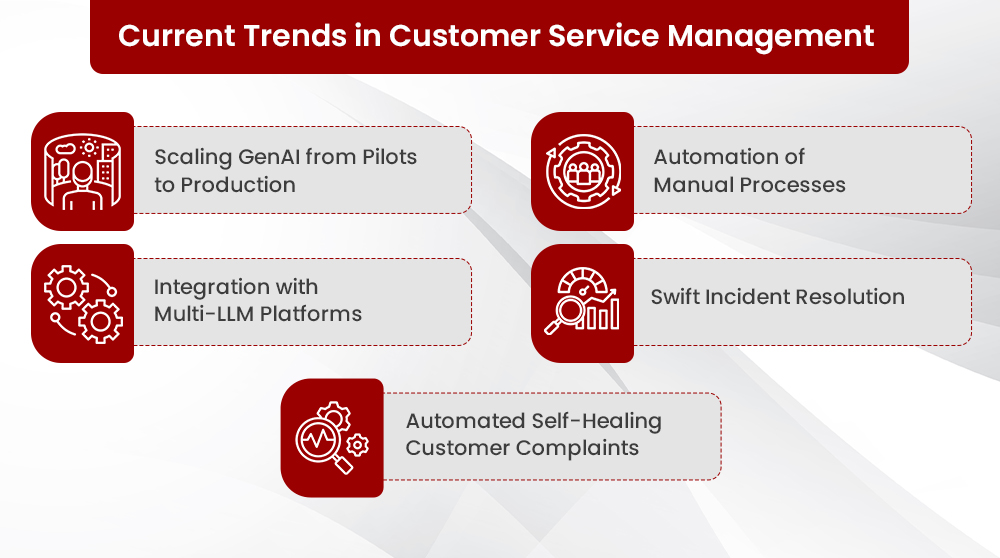
- Scaling GenAI from Pilots to Production: An increasing proportion of companies now attribute revenue uplift from GenAI use cases1— particularly in customer-facing processes such as chat, email triage, agent assist, and next-best-action.
- Automation of Manual Processes: AI-based capabilities enable case summary and resolution recommendations by diminishing redundant manual actions, enhancing agent productivity, and reducing operational expenses.
- Integration with Multi-LLM Platforms: Incident management in sync with various AI-based models provides quicker, more accurate results while ensuring privacy and compliance.
- Swift Incident Resolution: Leveraging AI to automate incident prioritization and summarization shortens time to response, thereby boosting customer satisfaction.
- Automated Self-Healing Customer Complaints: GenAI-powered self-service reduces human-assisted cases, driving customer experience and loyalty.
Key Strategies for CSM Success in 2026
1. AI-Enhanced Customer Insights
Organizations will focus on transforming fragmented customer data into unified, actionable intelligence that powers personalization at scale through the following:
- Integrate cross-functional profiles, CRM, support, billing, usage, and marketing preferences—using robust identity resolution and governance frameworks.
- Apply predictive modeling to assess churn risk, forecast lifetime value, and determine next-best actions and customer intent across all channels.
- Embed these insights into agent-assist tools and journey orchestration platforms to ensure every interaction, human or automated, starts with a deep understanding of the customer.
Example: Delta announces2 AI-powered knowledge management for reservation and customer-care agents and enhanced on-site search for consumers—all demonstrating how insight platforms reduce handle time and improve relevance in the moment.
2. Automation of Routine Tasks
Organizations must focus on maximizing operational efficiency by automating high-volume interactions while preserving human expertise for complex cases.
- Automate 60–70% of routine tasks, including status checks, password resets, and order inquiries—freeing agents to focus on exceptions and high-value engagements.
- Deploy LLM-powered chat and voice interfaces to identify intent, verify identity, and complete transactions, with seamless handoff to agents when needed—complete with full conversation context.
- Streamline back-office operations through automation of case enrichment, summarization, dispositioning, and wrap-up processes.
- Apply smart containment and escalation protocols to maintain service quality and ensure smooth transitions across channels.
For instance, a bank3 serving millions of self-service interactions every day, mentioned cumulative interactions in the billions and close to 50 million users—evidence that automation at scale can be both highly adopted and long-lasting.
3. Personalized Customer Experience
Organizations will move beyond surface-level personalization to deliver context-aware, predictive, and emotionally intelligent experiences that adapt in real time.
- Personalization today means more than using a customer’s name—it’s about understanding their journey, preferences, and current needs. Success teams must leverage historical data, behavioral signals, and real-time context to tailor every interaction.
- Embed predictive nudges into self-service flows—for example, “It looks like your last payment didn’t go through. Would you like to resolve it now?”—to guide customers proactively and reduce friction.
- Deliver adaptive content and dynamic forms that auto-populate with verified customer data, minimizing effort and increasing accuracy.
- Use AI-driven decisioning models to trigger timely offers and remediation, such as credits, expedited shipping, or personalized discounts—always within the boundaries of business rules and profitability thresholds.
- Incorporate emotional cues and sentiment analysis to adjust tone, channel, and escalation paths—ensuring that personalization feels human, not robotic.
- Continuously refine personalization strategies through feedback loops, A/B testing, and performance analytics to stay aligned with evolving customer expectations.
4. Integration with CRM and Collaboration Tools
AI value collapses without tight integration. Organizations must make service a connected capability:
- Embed bot and agent assist directly in CRM so cases, knowledge, and customer context are shared.
- Connect to collaboration hubs (Slack/Teams) for swarming and expert routing; use AI to recommend the right resolver group with rationale.
- Synchronize knowledge bases so updates propagate to both bots and agents, with feedback loops.
5. Continuous Feedback Loops
Organizations must treat every interaction as a learning event.
- Capture conversation transcripts, outcomes, CSAT, and time-to-resolution into a model improvement pipeline.
- Use A/B tests on prompts, policies, and flows; promote only those variants that improve containment and satisfaction.
- Establish AIOps and risk reviews for hallucination checks, bias monitoring, and safe-completion rules—then publish guidelines so agents and customers trust the system.
Measuring Success in AI-Driven Customer Service Management
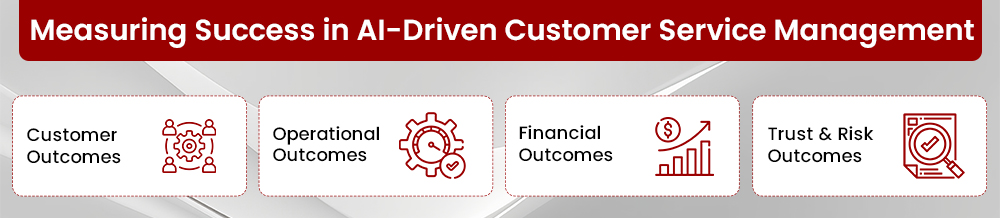
Organizations must not be overwhelmed by vanity dashboards but anchor measurement on four outcomes and tie each to executive-level targets:
1. Customer Outcomes
- CSAT/NPS by intent and channel
- Customer Effort Score (CES) and First-Contact Resolution (FCR)
- Promise-keeping (e.g., % met SLAs for callbacks/shipments)
2. Operational Outcomes
- Containment rate (self-service resolution without human), with guardrails on Customer-Verified Resolution
- AHT/Handle time for human-assisted contacts, aided by summarization and agent assist
- Backlog age and deflection of repetitive contacts
3. Financial Outcomes
- Cost-to-serve per contact and per customer
- Revenue lift from proactive saves/upsells triggered by next-best-action
- Avoided churn and customer lifetime value deltas
4. Trust and Risk Outcomes
- Hallucination/Policy-violation rate (per 1k interactions)
- Escalations due to AI error
- Compliance and privacy event counts
Conclusion
Winning customer service in 2026 is about scaling what already works—AI-driven insights, targeted automation, human-in-the-loop excellence, and relentless measurement—while preparing for the agentic future. The mandate is clear: build the data foundation, embed AI in the tools your teams use, automate the mundane, and design escalation paths that make human service better, not busier. The organizations that execute this with discipline will cut cost-to-serve, lift satisfaction, and create experiences customers prefer.
As a ServiceNow Invested Partner, inMorphis helps enterprises design and implement future-ready CSM strategies that blend automation, GenAI, and human expertise for measurable business impact. Whether you are modernizing your service operations or preparing for the agentic future, our team ensures your ServiceNow platform delivers maximum value. Contact us today to accelerate your CSM transformation
