How quickly could your enterprise show a single, consistent view of its top risks, related controls, open issues, and owners if asked today?
In many enterprises, the answer still relies on fragmented spreadsheets, email exchanges, and disconnected team reports. By the time a consolidated view is available, the underlying risk profile has already shifted.
With ServiceNow IRM (Integrated Risk Management) you can change the conversation. Instead of treating risk, compliance, and audit as parallel activities, ServiceNow IRM brings them together on a single platform. So, risks, issues, policies, controls, assessments, and evidence all move through the same, traceable workflows.
In this blog post, we’ll explore what ServiceNow IRM actually does in practice, how it supports a modern risk management process, which capabilities matter most in the first year of adoption, how AI and predictive insights enhance decision‑making, and how inMorphis helps businesses turn the platform into real outcomes rather than just another tool.
Why is Integrated Risk Management Crucial for Modern IT Enterprises?
Risk management today is more about advantages than avoidance. In hyper‑connected industries where every IT system interacts with countless vendors, users, and data streams, visibility is the new security. ServiceNow IRM helps technology‑driven enterprises turn that visibility into structured, day‑to‑day decision support.
Enhancing Decision-Making with Real-Time Insights
ServiceNow IRM Integrated risk intelligence into daily operations, giving decision makers the complete picture before they act. Whether evaluating a new vendor ecosystem or scaling a digital product into another region, executives can instantly assess financial exposure, compliance impact, and security readiness all from the ServiceNow IRM unified dashboard.
Protecting Reputation through Proactive Monitoring
With automated workflows and risk-triggered alerts (including data from integrated security tools), ServiceNow IRM flags potential control or compliance gaps before they escalate. That proactive visibility allows technology‑driven enterprises to maintain uptime, strengthen stakeholder trust, and preserve reputation even amid constant regulatory change.
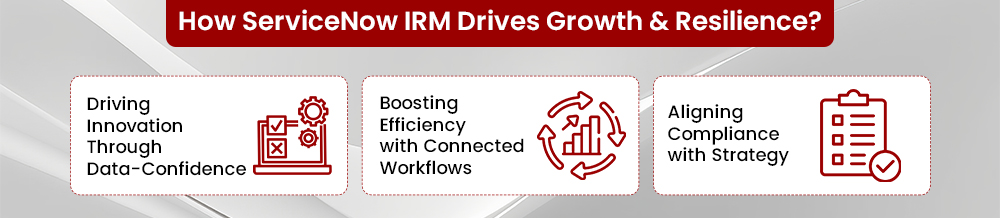
How ServiceNow IRM Drives Growth and Resilience?
When governance, compliance, and IT operations are in silos, enterprises end up reacting to risks after they’ve already impacted outcomes. ServiceNow IRM eliminates that lag by interconnecting every risk vector from cybersecurity and compliance to vendor performance and audit management into a unified, intelligent risk ecosystem.
This is achieved through key capabilitiesand integrations such as:
1. Driving Innovation through Data‑Confidence
ServiceNow IRM helps enterprises act faster by offering real‑time visibility into control status, audit progress, and emerging risk trends.
Teams can launch new IT initiatives knowing they have the analytics backbone to validate decisions, reducing hesitation without compromising oversight.
Example: A telecom enterprise deploying new 5G services uses ServiceNow IRM to assess policy gaps, automate compliance documentation, and track vendor reliability, accelerating rollout time while maintaining regulatory assurance.
2. Boosting Efficiency with Connected Workflows
Manual evidence collection and spreadsheet tracking slow teams to a crawl. IRM replaces those silos with automated between policies, controls, and issues across departments.
The results: significant time savings, cleaner audits, and a transparent view of enterprise‑wide risk posture.
3. Aligning Compliance with Strategy
Traditional compliance is reactive; integrated compliance is strategic. ServiceNow IRM embeds regulatory commitments into everyday workflows, so adherence doesn’t sit apart from productivity.
Instead of limiting innovation, compliance becomes a framework for operational discipline and smarter decision‑making.
For a deeper understanding of how IRM shapes enterprise governance, explore ISACA’s IT Risk Resource Center - a trusted reference for aligning technology controls with organizational maturity.1
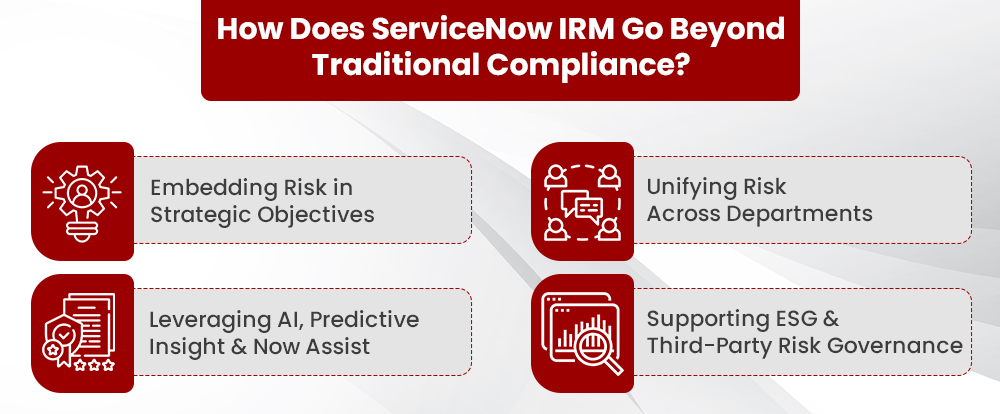
How Does ServiceNow IRM Go Beyond Traditional Compliance?
Meeting compliance requirements is not the same as managing risk well for a digital enterprise. ServiceNow IRM moves beyond basic obligation tracking by aligning every risk initiative with measurable business outcomes. It does this through the following four Key ways:
1. Embedding Risk in Strategic Objectives
Every technology enterprise works toward metrics like uptime, user experience, or cost efficiency. ServiceNow IRM maps these high‑value objectives directly to risk controls, ensuring that enterprise decisions always balance potential impact and reward.
2. Unifying Risk Across Departments
Siloed perspectives cause delayed response times. IRM dissolves those barriers through shared data, dashboards, and workflows, whether it’s IT operations, procurement, or security risk teams.
This holistic integration reduces duplication and clarifies ownership, giving leaders a single source of truth for enterprise accountability.
3. Leveraging AI, Predictive Insight, and Now Assist
The ServiceNow Washington release marked a major step in bringing AI‑powered assistance into ServiceNow IRM, introducing Now Assist capabilities for summaries, recommendations, and predictive insights. With Now Assist, teams can quickly summarize compliance findings, draft audit responses, and even forecast potential incidents.2
With every subsequent ServiceNow release, these AI capabilities continue to mature expanding use cases, improving accuracy, and embedding intelligence deeper into day‑to‑day IRM workflows. This shift from manual data handling to predictive governance enables enterprises to anticipate risk instead of investigating it post‑incident.
For a practical view of AI-driven triage and orchestration beyond IRM, see how AI agents in enterprise workflows accelerate resolution from ticket triage to full-stack automation.
4. Supporting ESG and Third-Party Risk Governance
Boards increasingly evaluate risk through environmental, social, and compliance lenses.
ServiceNow IRM incorporates ESG and vendor risk modules so enterprises can assess supplier ethics, sustainability compliance, and partnership exposure within the same workflow, bridging CSR commitments and operational resilience seamlessly.
How Does ServiceNow IRM Strengthen Enterprise Resilience and Stakeholder Trust?
ServiceNow IRM moves beyond basic obligation tracking by aligning every risk initiative with measurable business outcomes. Here’s how that shift looks in practice:
- Foresight for Continuity: Predictive alerts flag operational threats early, helping enterprises plan continuity before disruption hits.
- Stakeholder Confidence: Automated, evidence‑backed reporting assures executives and regulators that governance obligations are continually met.
- Customer Loyalty Through Assurance: Demonstrating consistent control maturity enhances trust in digital services, strengthening brand reliability.
The ability to “see around corners” becomes a true differentiator for technology‑led enterprises competing in volatile markets.
What’s Next for IT Enterprises Adopting ServiceNow IRM?
Integrated Risk Management is an enterprise‑wide capability redefining how technology leaders think, plan, and grow.
ServiceNow IRM, reinforced by AI, automation, and cross‑platform visibility, enables teams to:
- Transform compliance into a continuous growth mechanism.
- Reduce operational blind spots across IT, finance, and security.
- Empower innovation with confidence and evidence‑driven governance.
As digital ecosystems expand, the real question isn’t if risks occur, but how quickly enterprises adapt.
At inMorphis, we help technology‑driven enterprises integrate, automate, and scale their risk programs using ServiceNow IRM. From governance design to workflow enablement, our expertise aligns compliance with continuous business value.
Turn uncertainty into strategic growth. Get a demo now to see how a tailored ServiceNow IRM framework can elevate resilience, accelerate transformation, and redefine risk for your IT enterprise.
