Enterprises claim to take data protection seriously, but how many can prove it, continuously and in real time? As privacy laws tighten and digital ecosystems expand, traditional, manual compliance processes struggle to keep pace.
ServiceNow GRC addresses this challenge by embedding governance, risk, and compliance into everyday workflows, enabling enterprises to move beyond reactive practices toward measurable, proactive data protection.
This blog explores how enterprises can leverage ServiceNow GRC to strengthen data protection and privacy compliance. From unifying governance frameworks to automating control monitoring and evidence management, it highlights the platform’s key capabilities and implementation of best practices that drive continuous compliance and audit readiness.
Understanding how data protection and privacy frameworks operate is the first step toward building an intelligent, automated compliance ecosystem.
Understanding Data Protection and Privacy Compliance
Data protection and privacy compliance ensure that personal and sensitive data are collected, processed, and stored in accordance with legal and ethical principles. These frameworks protect individuals’ rights and hold enterprises that process data accountable. The key global and regional regulations include:
- General Data Protection Regulation (GDPR)1: Requires lawful, fair, and transparent processing of data and grants individuals rights such as access, correction, and deletion.
- California Consumer Privacy Act (CCPA)2: Provides California residents with rights to control their personal information and mandates transparency in data sharing.
- Digital Personal Data Protection (DPDP) Act 2023 (India)3: Introduces consent-based processing, data fiduciary responsibilities, and stricter penalties for non-compliance.
From a technical perspective, compliance involves implementing robust security controls, establishing auditable data flows, and maintaining transparency in how data is collected, used, and shared. It also includes mechanisms for encryption, access governance, automated incident reporting, and consent lifecycle management.
What are the Core Capabilities of ServiceNow GRC?
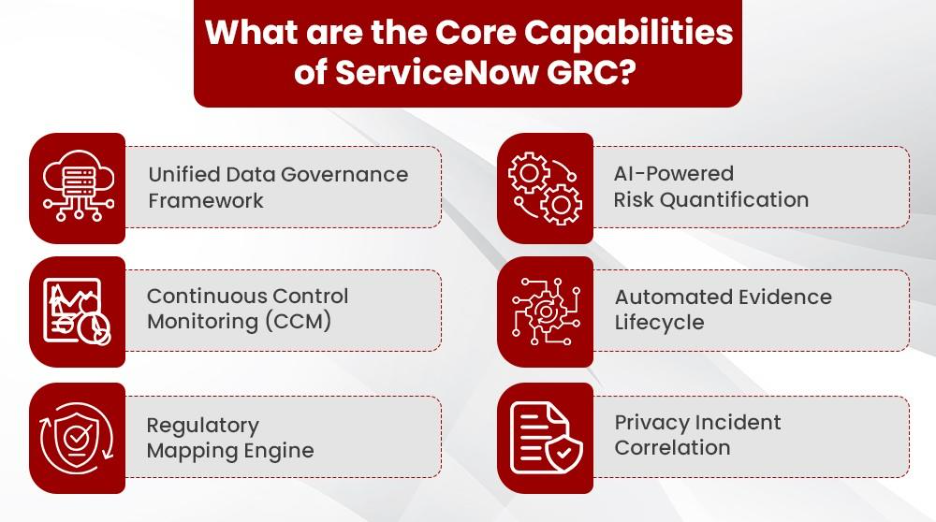
ServiceNow GRC serves as a comprehensive governance framework that connects data protection policies, compliance workflows, and automated controls within a single enterprise platform. It allows enterprises to identify risks, enforce privacy controls, and maintain continuous audit readiness across IT and business environments. The key technical capabilities of ServiceNow GRC are:
- Unified Data Governance Framework: Provides a single source of truth for all policies, control objectives, and regulatory mappings through the Policy and Compliance Workspace.
- AI-Powered Risk Quantification: Uses predictive intelligence to analyze historical risk data and assign real-time risk scores based on incident frequency, control violations, and likelihood of impact.
- Continuous Control Monitoring (CCM): Integrates with IT and cloud systems such as AWS, Azure, and SAP to automatically validate security controls, including access management, data encryption, and configuration compliance.
- Automated Evidence Lifecycle: Through the audit management module, evidence such as logs, screenshots, and configurations is automatically gathered, time-stamped, and stored in the Evidence Library for audit readiness.
- Regulatory Mapping Engine: Uses the Unified Compliance Framework (UCF) to link organizational controls to international standards such as ISO 27001, NIST 800-53, and GDPR Articles, simplifying compliance reporting.
- Privacy Incident Correlation: Integrates with ServiceNow Security Operations (SecOps) to automatically link security incidents with related compliance risks and initiate mitigation workflows.
How to Implement ServiceNow GRC for Data Protection?
Deploying ServiceNow GRC effectively requires a strategic and technically structured approach that aligns business goals with IT governance and security practices.
1. Assessment and Data Discovery
Conduct a comprehensive analysis of data sources, regulatory obligations, and existing privacy practices. Integrate with ServiceNow Discovery and CMDB to automatically identify and classify data assets that store personal or sensitive information.
2. Integration Architecture
Connect ServiceNow GRC to IAM (Identity and Access Management) systems, such as Active Directory or Okta, and with Security Information and Event Management (SIEM) tools like Splunk. These integrations enable automated validation of access policies and real-time event correlation.
3. Policy Automation
Configure policies and controls in the Policy and Compliance Workspace and automate compliance monitoring using Flow Designer workflows. When a deviation is detected, the system automatically creates a remediation task for the assigned control owner.
4. Risk and Control Validation
Implement Control Indicators (CIs) that continuously evaluate control performance and send results to Risk Scoring models. Automated workflows then escalate high-risk findings to compliance managers.
5. Evidence Management
Automate the collection of audit evidence through scheduled data feeds from external systems, like AWS CloudTrail or DLP tools. Store them within the Evidence Library for seamless audit traceability.
6. Compliance Dashboards
Use Performance Analytics to visualize compliance status, policy effectiveness, and regulatory alignment across departments. Dashboards can also track KPIs such as risk closure rates and audit readiness scores.
How to Overcome ServiceNow GRC Implementation Challenges?
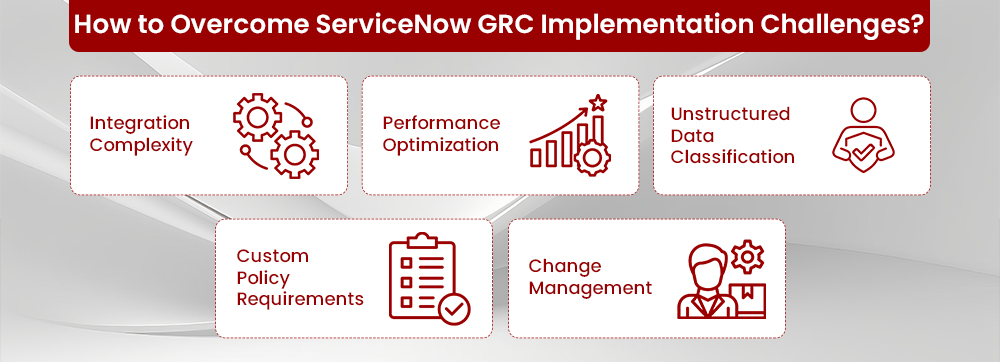
Implementing ServiceNow GRC at scale can involve technical and organizational challenges that must be managed proactively.
- Integration Complexity: Large enterprises often operate across multiple legacy systems. Use IntegrationHub and API-based connectors to enable smooth data exchange between ServiceNow GRC and external applications such as SAP, Jira, or Oracle.
- Performance Optimization: For high-volume implementations, use asynchronous data fetching and table partitioning to maintain system performance and reduce processing latency.
- Unstructured Data Classification: Integrate with discovery tools capable of scanning unstructured data repositories such as email servers or shared drives and feed the results into the Data Classification Framework.
- Custom Policy Requirements: Extend out-of-the-box policy logic using Script Includes to handle regional compliance variations, such as DPDP Act consent expiration or jurisdiction-specific retention rules.
- Change Management: Establish a Center of Excellence (CoE) with compliance experts, ServiceNow developers, and IT security leads to drive adoption, manage configurations, and maintain consistency across business units.
By addressing these areas, enterprises can achieve faster deployment, minimize errors, and ensure scalability of their compliance programs.
Conclusion
Modern data protection requires intelligent, automated governance that continuously monitors and enforces compliance across IT ecosystems. ServiceNow GRC provides this capability by integrating privacy, risk, and compliance operations into a unified platform that leverages AI-driven analytics, Continuous Control Monitoring (CCM), and real-time data integrations. These features enable proactive risk detection, automated remediation, and seamless alignment with global regulations such as GDPR, CCPA, and the DPDP Act.
At inMorphis, we help enterprises architect and implement ServiceNow GRC solutions that transform compliance into a self-sustaining governance framework. By connecting GRC modules with IAM, SIEM, and DLP systems, we enable end-to-end visibility, automated evidence management, and audit readiness at scale. Contact us today and see how ServiceNow GRC makes data compliance easy.
