In 2026, predictive maintenance is no longer just a “nice-to-have" but a business essential for manufacturing and retail organizations operating in highly automated, data-driven environments. Equipment downtime directly affects production lines, supply chains, and customer experience. Subsequently, the shift from reactive to predictive maintenance is being backed by intelligent platforms that combine AI, automation, and real-time asset visibility.
By using ServiceNow Asset Management with AI capabilities, organizations can predict failures, automatically generate incidents, and proactively schedule maintenance. With the evolution of the AIOps platform, deeper integration with Operational Technology (OT) systems, and the rise of ServiceNow GenAI, businesses are now able to prevent disruptions before they occur.
In this informative blog, we will explore how ServiceNow AI is helping organizations predict equipment failures, reduce downtime, and build more resilient operations.
Is Predictive Intelligence Replacing Reactive Maintenance?
Traditional maintenance models were reactive, where machines failed, tickets were raised, and teams rushed to fix concerns. Even preventive maintenance was dependent on fixed schedules, often resulting in unnecessary servicing or missed early warning signs. On the contrary, predictive maintenance powered by AI flips this model completely. The modern AI Ops platform makes use of machine learning, analytics, and real-time telemetry to continuously evaluate asset health and identify shortcomings.
In 2026, ServiceNow’s predictive capabilities go beyond simple monitoring. The platform assesses historical performance, sensor data, and operational patterns to predict potential failures with high accuracy. Instead of reacting to incidents, organizations can now act on early signals, like temperature spikes, vibration irregularities, or declining performance trends. This transition is specifically essential in manufacturing, where even a few minutes of downtime can halt the entire production lines. Also, in retail environments, predictive maintenance ensures uninterrupted operations across warehouses, POS systems, and logistics infrastructure.
Thus, by embedding intelligence into asset workflows, ServiceNow allows a transition from “break-fix” to “predict-prevent”, reducing downtime, maintenance costs, and operational risks.
How Does ServiceNow Asset Management Integrate with Operational Technology?
In today’s time, one of the major advancements is the smooth integration of operational technology with enterprise IT systems. Operational technology usually includes physical assets like machinery, robotics, sensors, and industrial control systems, the core components of manufacturing and retail infrastructure.
ServiceNow’s operational technology offers a unified, contextual view of these systems, allowing organizations to monitor and manage them alongside IT assets. With ServiceNow Asset Management, every asset becomes part of a connected ecosystem. Data flows from IoT sensors and OT devices into the platform, where AI models evaluate performance in real time. This builds a digital thread that connects asset data, service history, and operational context.
For example:
- A manufacturing robot showing abnormal vibration patterns is flagged instantly.
- The system correlates this with historical failure data.
- A potential breakdown is predicted before it impacts production.
This integration of IT and OT eliminates data silos and allows end-to-end visibility. It also ensures that maintenance teams have the right context of what failed, why it failed, and what needs to be done next. In retail, this divergence extends to refrigeration systems, supply chain equipment, and in-store technologies, ensuring seamless operations and consistent customer experiences.
Automating Incidents and Maintenance with ServiceNow GenAI
Automation is where predictive maintenance truly delivers value and this is where ServiceNow GenAI plays a unique role in the present time. When AI identifies a potential issue, the system does not just send an alert. It initiates a fully automated workflow where:
- Incidents are auto-generated with detailed context
- Root cause insights are provided in natural language
- Maintenance tasks are scheduled automatically
- Relevant teams are notified with actionable recommendations
ServiceNow’s Predictive AIOps use AI to transform complex alerts into meaningful, actionable insights and even automate remediation steps. ServiceNow GenAi improves this process further by streamlining decision-making. Instead of assessing raw data, technicians get AI-generated summaries, recommended actions, and step-by-step guidance. This minimizes dependency on highly specialized expertise and speeds up resolution times. For instance:
- A failing conveyor belt triggers an AI-generated incident
- GenAI summarizes the issue and suggests replacement timelines
- A maintenance schedule is automatically created during non-peak hours
This level of automation offered by inMorphis guarantees that the issues are addressed before they escalate, reducing disruptions and improving operational efficiency.
How Does Predictive Maintenance Reduce Downtime and Drive ROI?
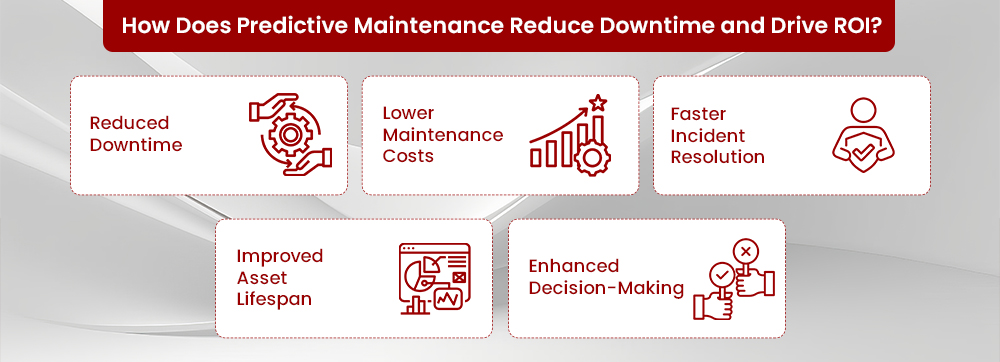
The real value of predictive maintenance lies in its measurable business outcomes. By integrating ServiceNow Asset Management1, AI, and automation, businesses can achieve significant improvements in uptime, cost efficiency, and productivity. Predictive AIOps allows early identification of anomalies and proactive remediation, reducing outages and improving service reliability. The key benefits include:
1. Reduced Downtime: Before predictive failures happen, they ensure continuous operations, particularly in high-stakes manufacturing environments.
2. Lower Maintenance Costs: Instead of routine or emergency repairs, maintenance is performed only when required, optimizing resource utilization.
3. Faster Incident Resolution: Automated workflows and AI-driven insights majorly reduce mean time to resolution (MTTR).
4. Improved Asset Lifespan: Continuous monitoring and timely interventions extend the life of critical equipment.
5. Enhanced Decision-Making: With ServiceNow GenAI, leaders acquire actionable insights and predictive recommendations, allowing smarter operational strategies.
In 2026, businesses are adopting AI-driven predictive maintenance are not just improving efficiency, they are building resilient, self-healing operations. The ability to predict and prevent failures is becoming a key competitive benefit in both manufacturing and retail sectors. Predictive maintenance with ServiceNow GenAI represents a fundamental shift in how businesses manage assets and operations. By leveraging an advanced AIOps platform, integrating Operational Technology, and harnessing the power of ServiceNow GenAI, organizations can move beyond reactive maintenance and into a future where downtime is not just managed—but prevented entirely.
The Future of Predictive Maintenance
As manufacturing and retail operations are becoming more complex in the present time, the cost of unplanned downtime continues to rise. Predictive maintenance is no more just an option, but an essential for maintaining operational continuity, protecting revenue, and offering consistent customer experiences.
By integrating ServiceNow Asset Management with AI capabilities, businesses can shift from reactive responses to proactive prevention. The power of an advanced AIOps platform, smooth integration with Operational Technology, and the intelligence of ServiceNow GenAI allows businesses to identify issues early, automate responses, and optimize maintenance strategies at scale.
The outcome is a smarter, more resilient operation, one where assets are continuously monitored, risks are minimized, and teams are empowered with real-time insights. As businesses continue to embrace AI-driven transformation, predictive maintenance will play an essential role in building future-ready operations that don’t just respond to disruptions but also stay ahead of them. What’s holding you back, then? Partner with inMorphis to leverage ServiceNow AI, streamline maintenance workflows, and build a more proactive, future-ready enterprise.
Reference:
